
| Date | 5th, Jun 2020 |
|---|
Home > Press > Self-assembling, biomimetic composites possess unusual electrical properties
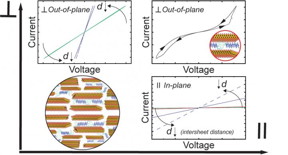 Biomimetic composites are produced by topological interactions, expanding the limits of the physical properties, such as electrical conductivity.
CREDIT
Mert Vural, Penn State
Biomimetic composites are produced by topological interactions, expanding the limits of the physical properties, such as electrical conductivity.
CREDIT
Mert Vural, Penn State
Abstract: Sometimes, breaking rules is not a bad thing. Especially when the rules are apparent laws of nature that apply in bulk material, but other forces appear in the nanoscale.
University Park, PA | Posted on June 4th, 2020
"Nature knows how to go from the small, atomic scale to larger scales," said Melik Demirel, professor of engineering science and mechanics and holder of the Lloyd and Dorothy Foehr Huck Chair in Biomimetic Materials. "Engineers have used mixing rules to enhance properties, but have been limited to a single scale. We've never gone down to the next level of hierarchical engineering. The key challenge is that there are apparent forces at different scales from molecules to bulk."
Composites, by definition, are composed of more than one component. Mixture rules say that, while the ratios of one component to another can vary, there is a limit on the physical properties of the composite. According to Demirel, his team has broken that limit, at least on the nanoscale.
"If you have a conducting polymer composite the amounts of polymer and metal compound are limited by the rule of mixtures," said Demirel. "The rules govern everything about the matrix and filler. We took materials -- a biopolymer and an atomically thin conducting material -- let them organize by self assembly, and broke the rule of mixtures."
The team's materials are composed of a biomimetic polymer based on tandem repeat proteins produced by gene duplication and inspired by the structure of squid ring teeth proteins, and conducting titanium carbide 2D MXene, an only a few-molecules-thick layer of metal. This layered composite self-assembles and the polymer mediates the distance between the metal layers. By using genetic engineering of tandem repeat proteins -- a biopolymer that repeats a conserved sequence -- the researchers can control the inter-layer distance of conducting layers without changing the composite fractions. The researchers' goal is to create self-assembling materials with unprecedented control over their physical properties using synthetic biology.
Because the polymer self-assembles into a cross-linked network, the matrix-to-filler ratios in tiny areas can break the mixture rules, and the electrical properties of the layered material changes. The researchers report the results of their work in a recent issue of ACS Nano.
This biomimetic polymer metal composite can be both flexible and conductive in the proper bulk mixtures. On the microscopic scale, when the structural symmetry is broken, electrical conductivity depends on direction.
"What is unique is that now you can get in-plane electrical conductivity that differs from out-of-plane conductivity," said Demirel.
As long as the current is going along the plane of the 2D material layers, the conductivity is linear, but if the current is directed across the layers, the conductivity becomes nonlinear.
"Now we can make a storage device," said Demirel. "We could also make diodes, switches, regulators and other electronic devices. We want to make materials that are designed with desired properties for building novel functionalities, which are difficult to achieve or previously unattainable."
###
Also working on this project from Penn State are Haoyue Zhu and Huihun Jung, postdoctoral fellows in engineering science and mechanics; and Benjamin D. Allen, research associate. Other researchers on the project were Mert Vural, postdoctoral fellow at Link�ping University in Sweden and formerly a postdoctoral fellow at Penn State, and Abdon Pena-Francesch, soon to be a Penn State doctoral graduate and an assistant professor at the University of Michigan.
The Army Research Office and the Air Force Office of Scientific Research basic science programs supported this work.
####
For more information, please click here
Contacts:A'ndrea Elyse Messer
814-865-5689
@penn_state
Copyright © Penn State
If you have a comment, please Contact us.
Issuers of news releases, not 7th Wave, Inc. or Nanotechnology Now, are solely responsible for the accuracy of the content.
Bookmark:


News and information
 New technology helps reveal inner workings of human genome June 24th, 2022
Boron nitride nanotube fibers get real: Rice lab creates first heat-tolerant, stable fibers from wet-spinning process June 24th, 2022
2 Dimensional Materials
Controlled synthesis of crystal flakes paves path for advanced future electronics June 17th, 2022
Solving the puzzle of 2D disorder: An interdisciplinary team developed a new method to characterize disorder in 2D materials June 17th, 2022
UBCO researchers change the game when it comes to activity tracking: Flexible, highly sensitive motion device created by extrusion printing June 17th, 2022
Bumps could smooth quantum investigations: Rice University models show unique properties of 2D materials stressed by contoured substrates June 10th, 2022
Govt.-Legislation/Regulation/Funding/Policy
Solving the solar energy storage problem with rechargeable batteries that can convert and store energy at once June 24th, 2022
Boron nitride nanotube fibers get real: Rice lab creates first heat-tolerant, stable fibers from wet-spinning process June 24th, 2022
UBCO researchers change the game when it comes to activity tracking: Flexible, highly sensitive motion device created by extrusion printing June 17th, 2022
University of Illinois Chicago joins Brookhaven Lab's Quantum Center June 10th, 2022
Possible Futures
New technology helps reveal inner workings of human genome June 24th, 2022
Boron nitride nanotube fibers get real: Rice lab creates first heat-tolerant, stable fibers from wet-spinning process June 24th, 2022
Memory Technology
Quantum network nodes with warm atoms June 24th, 2022
Boron nitride nanotube fibers get real: Rice lab creates first heat-tolerant, stable fibers from wet-spinning process June 24th, 2022
Reconfigurable silicon nanoantennas controlled by vectorial light field May 6th, 2022
Artificial neurons go quantum with photonic circuits: Quantum memristor as missing link between artificial intelligence and quantum computing March 25th, 2022
Self Assembly
Nanoclusters self-organize into centimeter-scale hierarchical assemblies April 22nd, 2022
Atom by atom: building precise smaller nanoparticles with templates March 4th, 2022
Nanostructures get complex with electron equivalents: Nanoparticles of two different sizes break away from symmetrical designs January 14th, 2022
Discoveries
New technology helps reveal inner workings of human genome June 24th, 2022
Boron nitride nanotube fibers get real: Rice lab creates first heat-tolerant, stable fibers from wet-spinning process June 24th, 2022
Materials/Metamaterials
Nanotubes: a promising solution for advanced rubber cables with 60% less conductive filler June 1st, 2022
New route to build materials out of tiny particles May 27th, 2022
A one-stop shop for quantum sensing materials May 27th, 2022
Announcements
New technology helps reveal inner workings of human genome June 24th, 2022
Boron nitride nanotube fibers get real: Rice lab creates first heat-tolerant, stable fibers from wet-spinning process June 24th, 2022
Interviews/Book Reviews/Essays/Reports/Podcasts/Journals/White papers/Posters
Quantum network nodes with warm atoms June 24th, 2022
New technology helps reveal inner workings of human genome June 24th, 2022
Military
Boron nitride nanotube fibers get real: Rice lab creates first heat-tolerant, stable fibers from wet-spinning process June 24th, 2022
Bumps could smooth quantum investigations: Rice University models show unique properties of 2D materials stressed by contoured substrates June 10th, 2022
Nanostructured fibers can impersonate human muscles June 3rd, 2022
Lightening up the nanoscale long-wavelength optoelectronics May 13th, 2022
