
| Date | 9th, Jun 2020 |
|---|
Home > Press > New tool helps nanorods stand out: Rice team�s SEMseg method makes nanoparticle analysis quicker and more affordable
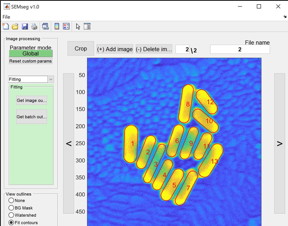 Rice University scientists have created an open-source algorithm, SEMseg, that simplifies nanoparticle analysis using scanning electron microscope images. (Credit: Landes Research Group/Rice University)
Abstract: Rice University scientists have developed an easy and affordable tool to count and characterize nanoparticles.
Houston, TX | Posted on June 8th, 2020
nanoparticles, objects smaller than 100 nanometers, from scanning electron microscope (SEM) images that are otherwise difficult if not impossible to analyze.
The size and shape of the particles influences how well they work in optoelectronic devices, catalysts and sensing applications like surface-enhanced Raman spectroscopy.
SEMseg is described in a study led by Landes and Rice graduate student Rashad Baiyasi in the American Chemical Society�s Journal of Physical Chemistry A.
The program is available for download from GitHub at https://github.com/LandesLab?tab=repositories.
SEMseg -- for SEM segmentation -- springs from the team�s study in Science last year that showed how proteins can be used to push nanorods into chiral assemblies. �This work was one result of that,� Landes said. �We realized there was no good way to quantitatively analyze SEM images.�
Counting and characterizing individual or aggregate nanorods is usually done with complex and expensive transmission electron microscopes (TEM), manual measurement that is prone to human bias or programs that fail to distinguish between particles unless they�re far apart. SEMseg extracts pixel-level data from low-contrast, low-resolution SEM images and recombines it into sharp images.
SEMseg can quickly distinguish individual nanorods in closely packed assemblies and aggregates to determine the size and orientation of each particle and the size of gaps between them. That allows for a more efficient statistical analysis of aggregates.
�In a matter of minutes, SEMseg can characterize nanoparticles in large datasets that would take hours to measure manually,� Baiyasi said.
Segmenting nanoparticles, he said, refers to isolating and characterizing each constituent particle in an aggregate. Isolating the constituent nanoparticles lets researchers analyze and characterize the heterogenous structure of aggregates.
Baiyasi said SEMseg can be adapted for such other imaging techniques as atomic force microscopy and could be extended for other nanoparticle shapes, like cubes or triangles.
Co-authors are Rice postdoctoral researchers Miranda Gallagher and Qingfeng Zhang and graduate students Lauren McCarthy and Emily Searles. Link is a professor of chemistry and of electrical and computer engineering. Landes is a professor of chemistry, of electrical and computer engineering and of chemical and biomolecular engineering.
The Army Research Office, the National Science Foundation and the Robert A. Welch Foundation supported the research.
####
About Rice UniversityLocated on a 300-acre forested campus in Houston, Rice University is consistently ranked among the nation�s top 20 universities by U.S. News & World Report. Rice has highly respected schools of Architecture, Business, Continuing Studies, Engineering, Humanities, Music, Natural Sciences and Social Sciences and is home to the Baker Institute for Public Policy. With 3,962 undergraduates and 3,027 graduate students, Rice�s undergraduate student-to-faculty ratio is just under 6-to-1. Its residential college system builds close-knit communities and lifelong friendships, just one reason why Rice is ranked No. 1 for lots of race/class interaction and No. 4 for quality of life by the Princeton Review. Rice is also rated as a best value among private universities by Kiplinger�s Personal Finance.
Follow Rice News and Media Relations via Twitter @RiceUNews.
For more information, please click here
Contacts:Jeff Falk713-348-6775
Mike Williams713-348-6728
Copyright © Rice University
If you have a comment, please Contact us.
Issuers of news releases, not 7th Wave, Inc. or Nanotechnology Now, are solely responsible for the accuracy of the content.
Bookmark:


 Chemists clarify a chiral conundrum:
Wiess School of Natural Sciences:
News and information
New technology helps reveal inner workings of human genome June 24th, 2022
Boron nitride nanotube fibers get real: Rice lab creates first heat-tolerant, stable fibers from wet-spinning process June 24th, 2022
Imaging
Snapshot measurement of single nanostructure�s circular dichroism March 25th, 2022
Better understanding superconductors with Higgs spectroscopy Prof. Stefan Kaiser from TU Dresden awarded ERC Consolidator Grant March 18th, 2022
Visualizing the invisible: New fluorescent DNA label reveals nanoscopic cancer features March 4th, 2022
Govt.-Legislation/Regulation/Funding/Policy
Solving the solar energy storage problem with rechargeable batteries that can convert and store energy at once June 24th, 2022
Boron nitride nanotube fibers get real: Rice lab creates first heat-tolerant, stable fibers from wet-spinning process June 24th, 2022
UBCO researchers change the game when it comes to activity tracking: Flexible, highly sensitive motion device created by extrusion printing June 17th, 2022
University of Illinois Chicago joins Brookhaven Lab's Quantum Center June 10th, 2022
Possible Futures
New technology helps reveal inner workings of human genome June 24th, 2022
Boron nitride nanotube fibers get real: Rice lab creates first heat-tolerant, stable fibers from wet-spinning process June 24th, 2022
Discoveries
New technology helps reveal inner workings of human genome June 24th, 2022
Boron nitride nanotube fibers get real: Rice lab creates first heat-tolerant, stable fibers from wet-spinning process June 24th, 2022
Announcements
New technology helps reveal inner workings of human genome June 24th, 2022
Boron nitride nanotube fibers get real: Rice lab creates first heat-tolerant, stable fibers from wet-spinning process June 24th, 2022
Interviews/Book Reviews/Essays/Reports/Podcasts/Journals/White papers/Posters
Quantum network nodes with warm atoms June 24th, 2022
New technology helps reveal inner workings of human genome June 24th, 2022
Tools
New technology helps reveal inner workings of human genome June 24th, 2022
Snapshot measurement of single nanostructure�s circular dichroism March 25th, 2022
Eyebrow-raising: Researchers reveal why nanowires stick to each other February 11th, 2022
JEOL Introduces New Scanning Electron Microscope with �Simple SEM� Automation and Live Elemental and 3D Analysis January 14th, 2022
Military
Boron nitride nanotube fibers get real: Rice lab creates first heat-tolerant, stable fibers from wet-spinning process June 24th, 2022
Bumps could smooth quantum investigations: Rice University models show unique properties of 2D materials stressed by contoured substrates June 10th, 2022
Nanostructured fibers can impersonate human muscles June 3rd, 2022
Lightening up the nanoscale long-wavelength optoelectronics May 13th, 2022
Grants/Sponsored Research/Awards/Scholarships/Gifts/Contests/Honors/Records
Solving the solar energy storage problem with rechargeable batteries that can convert and store energy at once June 24th, 2022
Boron nitride nanotube fibers get real: Rice lab creates first heat-tolerant, stable fibers from wet-spinning process June 24th, 2022
