
| Date | 11th, Jun 2020 |
|---|
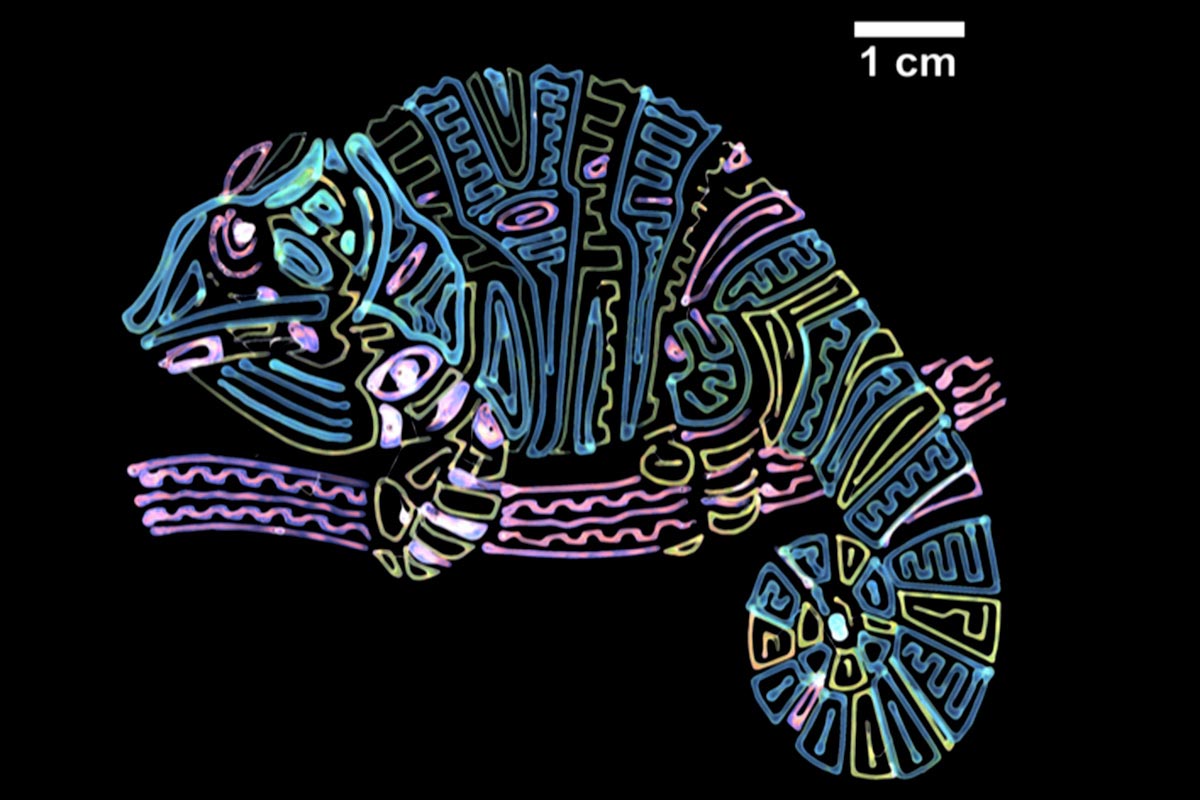
Inspired by nature, Illinois researchers developed synthetic structure-based color materials – like those found in chameleon skin — for polymer inks used in 3D printing. Credit: Photo courtesy Diao Research Group
Brilliantly colored chameleons, butterflies, opals – and now some 3D-printed materials – reflect color by using nanoscale structures called photonic crystals.
A new study that demonstrates how a modified 3D-printing process provides a versatile approach to producing multiple colors from a single ink is published in the journal Science Advances.
Some of the most vibrant colors in nature come from a nanoscale phenomenon called structural coloration. When light rays reflect off these periodically placed structures located in the wings and skins of some animals and within some minerals, they constructively interfere with each other to amplify certain wavelengths and suppress others. When the structures are well ordered and small enough – about a thousand times smaller than a human hair, the researchers said – the rays produce a vivid burst of color.
“It is challenging to reproduce these vibrant colors in the polymers used to produce items like environmentally friendly paints and highly selective optical filters,” said study leader Ying Diao, a chemical and biomolecular engineering professor at the University of Illinois at Urbana-Champaign. “Precise control of polymer synthesis and processing is needed to form the incredibly thin, ordered layers that produce the structural color as we see in nature.”
The study reports that by carefully tuning the assembly process of uniquely structured bottlebrush-shaped polymers during 3D printing, it is possible to print photonic crystals with tunable layer thicknesses that reflect the visible light spectrum from a single ink.
The ink contains branched polymers with two bonded, chemically distinct segments. The researchers dissolve the material into a solution that mixes the polymer chains just before printing. After printing and as the solution dries, the components separate at a microscopic scale, forming nanoscale layers that exhibit different physical properties depending on the speed of assembly.
“The biggest challenge of the polymer synthesis is combining the precision required for the nanoscale assembly with the production of the large amounts of material necessary for the 3D-printing process,” said co-author Damien Guironnet, a professor of chemical and biomolecular engineering.
In the lab, the team uses a modified consumer 3D printer to fine-tune how fast a printing nozzle moves across a temperature-controlled surface. “Having control over the speed and temperature of ink deposition allows us to control the speed of assembly and the internal layer thickness at the nanoscale, which a normal 3D printer cannot do,” said Bijal Patel, a graduate student and lead author of the study. “That dictates how light will reflect off of them and, therefore, the color we see.”
