
| Date | 13th, Jun 2020 |
|---|
Home > Press > Prodigiosin-based solution has selective activity against cancer cells: A new nanoformulation was described by Kazan University's Bionanotechnology Lab in Frontiers in Bioengineering and Biotechnology
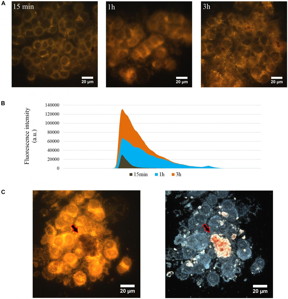 The release of prodigiosin from p-HNTs in cytoplasm of HCT116 cells. Fluorescence images of p-HNTs-treated cells were taken after 15 min, 1 and 3 h of incubation (A). fluorescence intensity histogram (B) demonstrated that the fluorescence intensity increased proportionally to the incubation time. Comparative analysis of dark-field and fluorescence images (C) demonstrates the absence of extracellular leakage of prodigiosin. The arrows indicate the red colored p-HNTs aggregate on the cell surface which cannot be visualized on fluorescent image.
CREDIT
Kazan Federal University
The release of prodigiosin from p-HNTs in cytoplasm of HCT116 cells. Fluorescence images of p-HNTs-treated cells were taken after 15 min, 1 and 3 h of incubation (A). fluorescence intensity histogram (B) demonstrated that the fluorescence intensity increased proportionally to the incubation time. Comparative analysis of dark-field and fluorescence images (C) demonstrates the absence of extracellular leakage of prodigiosin. The arrows indicate the red colored p-HNTs aggregate on the cell surface which cannot be visualized on fluorescent image.
CREDIT
Kazan Federal University
Abstract: Together with colleagues from the University of Palermo, KFU employees offer a nano preparation based on biocompatible halloysite nanotubes and bacterial pigment prodigiosin; the latter is known to selectively disrupt cancer cells without damaging the healthy ones.
Kazan, Russian Federation | Posted on June 12th, 2020
"Halloysite nanotubes are known for their low toxicity in in vitro and in vivo systems and the ability to modify the outer and inner surfaces. The cavity of a nanotube can be loaded with compounds of various nature, including drugs, and modification of the ends with polymers allows the creation of targeted delivery systems with a controlled release of loaded substances," says co-author Rawil Fakhrullin, Chief Research Associate of the Bionanotechnology Lab.
The uniqueness of this new solution is its selectivity against malignant cells, unlike chemotherapy which damages mesenchymal stem cells and fibroblasts.
"The pigment prodigiosin is synthesized by various microorganisms. We isolate it from the cells of the bacteria Serratia marcescens. The antibacterial, fungicidal and anticancer activity of prodigiosin is widely known, however, some of its physico-chemical properties, in particular hydrophobicity, limit the use of prodigiosin as a drug. The loading of prodigiosin into halloysite nanotubes circumvents these limitations. In addition, in the form of a nanopreparation, prodigiosin penetrates into the cells within 30 minutes. Moreover, the effect on cancer cells leads to the development of irreversible processes in them and to their death. At the same time, non-cancerous cells retain their activity and viability," explains co-author Ekaterina Naumenko.
This development paves way to better antitumor therapies with selective activity.
####
For more information, please click here
Contacts:Yury Nurmeev
@KazanUni
Copyright © Kazan Federal University
If you have a comment, please Contact us.
Issuers of news releases, not 7th Wave, Inc. or Nanotechnology Now, are solely responsible for the accuracy of the content.
Bookmark:


Cancer
 New technology helps reveal inner workings of human genome June 24th, 2022
News and information
New technology helps reveal inner workings of human genome June 24th, 2022
Boron nitride nanotube fibers get real: Rice lab creates first heat-tolerant, stable fibers from wet-spinning process June 24th, 2022
Possible Futures
New technology helps reveal inner workings of human genome June 24th, 2022
Boron nitride nanotube fibers get real: Rice lab creates first heat-tolerant, stable fibers from wet-spinning process June 24th, 2022
Nanotubes/Buckyballs/Fullerenes/Nanorods
Boron nitride nanotube fibers get real: Rice lab creates first heat-tolerant, stable fibers from wet-spinning process June 24th, 2022
Nanotubes: a promising solution for advanced rubber cables with 60% less conductive filler June 1st, 2022
Protective equipment with graphene nanotubes meets the strictest ESD safety standards March 25th, 2022
CEA and Startup C12 Join Forces to Develop Next-Generation Quantum Computers with Multi-Qubit Chips at Wafer Scale March 25th, 2022
Discoveries
New technology helps reveal inner workings of human genome June 24th, 2022
Boron nitride nanotube fibers get real: Rice lab creates first heat-tolerant, stable fibers from wet-spinning process June 24th, 2022
Announcements
New technology helps reveal inner workings of human genome June 24th, 2022
Boron nitride nanotube fibers get real: Rice lab creates first heat-tolerant, stable fibers from wet-spinning process June 24th, 2022
Interviews/Book Reviews/Essays/Reports/Podcasts/Journals/White papers/Posters
Quantum network nodes with warm atoms June 24th, 2022
New technology helps reveal inner workings of human genome June 24th, 2022
Nanobiotechnology
New technology helps reveal inner workings of human genome June 24th, 2022
New nano-gel to protect children receiving chemotherapy from hearing loss June 17th, 2022
