
Jun 18, 2020
(Nanowerk News) Molecular switches – they are the molecular counterparts of electrical switches and play an important role in many processes in nature. Such molecules can reversibly interconvert between two or more states and thereby control molecular processes.
In living organisms, for example, they play a role in muscle contraction but also our visual perception is based on the dynamics of a molecular switch in the eye.
Scientists are working intensively to develop novel molecular components that enable switching between different states, so that molecular processes can be specifically controlled.
A European research team led by nanotechnologist Dr. Saeed Amirjalayer from the University of Münster now gained a deeper insight into the processes of a molecular switch: Using molecular dynamics simulations, the scientists produced a photographic film at the atomic level and thus tracked the motion of a molecular building block.
The result was a light-controlled "pedalo-type motion", going forward and backward. Although it had already been predicted in this context in earlier work, it could not be directly proven so far.
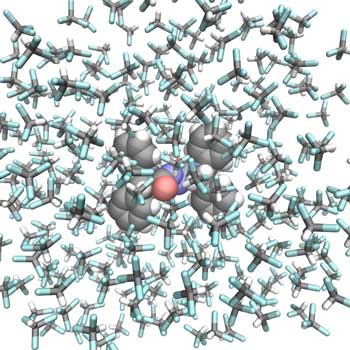 Molecular structure of the photo-responsive molecular switch (center) surrounded by solvent molecules. The scientists revealed a light-induced pedalo-type motion. (© ACS)
In the future, the results may help to control the properties of materials with the help of molecular switches – for example, in order to release drugs specifically from nano-capsules.
"For efficient embedding in novel responsive materials, detailed elucidation of the switching process and thus the way they function at the molecular and atomic level is crucial," emphasizes Dr. Saeed Amirjalayer, group leader at the Institute of Physics at Münster University and the Center for Nanotechnology (CeNTech).
The study has been published in the The Journal of Physical Chemistry Letters ("Photoinduced Forward and Backward Pedalo-Type Motion of a Molecular Switch").
Molecular structure of the photo-responsive molecular switch (center) surrounded by solvent molecules. The scientists revealed a light-induced pedalo-type motion. (© ACS)
In the future, the results may help to control the properties of materials with the help of molecular switches – for example, in order to release drugs specifically from nano-capsules.
"For efficient embedding in novel responsive materials, detailed elucidation of the switching process and thus the way they function at the molecular and atomic level is crucial," emphasizes Dr. Saeed Amirjalayer, group leader at the Institute of Physics at Münster University and the Center for Nanotechnology (CeNTech).
The study has been published in the The Journal of Physical Chemistry Letters ("Photoinduced Forward and Backward Pedalo-Type Motion of a Molecular Switch").
Molecular structure of the photo-responsive molecular switch (center) surrounded by solvent molecules. The scientists revealed a light-induced pedalo-type motion. (© ACS)
In the future, the results may help to control the properties of materials with the help of molecular switches – for example, in order to release drugs specifically from nano-capsules.
"For efficient embedding in novel responsive materials, detailed elucidation of the switching process and thus the way they function at the molecular and atomic level is crucial," emphasizes Dr. Saeed Amirjalayer, group leader at the Institute of Physics at Münster University and the Center for Nanotechnology (CeNTech).
The study has been published in the The Journal of Physical Chemistry Letters ("Photoinduced Forward and Backward Pedalo-Type Motion of a Molecular Switch").
