
Jun 25, 2020
(Nanowerk News) Researchers from Basel, Bochum and Copenhagen have gained new insights into the energy states of quantum dots. They are semiconductor nanostructures and promising building blocks for quantum communication. With their experiments, the scientists confirmed certain energy transitions in quantum dots that had previously only been predicted theoretically: the so-called radiative Auger process. For their investigations, the researchers in Basel and Copenhagen used special samples that the team from the Chair of Applied Solid State Physics at Ruhr-Universität Bochum had produced.
The researchers report their results in the journal Nature Nanotechnology ("Radiative Auger process in the single-photon limit").
 Schematic representation of a charged exciton, i.e. an excited state consisting of two electrons and one hole within a quantum dot. (Image: Arne Ludwig)
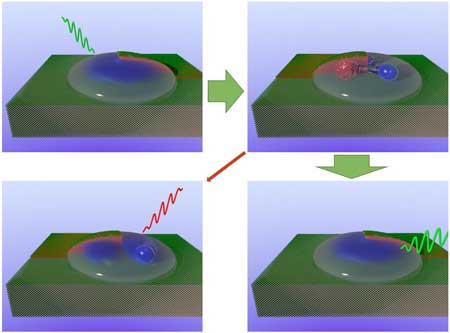 An electron inside a quantum dot is raised by a photon (green waveform) to a higher energy level. The result is a so-called exciton, an excited state consisting of two electrons and one hole. By emitting a photon (green waveform), the system returns to the ground state (green path). In rare cases, a radiative Auger process takes place (red arrow): an electron stays in the excited state, while a photon of lower energy (red waveform) is emitted. (Image: Arne Ludwig)
Lock up charge carriers
In order to create a quantum dot, the Bochum researchers use self-organizing processes in crystal growth. In the process, they produce billions of nanometer-sized crystals of, for example, indium arsenide. In these they can trap charge carriers, such as a single electron. This construct is interesting for quantum communication because information can be encoded with the help of charge carrier spins. For this coding, it is necessary to be able to manipulate and read the spin from the outside. During readout, quantum information can be imprinted into the polarization of a photon, for example. This then carries the information further at the speed of light and can be used for quantum information transfer. This is why scientists are interested, for example, in what exactly happens in the quantum dot when energy is irradiated from outside onto the artificial atom.
Schematic representation of a charged exciton, i.e. an excited state consisting of two electrons and one hole within a quantum dot. (Image: Arne Ludwig)
Special energy transitions demonstrated
Atoms consist of a positively charged core which is surrounded by one or more negatively charged electrons. When one electron in the atom has a high energy, it can reduce its energy by two well-known processes: in the first process the energy is released in the form of a single quantum of light (a photon) and the other electrons are unaffected. A second possibility is an Auger process, where the high energy electron gives all its energy to other electrons in the atom. This effect was discovered in 1922 by Lise Meitner and Pierre Victor Auger. About a decade later, a third possibility has been theoretically described by the physicist Felix Bloch: in the so-called radiative Auger process, the excited electron reduces its energy by transferring it to both, a light quantum and another electron in the atom. A semiconductor quantum dot resembles an atom in many aspects. However, for quantum dots, the radiative Auger process had only been theoretically predicted so far. Now, the experimental observation has been achieved by researchers from Basel. Together with their colleagues from Bochum and Copenhagen, the Basel-based researchers Dr. Matthias Löbl and Professor Richard Warburton have observed the radiative Auger process in the limit of just a single photon and one Auger electron. For the first time, the researchers demonstrated the connection between the radiative Auger process and quantum optics. They show that quantum optics measurements with the radiative Auger emission can be used as a tool for investigating the dynamics of the single electron.
An electron inside a quantum dot is raised by a photon (green waveform) to a higher energy level. The result is a so-called exciton, an excited state consisting of two electrons and one hole. By emitting a photon (green waveform), the system returns to the ground state (green path). In rare cases, a radiative Auger process takes place (red arrow): an electron stays in the excited state, while a photon of lower energy (red waveform) is emitted. (Image: Arne Ludwig)
