
Jul 01, 2020
(Nanowerk News) New details are known about an important cell structure: For the first time, two Würzburg research groups have been able to map the synaptonemal complex three-dimensionally with a resolution of 20 to 30 nanometres.
The synaptonemal complex is a ladder-like cell structure that plays a major role in the development of egg and sperm cells in humans and other mammals.
"The structure of this complex has hardly been changed in evolution, but its protein components vary greatly from organism to organism," says Professor Ricardo Benavente, cell and developmental biologist at the Biocenter of Julius-Maximilians-Universität (JMU) Würzburg in Bavaria, Germany.
This points to the fact that the structure is crucial for the undisturbed function of the complex. Benavente is investigating the synaptonemal complex together with Markus Sauer, Professor of Biotechnology and Biophysics at the JMU Biocenter.
The latest findings of the two research groups have been published in the journal Nature Communications ("Tracking down the molecular architecture of the synaptonemal complex by expansion microscopy").
The data indicate, among other things, that the synaptonemal complex in the case of the mouse is not, as previously assumed, double-layered, but far more complex.
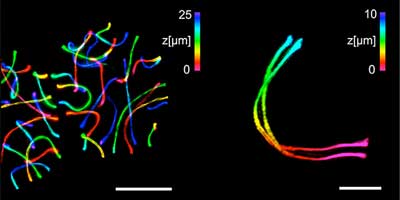 Left two sperm-forming cells expanded with ExM-SIM and imaged with a diffraction limited microscope. On the right, a detailed 3D image of a single synaptonemal complex. The 3D information is colour-coded, the measuring bar on the left corresponds to 25 micrometres, the bar on the right to three micrometres. (Image: Arbeitsgruppen Benavente und Sauer / Universität Würzburg)
Left two sperm-forming cells expanded with ExM-SIM and imaged with a diffraction limited microscope. On the right, a detailed 3D image of a single synaptonemal complex. The 3D information is colour-coded, the measuring bar on the left corresponds to 25 micrometres, the bar on the right to three micrometres. (Image: Arbeitsgruppen Benavente und Sauer / Universität Würzburg)
