
Jul 08, 2020
(Nanowerk News) Graphene consists of a single layer of carbon atoms. Exceptional electronic, thermal, mechanical and optical properties have made graphene one of the most studied materials at the moment.
For many applications in electronics and energy technology, however, graphene must be combined with other materials: Since graphene is so thin, its properties drastically change when other materials are brought into direct contact with it.
However, combining graphene with other materials at the molecular level is difficult: The way graphene interacts with other materials depends not only on which material you choose, but also on how these materials are brought into contact with the graphene.
Rather than sticking a finished material layer to the graphene, the appropriate atoms are brought into contact with the graphene in such a way that they "grow" on the graphene in the desired crystal structure.
Until now the mechanisms of the "growth" of such other materials on graphene have often remained unclear. A new joint study by research teams from the TU Wien and the University of Vienna for the first time observes now how indium oxide grows on graphene. The combination of indium oxide with graphene is important, for example for displays and sensors.
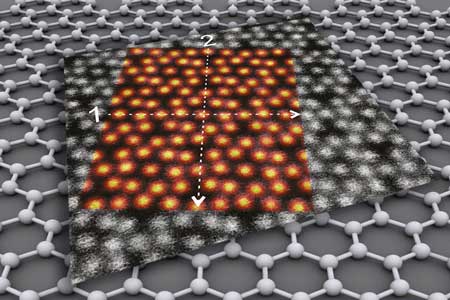 Indium oxide on graphene. (Image: Vienna University of Technology)
The results have now been presented in the scientific journal Advanced Functional Materials ("Process Pathway Controlled Evolution of Phase and Van-der-Waals Epitaxy in In/In2O3 on Graphene Heterostructures").
Indium oxide on graphene. (Image: Vienna University of Technology)
The results have now been presented in the scientific journal Advanced Functional Materials ("Process Pathway Controlled Evolution of Phase and Van-der-Waals Epitaxy in In/In2O3 on Graphene Heterostructures").
Indium oxide on graphene. (Image: Vienna University of Technology)
The results have now been presented in the scientific journal Advanced Functional Materials ("Process Pathway Controlled Evolution of Phase and Van-der-Waals Epitaxy in In/In2O3 on Graphene Heterostructures").
