
Jul 08, 2020
(Nanowerk News) Graphene consists of a single layer of carbon atoms arranged in a honeycomb structure. The material is of interest not only in basic research but also for various applications given to its unique properties, which include excellent electrical conductivity as well as astonishing strength and rigidity.
Research teams around the world are working to further expand these characteristics by substituting carbon atoms in the crystal lattice with atoms of different elements.
Moreover, the electric and magnetic properties can also be modified by the formation of pores in the lattice.
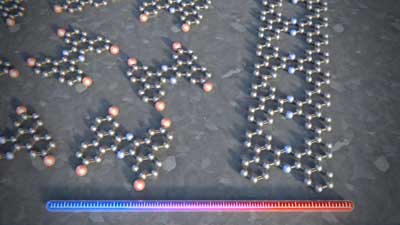 The individual building blocks are heated on a silver surface in order to synthesize a porous graphene ribbon that exhibits semiconducting properties and a ladder-like structure. In each rung of the ladder, two carbon atoms have been replaced with nitrogen atoms (blue). (Image: University of Basel, Department of Physics)
In order to synthesize these porous, nitrogen-containing graphene ribbons, the researchers heated the individual building blocks step by step on a silver surface in a vacuum. The ribbons are formed at temperatures up to 220 °C.
Atomic force microscopy allowed the researchers not only to monitor the individual steps in the synthesis, but also to confirm the perfect ladder structure - and stability - of the molecule.
The individual building blocks are heated on a silver surface in order to synthesize a porous graphene ribbon that exhibits semiconducting properties and a ladder-like structure. In each rung of the ladder, two carbon atoms have been replaced with nitrogen atoms (blue). (Image: University of Basel, Department of Physics)
In order to synthesize these porous, nitrogen-containing graphene ribbons, the researchers heated the individual building blocks step by step on a silver surface in a vacuum. The ribbons are formed at temperatures up to 220 °C.
Atomic force microscopy allowed the researchers not only to monitor the individual steps in the synthesis, but also to confirm the perfect ladder structure - and stability - of the molecule.
Ladder-like structure
Now, a team of researchers led by the physicist Professor Ernst Meyer of the University of Basel and the chemist Dr. Shi-Xia Liu from the University of Bern have succeeded in producing the first graphene ribbons whose crystal lattice contains both periodic pores and a regular pattern of nitrogen atoms. The structure of this new material resembles a ladder, with each rung containing two atoms of nitrogen.
The individual building blocks are heated on a silver surface in order to synthesize a porous graphene ribbon that exhibits semiconducting properties and a ladder-like structure. In each rung of the ladder, two carbon atoms have been replaced with nitrogen atoms (blue). (Image: University of Basel, Department of Physics)
In order to synthesize these porous, nitrogen-containing graphene ribbons, the researchers heated the individual building blocks step by step on a silver surface in a vacuum. The ribbons are formed at temperatures up to 220 °C.
Atomic force microscopy allowed the researchers not only to monitor the individual steps in the synthesis, but also to confirm the perfect ladder structure - and stability - of the molecule.
