
| Date | 11th, Jul 2020 |
|---|
Home > Press > Porous graphene ribbons doped with nitrogen for electronics and quantum computing
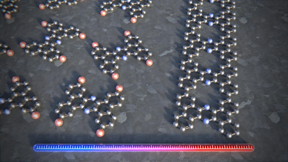 The individual building blocks are heated on a silver surface in order to synthesize a porous graphene ribbon that exhibits semiconducting properties and a ladder-like structure. In each rung of the ladder, two carbon atoms have been replaced with nitrogen atoms (blue).
CREDIT
University of Basel, Department of Physics
The individual building blocks are heated on a silver surface in order to synthesize a porous graphene ribbon that exhibits semiconducting properties and a ladder-like structure. In each rung of the ladder, two carbon atoms have been replaced with nitrogen atoms (blue).
CREDIT
University of Basel, Department of Physics
Abstract: Graphene consists of a single layer of carbon atoms arranged in a honeycomb structure. The material is of interest not only in basic research but also for various applications given to its unique properties, which include excellent electrical conductivity as well as astonishing strength and rigidity. Research teams around the world are working to further expand these characteristics by substituting carbon atoms in the crystal lattice with atoms of different elements. Moreover, the electric and magnetic properties can also be modified by the formation of pores in the lattice.
Basel, Switzerland | Posted on July 10th, 2020
Ladder-like structure
Now, a team of researchers led by the physicist Professor Ernst Meyer of the University of Basel and the chemist Dr. Shi-Xia Liu from the University of Bern have succeeded in producing the first graphene ribbons whose crystal lattice contains both periodic pores and a regular pattern of nitrogen atoms. The structure of this new material resembles a ladder, with each rung containing two atoms of nitrogen.
In order to synthesize these porous, nitrogen-containing graphene ribbons, the researchers heated the individual building blocks step by step on a silver surface in a vacuum. The ribbons are formed at temperatures up to 220�C. Atomic force microscopy allowed the researchers not only to monitor the individual steps in the synthesis, but also to confirm the perfect ladder structure - and stability - of the molecule.
Extraordinary properties
Using scanning tunneling microscopy, the scientists from the Department of Physics and the Swiss Nanoscience Institute (SNI) at the University of Basel also demonstrated that these new graphene ribbons were no longer electrical conductors, like pure graphene, but actually behaved as semiconductors. Colleagues from the Universities of Bern and Warwick confirmed these findings by performing theoretical calculations of the electronic properties. "The semiconducting properties are essential for the potential applications in electronics, as their conductivity can be adjusted specifically," says Dr. R�my Pawlak, first author of the study.
From the literature, it is known that a high concentration of nitrogen atoms in the crystal lattice causes graphene ribbons to magnetize when subjected to a magnetic field. "We expect these porous, nitrogen-doped graphene ribbons to display extraordinary magnetic properties," says Ernst Meyer. "In the future, the ribbons could therefore be of interest for applications in quantum computing."
####
For more information, please click here
Contacts:Ernst Meyer
41-612-073-724
@UniBasel_en
Copyright © University of Basel
If you have a comment, please Contact us.
Issuers of news releases, not 7th Wave, Inc. or Nanotechnology Now, are solely responsible for the accuracy of the content.
Bookmark:


News and information
 New technology helps reveal inner workings of human genome June 24th, 2022
Boron nitride nanotube fibers get real: Rice lab creates first heat-tolerant, stable fibers from wet-spinning process June 24th, 2022
Graphene/ Graphite
OCSiAl expands its graphene nanotube production capacities to Europe June 17th, 2022
Bumps could smooth quantum investigations: Rice University models show unique properties of 2D materials stressed by contoured substrates June 10th, 2022
Nanotubes: a promising solution for advanced rubber cables with 60% less conductive filler June 1st, 2022
Dynamic metasurfaces and metadevices empowered by graphene May 6th, 2022
Imaging
Snapshot measurement of single nanostructure�s circular dichroism March 25th, 2022
Better understanding superconductors with Higgs spectroscopy Prof. Stefan Kaiser from TU Dresden awarded ERC Consolidator Grant March 18th, 2022
Visualizing the invisible: New fluorescent DNA label reveals nanoscopic cancer features March 4th, 2022
Possible Futures
New technology helps reveal inner workings of human genome June 24th, 2022
Boron nitride nanotube fibers get real: Rice lab creates first heat-tolerant, stable fibers from wet-spinning process June 24th, 2022
Chip Technology
Boron nitride nanotube fibers get real: Rice lab creates first heat-tolerant, stable fibers from wet-spinning process June 24th, 2022
Controlled synthesis of crystal flakes paves path for advanced future electronics June 17th, 2022
Quantum Computing
University of Illinois Chicago joins Brookhaven Lab's Quantum Center June 10th, 2022
Bumps could smooth quantum investigations: Rice University models show unique properties of 2D materials stressed by contoured substrates June 10th, 2022
Discoveries
New technology helps reveal inner workings of human genome June 24th, 2022
Boron nitride nanotube fibers get real: Rice lab creates first heat-tolerant, stable fibers from wet-spinning process June 24th, 2022
Announcements
New technology helps reveal inner workings of human genome June 24th, 2022
Boron nitride nanotube fibers get real: Rice lab creates first heat-tolerant, stable fibers from wet-spinning process June 24th, 2022
Interviews/Book Reviews/Essays/Reports/Podcasts/Journals/White papers/Posters
Quantum network nodes with warm atoms June 24th, 2022
New technology helps reveal inner workings of human genome June 24th, 2022
Tools
New technology helps reveal inner workings of human genome June 24th, 2022
Snapshot measurement of single nanostructure�s circular dichroism March 25th, 2022
Eyebrow-raising: Researchers reveal why nanowires stick to each other February 11th, 2022
JEOL Introduces New Scanning Electron Microscope with �Simple SEM� Automation and Live Elemental and 3D Analysis January 14th, 2022
