
| Date | 10th, Jul 2020 |
|---|
Home > Press > Graphene: It is all about the toppings: To fully exploit the potential of the'wonder material' graphene, it has to be combined with other materials
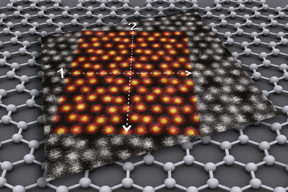 Indium oxide on a graphene layer
Abstract: Graphene consists of a single layer of carbon atoms. Exceptional electronic, thermal, mechanical and optical properties have made graphene one of the most studied materials at the moment. For many applications in electronics and energy technology, however, graphene must be combined with other materials: Since graphene is so thin, its properties drastically change when other materials are brought into direct contact with it.
Vienna, Austria | Posted on July 10th, 2020
However, combining graphene with other materials at the molecular level is difficult: The way graphene interacts with other materials depends not only on which material you choose, but also on how these materials are brought into contact with the graphene. Rather than sticking a finished material layer to the graphene, the appropriate atoms are brought into contact with the graphene in such a way that they "grow" on the graphene in the desired crystal structure.
Until now the mechanisms of the "growth" of such other materials on graphene have often remained unclear. A new joint study by research teams from the TU Wien and the University of Vienna for the first time observes now how indium oxide grows on graphene. The combination of indium oxide with graphene is important, for example for displays and sensors. The results have now been presented in the scientific journal "Advanced Functional Materials".
Graphene pizza
"As with a pizza, graphene technology is not only dependent on the graphene pizza base but also on its toppings," explains Bernhard C. Bayer from the Institute of Materials Chemistry at the TU Wien, who led the study. "How these toppings are applied to the graphene is, however, crucial."
In most cases, atoms in the gaseous state are condensed on the graphene. In the case of indium oxide, these are indium and oxygen. "But there are many parameters such as background pressure, temperature or the speed at which these atoms are directed at the graphene that influence the result drastically," says Bernhard Bayer. "It is therefore important to develop a fundamental understanding of the chemical and physical processes that actually take place. But to do this, you have to watch the growth process as it proceeds. "
This is exactly what the research team has now succeeded in doing: for the first time, the individual steps of growing indium oxide on graphene were observed in the electron microscope at atomic resolution.
Randomly distributed or perfectly aligned
"What was particularly interesting for us was the observation that, depending on the background pressure, the indium oxide crystallites either arrange themselves randomly on the graphene's crystal lattice or snap perfectly on one another like Lego bricks. This difference in arrangement can have a major impact on the application properties of the combined materials," says Kenan Elibol, first author of the study. The new findings will be useful to make the integration of graphene with other materials more predictable and controllable with respect to future application requirements.
####
For more information, please click here
Contacts:Florian Aigner
0043-158-801-41027
@tuvienna
Dr. Bernhard C. BayerInstitute of Materials ChemistryDivision Molecular Materials ChemistryTU WienGetreidemarkt 9, 1060 ViennaT +43 (1) 58801 - 165 228Twitter: @nanobayer
Copyright © Vienna University of Technology
If you have a comment, please Contact us.
Issuers of news releases, not 7th Wave, Inc. or Nanotechnology Now, are solely responsible for the accuracy of the content.
Bookmark:


News and information
 New technology helps reveal inner workings of human genome June 24th, 2022
Boron nitride nanotube fibers get real: Rice lab creates first heat-tolerant, stable fibers from wet-spinning process June 24th, 2022
Graphene/ Graphite
OCSiAl expands its graphene nanotube production capacities to Europe June 17th, 2022
Bumps could smooth quantum investigations: Rice University models show unique properties of 2D materials stressed by contoured substrates June 10th, 2022
Nanotubes: a promising solution for advanced rubber cables with 60% less conductive filler June 1st, 2022
Dynamic metasurfaces and metadevices empowered by graphene May 6th, 2022
Possible Futures
New technology helps reveal inner workings of human genome June 24th, 2022
Boron nitride nanotube fibers get real: Rice lab creates first heat-tolerant, stable fibers from wet-spinning process June 24th, 2022
Discoveries
New technology helps reveal inner workings of human genome June 24th, 2022
Boron nitride nanotube fibers get real: Rice lab creates first heat-tolerant, stable fibers from wet-spinning process June 24th, 2022
Announcements
New technology helps reveal inner workings of human genome June 24th, 2022
Boron nitride nanotube fibers get real: Rice lab creates first heat-tolerant, stable fibers from wet-spinning process June 24th, 2022
Interviews/Book Reviews/Essays/Reports/Podcasts/Journals/White papers/Posters
Quantum network nodes with warm atoms June 24th, 2022
New technology helps reveal inner workings of human genome June 24th, 2022
Energy
Solving the solar energy storage problem with rechargeable batteries that can convert and store energy at once June 24th, 2022
Organic water splitters get a boost June 10th, 2022
Engineering piezoelectricity and strain sensitivity in CdS to promote piezocatalytic hydrogen evolution May 13th, 2022
