
| Date | 18th, Jul 2020 |
|---|
Home > Press > 'Blinking" crystals may convert CO2 into fuels: Unusual nanoparticles could benefit the quest to build a quantum computer
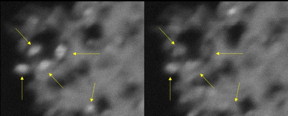 The arrows point to titanium dioxide nanocrystals lighting up and blinking (left) and then fading (right).
CREDIT
Tewodros Asefa and Eliska Mikmekova
The arrows point to titanium dioxide nanocrystals lighting up and blinking (left) and then fading (right).
CREDIT
Tewodros Asefa and Eliska Mikmekova
Abstract: Imagine tiny crystals that "blink" like fireflies and can convert carbon dioxide, a key cause of climate change, into fuels.
'Blinking" crystals may convert CO2 into fuels: Unusual nanoparticles could benefit the quest to build a quantum computer
New Brunswick, NJ | Posted on July 17th, 2020
A Rutgers-led team has created ultra-small titanium dioxide crystals that exhibit unusual "blinking" behavior and may help to produce methane and other fuels, according to a study in the journal Angewandte Chemie. The crystals, also known as nanoparticles, stay charged for a long time and could benefit efforts to develop quantum computers.
"Our findings are quite important and intriguing in a number of ways, and more research is needed to understand how these exotic crystals work and to fulfill their potential," said senior author Tewodros (Teddy) Asefa, a professor in the Department of Chemistry and Chemical Biology in the School of Arts and Sciences at Rutgers University-New Brunswick. He's also a professor in the Department of Chemical and Biochemical Engineering in the School of Engineering.
More than 10 million metric tons of titanium dioxide are produced annually, making it one of the most widely used materials, the study notes. It is used in sunscreens, paints, cosmetics and varnishes, for example. It's also used in the paper and pulp, plastic, fiber, rubber, food, glass and ceramic industries.
The team of scientists and engineers discovered a new way to make extremely small titanium dioxide crystals. While it's still unclear why the engineered crystals blink and research is ongoing, the "blinking" is believed to arise from single electrons trapped on titanium dioxide nanoparticles. At room temperature, electrons - surprisingly - stay trapped on nanoparticles for tens of seconds before escaping and then become trapped again and again in a continuous cycle.
The crystals, which blink when exposed to a beam of electrons, could be useful for environmental cleanups, sensors, electronic devices and solar cells, and the research team will further explore their capabilities.
###
The lead author is Tao Zhang, a Rutgers doctoral student. Co-authors include Alexei M. Tyryshkin, a Rutgers staff scientist, and researchers at Wuhan University of Technology and Czech Academy of Sciences. The research was funded by the U.S. National Science Foundation.
####
For more information, please click here
Contacts:Todd Bates
848-942-0550
@RutgersU
Copyright © Rutgers University
If you have a comment, please Contact us.
Issuers of news releases, not 7th Wave, Inc. or Nanotechnology Now, are solely responsible for the accuracy of the content.
Bookmark:


News and information
 New technology helps reveal inner workings of human genome June 24th, 2022
Boron nitride nanotube fibers get real: Rice lab creates first heat-tolerant, stable fibers from wet-spinning process June 24th, 2022
Govt.-Legislation/Regulation/Funding/Policy
Solving the solar energy storage problem with rechargeable batteries that can convert and store energy at once June 24th, 2022
Boron nitride nanotube fibers get real: Rice lab creates first heat-tolerant, stable fibers from wet-spinning process June 24th, 2022
UBCO researchers change the game when it comes to activity tracking: Flexible, highly sensitive motion device created by extrusion printing June 17th, 2022
University of Illinois Chicago joins Brookhaven Lab's Quantum Center June 10th, 2022
Possible Futures
New technology helps reveal inner workings of human genome June 24th, 2022
Boron nitride nanotube fibers get real: Rice lab creates first heat-tolerant, stable fibers from wet-spinning process June 24th, 2022
Discoveries
New technology helps reveal inner workings of human genome June 24th, 2022
Boron nitride nanotube fibers get real: Rice lab creates first heat-tolerant, stable fibers from wet-spinning process June 24th, 2022
Announcements
New technology helps reveal inner workings of human genome June 24th, 2022
Boron nitride nanotube fibers get real: Rice lab creates first heat-tolerant, stable fibers from wet-spinning process June 24th, 2022
Interviews/Book Reviews/Essays/Reports/Podcasts/Journals/White papers/Posters
Quantum network nodes with warm atoms June 24th, 2022
New technology helps reveal inner workings of human genome June 24th, 2022
Energy
Solving the solar energy storage problem with rechargeable batteries that can convert and store energy at once June 24th, 2022
Organic water splitters get a boost June 10th, 2022
Engineering piezoelectricity and strain sensitivity in CdS to promote piezocatalytic hydrogen evolution May 13th, 2022
Grants/Sponsored Research/Awards/Scholarships/Gifts/Contests/Honors/Records
Solving the solar energy storage problem with rechargeable batteries that can convert and store energy at once June 24th, 2022
Boron nitride nanotube fibers get real: Rice lab creates first heat-tolerant, stable fibers from wet-spinning process June 24th, 2022
Research partnerships
New technology helps reveal inner workings of human genome June 24th, 2022
Boron nitride nanotube fibers get real: Rice lab creates first heat-tolerant, stable fibers from wet-spinning process June 24th, 2022
