
| Date | 18th, Jul 2020 |
|---|
Home > Press > Scientists open new window into the nanoworld
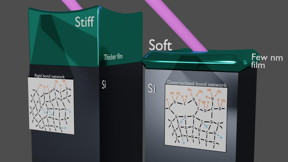 A graphic showing how shrinking a material down to thicknesses of just a few nanometers can disrupt its atomic bonds.
CREDIT
Kapteyn/Murnane Group/JILA
A graphic showing how shrinking a material down to thicknesses of just a few nanometers can disrupt its atomic bonds.
CREDIT
Kapteyn/Murnane Group/JILA
Abstract: University of Colorado Boulder researchers have used ultra-fast extreme ultraviolet lasers to measure the properties of materials more than 100 times thinner than a human red blood cell.
Boulder, CO | Posted on July 17th, 2020
The team, led by scientists at JILA, reported its new feat of wafer-thinness this week in the journal Physical Review Materials. The group's target, a film just 5 nanometers thick, is the thinnest material that researchers have ever been able to fully probe, said study coauthor Joshua Knobloch.
"This is a record-setting study to see how small we could go and how accurate we could be," said Knobloch, a graduate student at JILA, a partnership between CU Boulder and the National Institute of Standards and Technology (NIST).
He added that when things get small, the normal rules of engineering don't always apply. The group discovered, for example, that some materials seem to get a lot softer the thinner they become.
The researchers hope that their findings may one day help scientists to better navigate the often-unpredictable nanoworld, designing tinier and more efficient computer circuits, semiconductors and other technologies.
"If you're doing nanoengineering, you can't just treat your material like it's a normal big material," said Travis Frazer, lead author of the new paper and a former graduate student at JILA. "Because of the simple fact that it's small, it behaves like a different material."
"This surprising discovery--that very thin materials can be 10 times more flimsy than expected--is yet another example of how new tools can helps us to understand the nanoworld better," said Margaret Murnane, a coauthor of the new research, professor of physics at CU Boulder and JILA fellow.
Nano wiggles
The research comes at a time when many technology firms are trying to do just that: go small. Some companies are experimenting with ways to build efficient computer chips that layer thin films of material one on top of the other--like a filo pastry, but inside your laptop.
The problem with that approach, Frazer said, is that scientists have trouble predicting how those flakey layers will behave. They're just too delicate to measure in any meaningful way with the usual tools.
To help in that goal, he and his colleagues deployed extreme ultraviolet lasers, or beams of radiation that deliver shorter wavelengths than traditional lasers--wavelengths that are well-matched to the nanoworld. The researchers developed a set-up that allows them to bounce those beams off of layers of material just a few strands of DNA thick, tracking the different ways those films can vibrate.
"If you can measure how fast your material is wiggling, then you can figure out how stiff it is," Frazer said.
Atomic disruption
The method has also revealed just how much the properties of materials can change when you make them very, very small.
In the most recent study, for example, the researchers probed the relative strength of two films made out of silicon carbide: one about 46 nanometers thick, and the other just 5 nanometers thick. The team's ultraviolet laser delivered surprising results. The thinner film was about 10 times softer, or less rigid, than its thicker counterpart, something the researchers weren't expecting.
Frazer explained that, if you make a film too thin, you can cut into the atomic bonds that hold a material together--a bit like unraveling a frayed rope.
"The atoms at the top of the film have other atoms underneath them that they can hold onto," Frazer said. "But above them, the atoms don't have anything they can grab onto."
But not all materials will behave the same way, he added. The team also reran the same experiment on a second material that was nearly identical to the first with one big difference--this one had a lot more hydrogen atoms added in. Such a "doping" process can naturally disrupt the atomic bonds within a material, causing it to lose strength.
When the group tested that second, flimsier material using their lasers, they found something new: this material was just as strong when it was 44 nanometers thick as it was at a meager 11 nanometers thick.
Put differently, the additional hydrogen atoms had already weakened the material--a bit of extra shrinking couldn't do anymore damage.
In the end, the team says that its new ultraviolet laser tool gives scientists a window into a realm that was previously beyond the grasp of science.
"Now that people are building very, very small devices, they're asking how properties like thickness or shape can change how their materials behave," Knobloch said. "This gives us a new way of accessing information about nanoscale technology."
###
This research was supported by the STROBE National Science Foundation Science and Technology Center on Real-Time Functional Imaging.
Coauthors on the new study included JILA researchers Henry Kapteyn, professor of physics, Jorge Hern�ndez-Charpak; Kathy Hoogeboom-Pot; Damiano Nardi and Bego�a Abad. Other coauthors included Sadegh Yazdi at the Renewable and Sustainable Energy Institute at CU Boulder; Weilun Chao and Erik Anderson at the Lawrence Berkeley National Laboratory; and Marie Tripp and Sean King at Intel Corp.
####
For more information, please click here
Contacts:Daniel Strain
@cubouldernews
Copyright © University of Colorado at Boulder
If you have a comment, please Contact us.
Issuers of news releases, not 7th Wave, Inc. or Nanotechnology Now, are solely responsible for the accuracy of the content.
Bookmark:


News and information
 New technology helps reveal inner workings of human genome June 24th, 2022
Boron nitride nanotube fibers get real: Rice lab creates first heat-tolerant, stable fibers from wet-spinning process June 24th, 2022
Laboratories
University of Illinois Chicago joins Brookhaven Lab's Quantum Center June 10th, 2022
A one-stop shop for quantum sensing materials May 27th, 2022
Imaging
Snapshot measurement of single nanostructure�s circular dichroism March 25th, 2022
Better understanding superconductors with Higgs spectroscopy Prof. Stefan Kaiser from TU Dresden awarded ERC Consolidator Grant March 18th, 2022
Visualizing the invisible: New fluorescent DNA label reveals nanoscopic cancer features March 4th, 2022
Govt.-Legislation/Regulation/Funding/Policy
Solving the solar energy storage problem with rechargeable batteries that can convert and store energy at once June 24th, 2022
Boron nitride nanotube fibers get real: Rice lab creates first heat-tolerant, stable fibers from wet-spinning process June 24th, 2022
UBCO researchers change the game when it comes to activity tracking: Flexible, highly sensitive motion device created by extrusion printing June 17th, 2022
University of Illinois Chicago joins Brookhaven Lab's Quantum Center June 10th, 2022
Discoveries
New technology helps reveal inner workings of human genome June 24th, 2022
Boron nitride nanotube fibers get real: Rice lab creates first heat-tolerant, stable fibers from wet-spinning process June 24th, 2022
Announcements
New technology helps reveal inner workings of human genome June 24th, 2022
Boron nitride nanotube fibers get real: Rice lab creates first heat-tolerant, stable fibers from wet-spinning process June 24th, 2022
Interviews/Book Reviews/Essays/Reports/Podcasts/Journals/White papers/Posters
Quantum network nodes with warm atoms June 24th, 2022
New technology helps reveal inner workings of human genome June 24th, 2022
Tools
New technology helps reveal inner workings of human genome June 24th, 2022
Snapshot measurement of single nanostructure�s circular dichroism March 25th, 2022
Eyebrow-raising: Researchers reveal why nanowires stick to each other February 11th, 2022
JEOL Introduces New Scanning Electron Microscope with �Simple SEM� Automation and Live Elemental and 3D Analysis January 14th, 2022
Research partnerships
New technology helps reveal inner workings of human genome June 24th, 2022
Boron nitride nanotube fibers get real: Rice lab creates first heat-tolerant, stable fibers from wet-spinning process June 24th, 2022
