
Jul 22, 2020
(Nanowerk News) Since the beginning of 2019, the Fraunhofer Institute for Biomedical Engineering IBMT has been working on a comprehensive characterization and humantoxicological assessment of nanocellulose along its life cycle in the BMBF-funded joint project NanoCELL under the coordination of Postnova Analytics GmbH, in order to achieve a reliable risk assessment and safe use in environmentally friendly packaging materials.
Cellulose, a natural carbohydrate, is the most abundant organic substance on earth. Nanocellulose is extracted from renewable resources such as wood or cotton and is therefore a raw material in the field of bioeconomy. As nanocellulose has very good barrier properties for oxygen and mineral oils, it can therefore replace barrier materials from fossil raw materials.
The biodegradable material nanocellulose offers a promising approach to replace poorly degradable materials, thereby reducing plastic waste and thus opening up a possible way out of the microplastic problem in the environment.
In addition, several studies indicate that nanocellulose is more compatible with other polymers and papers and is therefore less problematic in the recycling process and leads to a higher recycling quality than commonly used materials.
Currently, there are large gaps in knowledge regarding the interaction of other nano-/microstructures made of cellulose, such as nanocellulose crystals and nanocellulose fibres. The toxicity of these materials depends strongly on their shape and size, surface chemistry and the quality of the manufacturing process (impurities).
Preliminary results indicate low dermal and oral toxicity, but are inconsistent in terms of toxicity after inhalation.
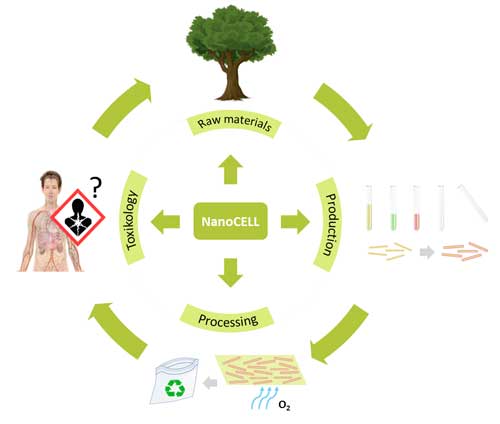 Among other things, the performance of nanocellulose-reinforced films and coatings is to be investigated in terms of their barrier properties against oxygen and mineral oils. In addition, standardized analysis strategies will be developed, from sample preparation to the physico-chemical characterization of nanocellulose in complex matrices such as saliva or intestinal fluid.
A further aspect is the toxicological evaluation of nanocellulose. For example, the transport of nanocellulose across the gastrointestinal barrier is simulated and the uptake of nanocellulose into human cells as well as the chemical degradation as a function of particle size and other particle properties is experimentally investigated. In parallel, intelligent test strategies based on novel in vitro and in silico methods are being developed to predict material risks.
Among other things, the performance of nanocellulose-reinforced films and coatings is to be investigated in terms of their barrier properties against oxygen and mineral oils. In addition, standardized analysis strategies will be developed, from sample preparation to the physico-chemical characterization of nanocellulose in complex matrices such as saliva or intestinal fluid.
A further aspect is the toxicological evaluation of nanocellulose. For example, the transport of nanocellulose across the gastrointestinal barrier is simulated and the uptake of nanocellulose into human cells as well as the chemical degradation as a function of particle size and other particle properties is experimentally investigated. In parallel, intelligent test strategies based on novel in vitro and in silico methods are being developed to predict material risks.
BMBF-project NanoCELL should provide sound knowledge
Against this background, the BMBF-funded joint project "NanoCELL" aims to fabricate nanocellulose materials and to develop standardized analysis methods and strategies to analyse nanocellulose along its life cycle.
Among other things, the performance of nanocellulose-reinforced films and coatings is to be investigated in terms of their barrier properties against oxygen and mineral oils. In addition, standardized analysis strategies will be developed, from sample preparation to the physico-chemical characterization of nanocellulose in complex matrices such as saliva or intestinal fluid.
A further aspect is the toxicological evaluation of nanocellulose. For example, the transport of nanocellulose across the gastrointestinal barrier is simulated and the uptake of nanocellulose into human cells as well as the chemical degradation as a function of particle size and other particle properties is experimentally investigated. In parallel, intelligent test strategies based on novel in vitro and in silico methods are being developed to predict material risks.
