
Jul 24, 2020
(Nanowerk News) Researchers from the University of Alicante’s Advanced Materials Laboratory have created an optimal, low-cost methane storage system. The team, led by UA Professor of Inorganic Chemistry Joaquín Silvestre, has used an MOF material (highly porous metal-organic framework). In the pores of this material, it is possible to create the conditions required to replicate gas structures under the sea, where millions of tonnes of natural gas are stored inside ice-like structures.
This system offers an alternative for natural gas transportation and natural gas-powered vehicles, like private cars, buses and ships. It is based on millimetric ice crystals that store gas, i.e. capture it and keep it stable.
The main advantage of these nanomaterials, Silvestre explains, is that with them “temperature can be reduced to 2 °C, and pressure to about 60 bars.” To liquefy natural gas and transport it by boat to different countries from its source, it must be at -162 °C and at high pressures. Compressed gas-powered buses, conversely, require a pressure of 250 bars. With the system developed in this study, these two obstacles can be overcome, as the pressure and temperature conditions are more favourable.
This finding, published in the Journal of the American Chemical Society ("Quest for an optimal methane hydrates formation in the pores of hydrolytically stable MOFs"), results from the collaborative work between researchers from Saudi Arabia’s King Abdullah University (KAUST), Morocco’s Mohammed VI Polytechnic University, the USA’s Oak Ridge National Laboratory and the ALBA synchrotron radiation accelerator in Barcelona.
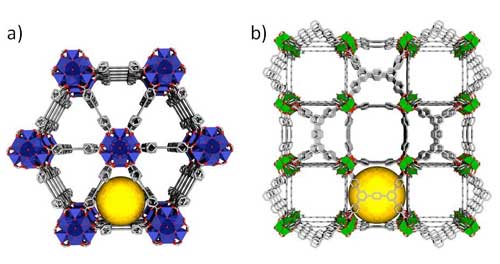 Crystalline structures of a) Y-shp-MOF-5 and b) Cr-soc-MOF-1. Yellow spheres highlight the triangular channels of Y-shp-MOF-5 and the cuboidal cages of Cr-soc-MOF-1. Color code: Y, blue; Cr, green; O, red; C, grey. H atoms and counter-ions are not represented for sake of clarity. (© American Chemical Society)
Crystalline structures of a) Y-shp-MOF-5 and b) Cr-soc-MOF-1. Yellow spheres highlight the triangular channels of Y-shp-MOF-5 and the cuboidal cages of Cr-soc-MOF-1. Color code: Y, blue; Cr, green; O, red; C, grey. H atoms and counter-ions are not represented for sake of clarity. (© American Chemical Society)
