
Jul 29, 2020
(Nanowerk News) A luxury automobile is not really a place to look for something like sisal, hemp or wood. Yet auto makers have been using natural fibres for decades.
Some high-end sedans and coupes use these in composite materials for interior door panels; engine, interior and noise insulation; and internal engine covers among other uses.
Unlike steels or aluminium, natural fibre composites do not rust or corrode. They can also be durable and easily molded.
The biggest benefits fibre reinforced polymer composites bring to cars are the light weight, good crash properties, and noise and vibration reducing characteristics.
But making more parts of a vehicle from renewable sources is a challenge. Natural fibre polymer composites can crack, break and bend. The reasons for this include too low tensile, flexural and impact strength in the composite material.
Researchers from the University of Johannesburg have now demonstrated that plantain, a starchy type of banana, is a promising source for an emerging type of composite materials for the automotive industry. The natural plantain fibres are combined with carbon nanotubes and epoxy resin to form a natural fibre-reinforced polymer hybrid nanocomposite material (Journal of Materials Research and Technology, "Physical, mechanical and thermal properties of high frequency microwave treated plantain (Musa Paradisiaca) fibre/MWCNT hybrid epoxy nanocomposites").
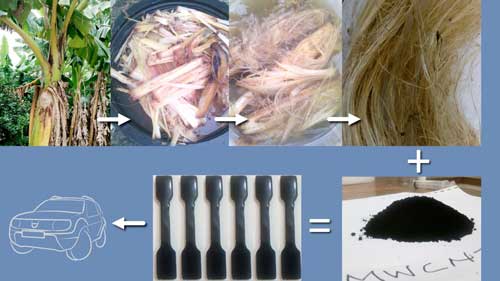 Carmakers have been using natural fibres for decades in high-end sedans and coupes. Natural fibers such as hemp, flax and wood are used in interior door panels; as well as engine, interior and noise insulation. But such natural fibre polymer composite materials can crack, break and bend. Researchers from the University of Johannesburg have shown that plantain pseudo-stems is a promising renewable source for an emerging type of lighter nanocomposite materials for the automotive industry. Reducing a vehicle's mass can improve fuel efficiency. (Image: Dr Patrick Ehi Imoisili, Therese van Wyk, University of Johannesburg)
Plantain is a year-round staple food crop in tropical regions of Africa, Asia and South America. Many types of plantain are eaten cooked.
The researchers moulded a composite material from epoxy resin, treated plantain fibers and carbon nanotubes. The optimum amount of nanotubes was 1% by weight of the plantain-epoxy resin combined.
The resulting plantain nanocomposite was much stronger and stiffer than epoxy resin on its own.
The composite had 31% more tensile and 34% more flexural strength than the epoxy resin alone. The nanocomposite also had 52% higher tensile modulus and 29% higher flexural modulus than the epoxy resin alone.
"The hybridization of plantain with multi-walled carbon nanotubes increases the mechanical and thermal strength of the composite. These increases make the hybrid composite a competitive and alternative material for certain car parts," says Prof Tien-Chien Jen.
Prof Jen is the lead researcher in the study and the Head of the Department of Mechanical Engineering Science at the University of Johannesburg.
Carmakers have been using natural fibres for decades in high-end sedans and coupes. Natural fibers such as hemp, flax and wood are used in interior door panels; as well as engine, interior and noise insulation. But such natural fibre polymer composite materials can crack, break and bend. Researchers from the University of Johannesburg have shown that plantain pseudo-stems is a promising renewable source for an emerging type of lighter nanocomposite materials for the automotive industry. Reducing a vehicle's mass can improve fuel efficiency. (Image: Dr Patrick Ehi Imoisili, Therese van Wyk, University of Johannesburg)
Plantain is a year-round staple food crop in tropical regions of Africa, Asia and South America. Many types of plantain are eaten cooked.
The researchers moulded a composite material from epoxy resin, treated plantain fibers and carbon nanotubes. The optimum amount of nanotubes was 1% by weight of the plantain-epoxy resin combined.
The resulting plantain nanocomposite was much stronger and stiffer than epoxy resin on its own.
The composite had 31% more tensile and 34% more flexural strength than the epoxy resin alone. The nanocomposite also had 52% higher tensile modulus and 29% higher flexural modulus than the epoxy resin alone.
"The hybridization of plantain with multi-walled carbon nanotubes increases the mechanical and thermal strength of the composite. These increases make the hybrid composite a competitive and alternative material for certain car parts," says Prof Tien-Chien Jen.
Prof Jen is the lead researcher in the study and the Head of the Department of Mechanical Engineering Science at the University of Johannesburg.
Carmakers have been using natural fibres for decades in high-end sedans and coupes. Natural fibers such as hemp, flax and wood are used in interior door panels; as well as engine, interior and noise insulation. But such natural fibre polymer composite materials can crack, break and bend. Researchers from the University of Johannesburg have shown that plantain pseudo-stems is a promising renewable source for an emerging type of lighter nanocomposite materials for the automotive industry. Reducing a vehicle's mass can improve fuel efficiency. (Image: Dr Patrick Ehi Imoisili, Therese van Wyk, University of Johannesburg)
Plantain is a year-round staple food crop in tropical regions of Africa, Asia and South America. Many types of plantain are eaten cooked.
The researchers moulded a composite material from epoxy resin, treated plantain fibers and carbon nanotubes. The optimum amount of nanotubes was 1% by weight of the plantain-epoxy resin combined.
The resulting plantain nanocomposite was much stronger and stiffer than epoxy resin on its own.
The composite had 31% more tensile and 34% more flexural strength than the epoxy resin alone. The nanocomposite also had 52% higher tensile modulus and 29% higher flexural modulus than the epoxy resin alone.
"The hybridization of plantain with multi-walled carbon nanotubes increases the mechanical and thermal strength of the composite. These increases make the hybrid composite a competitive and alternative material for certain car parts," says Prof Tien-Chien Jen.
Prof Jen is the lead researcher in the study and the Head of the Department of Mechanical Engineering Science at the University of Johannesburg.
