
Jul 30, 2020
(Nanowerk News) Whether in innovative high-tech materials, more powerful computer chips, pharmaceuticals or in the field of renewable energies, nanoparticles - smallest portions of bulk material - form the basis for a whole range of new technological developments.
Due to the laws of quantum mechanics, such particles measuring only a few millionths of a millimetre can behave completely differently in terms of conductivity, optics or robustness than the same material on a macroscopic scale.
In addition, nanoparticles or nanoclusters have a very large catalytically effective surface area compared to their volume. For many applications this allows material savings while maintaining the same performance.
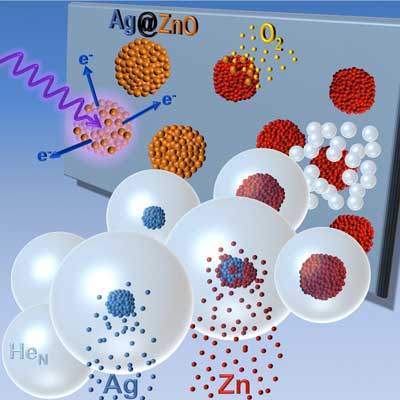 The graph illustrates the stepwise synthesis of Silver-Zinc Oxide core-shell clusters. (Image: TU Graz)
"There, they coalesce into a new aggregate and can be deposited on different substrates," explains experimental physicist Wolfgang Ernst from TU Graz.
He has been working on this so-called helium-droplet synthesis for twenty-five years now, has successively developed it further during this time, and has produced continuous research at the highest international level, mostly performed in "Cluster Lab 3", which has been set up specifically for this purpose at the IEP.
The graph illustrates the stepwise synthesis of Silver-Zinc Oxide core-shell clusters. (Image: TU Graz)
"There, they coalesce into a new aggregate and can be deposited on different substrates," explains experimental physicist Wolfgang Ernst from TU Graz.
He has been working on this so-called helium-droplet synthesis for twenty-five years now, has successively developed it further during this time, and has produced continuous research at the highest international level, mostly performed in "Cluster Lab 3", which has been set up specifically for this purpose at the IEP.
Further development of top-level research in Graz in the field of nanomaterials
Researchers at the Institute of Experimental Physics (IEP) at Graz University of Technology have developed a method for assembling nanomaterials as desired. They let superfluid helium droplets of an internal temperature of 0.4 Kelvin (i.e. minus 273 degrees Celsius) fly through a vacuum chamber and selectively introduce individual atoms or molecules into these droplets.
The graph illustrates the stepwise synthesis of Silver-Zinc Oxide core-shell clusters. (Image: TU Graz)
"There, they coalesce into a new aggregate and can be deposited on different substrates," explains experimental physicist Wolfgang Ernst from TU Graz.
He has been working on this so-called helium-droplet synthesis for twenty-five years now, has successively developed it further during this time, and has produced continuous research at the highest international level, mostly performed in "Cluster Lab 3", which has been set up specifically for this purpose at the IEP.
