
| Date | 1st, Aug 2020 |
|---|
Home > Press > Way, shape and form: Synthesis conditions define the nanostructure of manganese dioxide
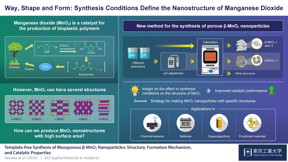 Scientists at Tokyo Institute of Technology explore a novel and simplistic method to synthesize manganese dioxide with a specific crystalline structure called β-MnO2. Their study sheds light on how different synthesis conditions can produce manganese dioxide with distinct porous structures, hinting at a strategy for the development of highly tuned MnO2 nanomaterials that could serve as catalysts in the fabrication of bioplastics.
CREDIT
Keigo Kamata, Tokyo Institute of Technology
Scientists at Tokyo Institute of Technology explore a novel and simplistic method to synthesize manganese dioxide with a specific crystalline structure called β-MnO2. Their study sheds light on how different synthesis conditions can produce manganese dioxide with distinct porous structures, hinting at a strategy for the development of highly tuned MnO2 nanomaterials that could serve as catalysts in the fabrication of bioplastics.
CREDIT
Keigo Kamata, Tokyo Institute of Technology
Abstract: Scientists at Tokyo Institute of Technology explore a novel and simplistic method to synthesize manganese dioxide with a specific crystalline structure called β-MnO2. Their study sheds light on how different synthesis conditions can produce manganese dioxide with distinct porous structures, hinting at a strategy for the development of highly tuned MnO2 nanomaterials that could serve as catalysts in the fabrication of bioplastics.
Tokyo, Japan | Posted on July 31st, 2020
Materials engineering has advanced to a point at which not only are we concerned about the chemical composition of a material, but also about its structure at a nanometric level. Nanostructured materials have recently drawn the attention of researchers from a variety of fields and for good reason; their physical, optical, and electrical characteristics can be tuned and pushed to the limit once methods to tailor their nanostructure are available.
Manganese dioxide (chemical formula MnO2) nanostructured metal oxide that can form many different crystalline structures, with applications across various engineering fields. One important use of MnO2 is as a catalyst for chemical reactions, and a particular crystalline structure of MnO2, called β-MnO2, is exceptional for the oxidation of 5-hydroxymethylfurfural into 2,5-furandicarboxylic acid (FDCA). Because FDCA can be used to produce environment-friendly bioplastics, finding ways to tune the nanostructure of β-MnO2 to maximize its catalytic performance is crucial.
However, producing β-MnO2 is difficult compared with other MnO2 crystalline structures. Existing methods are complicated and involve the use of template materials onto which β-MnO2 "grows" and ends up with the desired structure after several steps. Now, researchers from Tokyo Institute of Technology led by Prof. Keigo Kamata explore a template-free approach for the synthesis of different types of porous β-MnO2 nanoparticles.
Their method, described in their study published in ACS Applied Materials & Interfaces, is outstandingly simple and convenient. First, Mn precursors are obtained by mixing aqueous solutions and letting the solids precipitate. After filtration and drying, the collected solids are subjected to a temperature of 400�C in a normal air atmosphere, a process known as calcination. During this step, the material crystallizes and the black powder obtained afterwards is more than 97% porous β-MnO2.
Most notably, the researchers found this porous β-MnO2 to be much more efficient as a catalyst for synthesizing FDCA than the β-MnO2 produced using a more widespread approach called the "hydrothermal method." To understand why, they analyzed the chemical, microscopic, and spectral characteristics of β-MnO2 nanoparticles produced under different synthesis conditions.
They found that β-MnO2 can take on markedly different morphologies according to certain parameters. In particular, by adjusting the acidity (pH) of the solution in which the precursors are mixed, β-MnO2 nanoparticles with large spherical pores can be obtained. This porous structure has a higher surface area, thus providing better catalytic performance. Excited about the results, Kamata remarks: "Our porous β-MnO2 nanoparticles could efficiently catalyze the oxidation of HMF into FDCA in sharp contrast with β-MnO2 nanoparticles obtained via the hydrothermal method. Further fine control of the crystallinity and/or porous structure of β-MnO2 could lead to the development of even more efficient oxidative reactions."
What's more, this study provided much insight into how porous and tunnel structures are formed in MnO2, which could be key to extending its applications, as Kamata states: "Our approach, which involves the transformation of Mn precursors into MnO2 not in the liquid-phase (hydrothermal method) but under an air atmosphere, is a promising strategy for the synthesis of various MnO2 nanoparticles with tunnel structures. These could be applicable as versatile functional materials for catalysts, chemical sensors, lithium-ion batteries, and supercapacitors." Further studies like this one will hopefully allow us to one day harness the full potential that nanostructured materials have to offer.
####
About Tokyo Institute of TechnologyTokyo Tech stands at the forefront of research and higher education as the leading university for science and technology in Japan. Tokyo Tech researchers excel in fields ranging from materials science to biology, computer science, and physics. Founded in 1881, Tokyo Tech hosts over 10,000 undergraduate and graduate students per year, who develop into scientific leaders and some of the most sought-after engineers in industry. Embodying the Japanese philosophy of "monotsukuri," meaning "technical ingenuity and innovation," the Tokyo Tech community strives to contribute to society through high-impact research.
For more information, please click here
Contacts:Emiko Kawaguchi
81-357-342-975
Copyright © Tokyo Institute of Technology
If you have a comment, please Contact us.
Issuers of news releases, not 7th Wave, Inc. or Nanotechnology Now, are solely responsible for the accuracy of the content.
Bookmark:


News and information
 New technology helps reveal inner workings of human genome June 24th, 2022
Boron nitride nanotube fibers get real: Rice lab creates first heat-tolerant, stable fibers from wet-spinning process June 24th, 2022
Chemistry
Nanoscale chemically ordered-disordered domains in Fe3Pt alloys and their three-dimensional interface and lattice strain May 27th, 2022
Flexible quantum sieve made at TU Dresden filters the fuel of Starship Enterprise April 15th, 2022
Possible Futures
New technology helps reveal inner workings of human genome June 24th, 2022
Boron nitride nanotube fibers get real: Rice lab creates first heat-tolerant, stable fibers from wet-spinning process June 24th, 2022
Discoveries
New technology helps reveal inner workings of human genome June 24th, 2022
Boron nitride nanotube fibers get real: Rice lab creates first heat-tolerant, stable fibers from wet-spinning process June 24th, 2022
Materials/Metamaterials
Nanotubes: a promising solution for advanced rubber cables with 60% less conductive filler June 1st, 2022
New route to build materials out of tiny particles May 27th, 2022
A one-stop shop for quantum sensing materials May 27th, 2022
Announcements
New technology helps reveal inner workings of human genome June 24th, 2022
Boron nitride nanotube fibers get real: Rice lab creates first heat-tolerant, stable fibers from wet-spinning process June 24th, 2022
Interviews/Book Reviews/Essays/Reports/Podcasts/Journals/White papers/Posters
Quantum network nodes with warm atoms June 24th, 2022
New technology helps reveal inner workings of human genome June 24th, 2022
