
Aug 03, 2020
(Nanowerk News) Researchers at the Fraunhofer Institute for Reliability and Microintegration IZM have joined forces with partners in industry and healthcare to develop a handy graphene oxid based sensor platform to detect acute infections such as sepsis or the antibodies against the coronavirus within minutes.
The current situation with the COVID 19 pandemic underscores the importance of detecting infections quickly and accurately to prevent further spread. Today, symptoms provide the clues that help diagnose viral or bacterial infections.
However, many infections have similar symptoms, so these signs can easily be misread and the disease misdiagnosed. Blood tests provide certainty, but laboratories only carry these out when prescribed by the family physician. By the time the results arrive from the lab, doctors have often prescribed an antibiotic that may well be unnecessary.
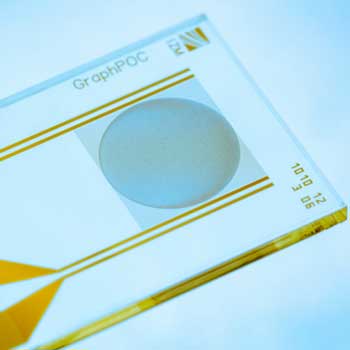 The Graph-POC graphene oxide-based biosensor. (Image: Volker Mai, Fraunhofer IZM)
The test may also be set up to detect antibodies that are present after a patient has recovered from an infection. Fraunhofer IZM researchers are now focusing on this application to detect earlier infections with the COVID-19 virus, which can help with efforts to trace how the infection has spread. The human body forms molecules or proteins called biomarkers in response to an infection. Capture molecules placed on the surface of the graphene-based sensor to detect these biomarkers. These tiny molecules contain just a few atoms, so the sensor has to be extremely accurate. Differential measurements of biomarkers’ concentration determine if an infection is present.
The Graph-POC graphene oxide-based biosensor. (Image: Volker Mai, Fraunhofer IZM)
The test may also be set up to detect antibodies that are present after a patient has recovered from an infection. Fraunhofer IZM researchers are now focusing on this application to detect earlier infections with the COVID-19 virus, which can help with efforts to trace how the infection has spread. The human body forms molecules or proteins called biomarkers in response to an infection. Capture molecules placed on the surface of the graphene-based sensor to detect these biomarkers. These tiny molecules contain just a few atoms, so the sensor has to be extremely accurate. Differential measurements of biomarkers’ concentration determine if an infection is present.
Just one drop of blood for a diagnosis
Researchers at the Fraunhofer IZM in Berlin have been working on the project Graph-POC since April 2018 on a graphene oxid based sensor platform to rise to precisely these challenges in diagnosing infections. A single drop of blood or saliva is all it takes to perform an accurate analysis. Just a few minutes after the drop is applied to the sensor’s surface, electrical signals convey the test result to the family doctor’s office. This rapid test provides certainty within just 15 minutes to replace the protracted blood work in the lab. It takes the error and guesswork out of diagnosis so the physician can prescribe the appropriate treatment or suitable antibiotics.
The Graph-POC graphene oxide-based biosensor. (Image: Volker Mai, Fraunhofer IZM)
The test may also be set up to detect antibodies that are present after a patient has recovered from an infection. Fraunhofer IZM researchers are now focusing on this application to detect earlier infections with the COVID-19 virus, which can help with efforts to trace how the infection has spread. The human body forms molecules or proteins called biomarkers in response to an infection. Capture molecules placed on the surface of the graphene-based sensor to detect these biomarkers. These tiny molecules contain just a few atoms, so the sensor has to be extremely accurate. Differential measurements of biomarkers’ concentration determine if an infection is present.
