
The team, led by Baohua Jia of the Swinburne University of Technology, Qiaoliang Bao formerly of Monash University, and Chengwei Qiu of the National University of Singapore, discovered that it is possible to generate nanoparticles by using a femtosecond laser beam to interact with the monolayer TMDC material, which is significantly different from the process produced by a continuous-wave laser.
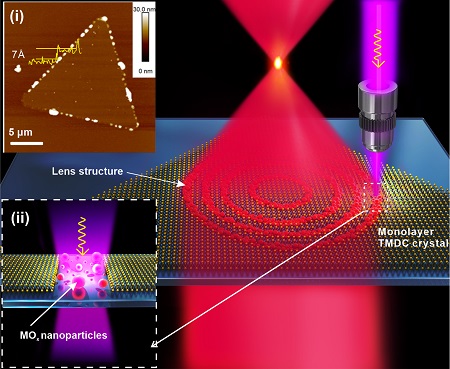
Because the laser pulse is so short, the material remains cold, allowing the nanoparticles to attach firmly to the substrate. The nanoparticles showed strong scattering to modulate the amplitude of light, which allows the lens to provide high efficiency and subwavelength resolution. The team was then able to demonstrate diffraction-limited imaging using the lenses.
“We have used the thinnest material in the world to fabricate a flat lens, and prove that the good performance of the ultrathin lens can lead to a high-resolution image,” said Han Lin, first author on the study.
Though lenses made from multilayer TMDCs have been demonstrated before, when their thickness is reduced to the subnanometer scale, their insufficient phase or amplitude modulation results in focusing efficiencies of less than 1%.
“It shows enormous potential in different applications, such as eyeglasses, microscopy lenses, telescopes, and camera lenses,” Lin said. “It is foreseeable that by using this technique, the weight and size of camera lenses can be significantly reduced in the near future.”
The research was published in Light: Science & Applications (www.doi.org/10.1038/s41377-020-00374-9).
