
While the materials the team used in its design do not vary from those used in conventional LEDs, there is a significant difference in physical shape. Whereas conventional LEDs shine light from a component that features a flat, planar body, the new light source consists of long, thin strands of zinc oxide. The team refers to the strands as fins. A fin is only about 5 µm in length, stretching approximately a tenth of the thickness of an average human hair.
An array of fins resembles a microscopic comb that extends to areas as large as 1 cm, and successfully receives more electrical current than existing LEDs. Though modern LEDs do increase their brightness as the currents of corresponding electrical feeds increase, brightness eventually dissipates.
The phenomenon is known as an “efficiency droop” — and it stands in the way of LEDs supporting applications in communications technology and medicine.
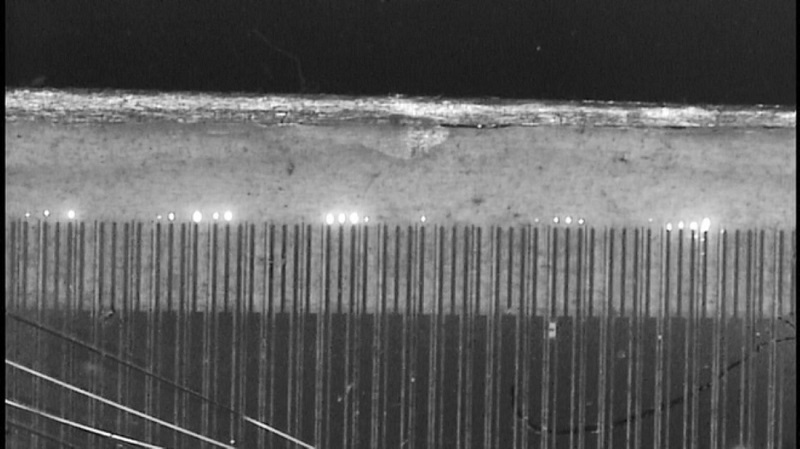
NIST said the team’s cursory goal for the research was to create a microscopic LED for use in very small applications. Ultimately, the novel design shone prominently in wavelengths bordering violet and ultraviolet ranges.
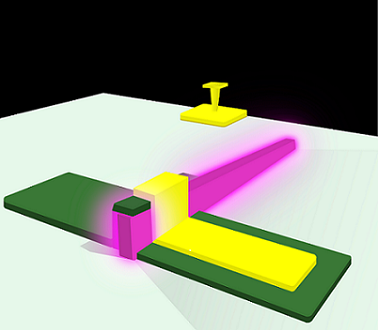
Because the LEDs’ comparatively broad emission eventually narrowed to two wavelengths of intense violet, the LED qualified as a tiny laser in the team’s experiments. Such a bright and compact device could empower chip-scale applications, such as those used for chemical sensing, high-definition displays, and hand-held communication.
“Converting an LED into a laser takes a large effort,” Nikoobakht said. “It usually requires coupling an LED to a resonance cavity that lets the light bounce around to make a laser. It appears that the fin design can do the whole job on its own, without needing to add another cavity.”
Participating scientists are from the IBM Thomas J. Watson Research Center, Rensselaer Polytechnic Institute, and the University of Maryland. The U.S. Army Cooperative Research Agreement partially supported the research.
The research was published in Science Advances (www.doi.org/10.1126/sciadv.aba4346).
