
| Date | 29th, Aug 2020 |
|---|
Home > Press > An improved wearable, stretchable gas sensor using nanocomposites
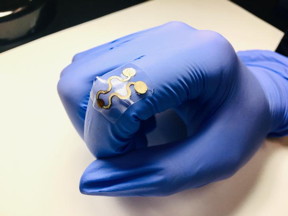 An example of a flexible gas sensor worn over a knuckle.
CREDIT
Cheng Lab, Penn State
An example of a flexible gas sensor worn over a knuckle.
CREDIT
Cheng Lab, Penn State
Abstract: A stretchable, wearable gas sensor for environmental sensing has been developed and tested by researchers at Penn State, Northeastern University and five universities in China.
University Park, PA | Posted on August 28th, 2020
The sensor combines a newly developed laser-induced graphene foam material with a unique form of molybdenum disulfide and reduced-graphene oxide nanocomposites. The researchers were interested in seeing how different morphologies, or shapes, of the gas-sensitive nanocomposites affect the sensitivity of the material to detecting nitrogen dioxide molecules at very low concentration. To change the morphology, they packed a container with very finely ground salt crystals.
Nitrogen dioxide is a noxious gas emitted by vehicles that can irritate the lungs at low concentrations and lead to disease and death at high concentrations.
When the researchers added molybdenum disulfide and reduced graphene oxide precursors to the canister, the nanocomposites formed structures in the small spaces between the salt crystals. They tried this with a variety of different salt sizes and tested the sensitivity on conventional interdigitated electrodes, as well as the newly developed laser-induced graphene platform. When the salt was removed by dissolving in water, the researchers determined that the smallest salt crystals enabled the most sensitive sensor.
"We have done the testing to 1 part per million and lower concentrations, which could be 10 times better than conventional design," says Huanyu Larry Cheng, assistant professor of engineering science and mechanics and materials science and engineering. "This is a rather modest complexity compared to the best conventional technology which requires high-resolution lithography in a cleanroom."
Ning Yi and Han Li, doctoral students at Penn State and co-authors on the paper in Materials Today Physics, added, "The paper investigated the sensing performance of the reduced graphene oxide/moly disulfide composite. More importantly, we find a way to enhance the sensitivity and signal-to-noise ratio of the gas sensor by controlling the morphology of the composite material and the configuration of the sensor-testing platform. We think the stretchable nitrogen dioxide gas sensor may find applications in real-time environmental monitoring or the healthcare industry."
###
Other Penn State authors on the paper, titled "Stretchable, Ultrasensitive, and Low-Temperature NO2 Sensors Based on Nanocomposites," are Li Yang, Jia Zhu, Xiaoqi Zheng and Zhendong Liu.
National Science Foundation and American Chemical Society Petroleum Research Fund funded this research with additional funding from Penn State and Northeastern.
####
For more information, please click here
Contacts:A'ndrea Elyse Messer
814-865-5689
@penn_state
Copyright © Penn State
If you have a comment, please Contact us.
Issuers of news releases, not 7th Wave, Inc. or Nanotechnology Now, are solely responsible for the accuracy of the content.
Bookmark:


News and information
 New technology helps reveal inner workings of human genome June 24th, 2022
Boron nitride nanotube fibers get real: Rice lab creates first heat-tolerant, stable fibers from wet-spinning process June 24th, 2022
Govt.-Legislation/Regulation/Funding/Policy
Solving the solar energy storage problem with rechargeable batteries that can convert and store energy at once June 24th, 2022
Boron nitride nanotube fibers get real: Rice lab creates first heat-tolerant, stable fibers from wet-spinning process June 24th, 2022
UBCO researchers change the game when it comes to activity tracking: Flexible, highly sensitive motion device created by extrusion printing June 17th, 2022
University of Illinois Chicago joins Brookhaven Lab's Quantum Center June 10th, 2022
Possible Futures
New technology helps reveal inner workings of human genome June 24th, 2022
Boron nitride nanotube fibers get real: Rice lab creates first heat-tolerant, stable fibers from wet-spinning process June 24th, 2022
Sensors
Photonic integrated erbium doped amplifiers reach commercial performance: Boosting light power revolutionizes communications and autopilots June 17th, 2022
A one-stop shop for quantum sensing materials May 27th, 2022
New nanomechanical oscillators with record-low loss May 13th, 2022
Discoveries
New technology helps reveal inner workings of human genome June 24th, 2022
Boron nitride nanotube fibers get real: Rice lab creates first heat-tolerant, stable fibers from wet-spinning process June 24th, 2022
Announcements
New technology helps reveal inner workings of human genome June 24th, 2022
Boron nitride nanotube fibers get real: Rice lab creates first heat-tolerant, stable fibers from wet-spinning process June 24th, 2022
Interviews/Book Reviews/Essays/Reports/Podcasts/Journals/White papers/Posters
Quantum network nodes with warm atoms June 24th, 2022
New technology helps reveal inner workings of human genome June 24th, 2022
Energy
Solving the solar energy storage problem with rechargeable batteries that can convert and store energy at once June 24th, 2022
Organic water splitters get a boost June 10th, 2022
Engineering piezoelectricity and strain sensitivity in CdS to promote piezocatalytic hydrogen evolution May 13th, 2022
Industrial
Boron nitride nanotube fibers get real: Rice lab creates first heat-tolerant, stable fibers from wet-spinning process June 24th, 2022
Nanotubes: a promising solution for advanced rubber cables with 60% less conductive filler June 1st, 2022
Protective equipment with graphene nanotubes meets the strictest ESD safety standards March 25th, 2022
OCSiAl receives the green light for Luxembourg graphene nanotube facility project to power the next generation of electric vehicles in Europe March 4th, 2022
Grants/Sponsored Research/Awards/Scholarships/Gifts/Contests/Honors/Records
Solving the solar energy storage problem with rechargeable batteries that can convert and store energy at once June 24th, 2022
Boron nitride nanotube fibers get real: Rice lab creates first heat-tolerant, stable fibers from wet-spinning process June 24th, 2022
