
| Date | 29th, Aug 2020 |
|---|
Home > Press > Round nanoparticles improve quality factors of surface lattice resonances: Study
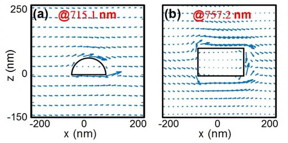 An energy flux propagates along a surface and bypasses the nanoparticle at SLR. The hemisphere shape introduces weaker perturbations than the rod shape, resulting in much lower loss and a much higher quality factor.
CREDIT
SIAT
An energy flux propagates along a surface and bypasses the nanoparticle at SLR. The hemisphere shape introduces weaker perturbations than the rod shape, resulting in much lower loss and a much higher quality factor.
CREDIT
SIAT
Abstract: Plasmonic surface lattice resonances (SLRs) supported by metal nanoparticle arrays have many merits such as strong field enhancements extended over large volumes, as well as long lifetimes, narrow linewidths, angle-dependent dispersion, and a wide range of wavelength tunability.
Beijing, China | Posted on August 28th, 2020
This study was published in Nature Photonics on August 10.
To reach atomic resolution with light has always been one of the ultimate goals in nano-optics. The advent of scanning near-field optical microscopy (SNOM) kindled hopes for the goal.
Prof. DONG and his colleagues successfully demonstrated sub-nanometer scale spatial resolution in the single-molecule Raman spectroscopy imaging with local enhancement effect of a nanocavity plasmon field in a study in 2013.
However, unlike the Raman scattering process, fluorescence will be quenched in the very immediate vicinity of metals which stops the resolution development of SNOM at around 10 nm.
The radiation properties (fluorescence) of molecules in the metal nanocavity are directly affected by the photon density of the nanocavity , and the photon density of the nanocavity is closely related to the structure of the probe tip. Therefore, it is the key to modify the structure of the probe and the electronic state of the molecules in the nanocavity to avoid the fluorescence quenching and achieve high-resolution photofluorescence imaging.
DONG's team further fine-tuned the plasmon nanocavity, especially in the fabrication and control of the atomic-level structure of the probe tip. They constructed an Ag tip apex with an atomistic protrusion and matched the nanocavity plasmon resonance with the effective energy of the incident laser and molecular luminescence.
Then, the researchers used an ultra-thin dielectric layer (three-atom-thick NaCl) to isolate the charge transfer between the nanocavity molecules and the metal substrate, achieving sub-nanometer resolution of the single-molecule photoluminescence imaging.
They found that with the probe approaching the molecule, even if their distance is less than 1 nm, the intensity of photoluminescence continues increasing monotonously. And the fluorescence quenching disappears completely.
Theoretical simulations showed that when the atomistic protrusion tip and the metal substrate form a plasmon nanocavity, the resonance response of the nanocavity plasmon and the lightning rod effect of the atomistic protrusion structure would have a synergistic effect. The synergistic effect generates a strong and highly localized electromagnetic field compressing the cavity mode volume to below 1 nm3, which greatly increases the localized photon density of states and the molecular radiation decay rate. These effects not only inhibit the fluorescence quenching, but also realize sub-nanometer-resolution photoluminescence imaging.
To achieve sub-nanometer spatial resolution, the size of the tip and the distance between the tip and the sample must be on the sub-nanometer scale.
The researchers further realized sub-molecular-resolved photoluminescence hyperspectral imaging with spectral information, and demonstrated the effects of local plasmon-exciton interaction on fluorescence intensity, peak position and peak width on the sub-nanometer scale.
This research achieved the long-awaited goal of using light to analyze the internal structure of molecules in SNOM, and provided a new technical method for detecting and modulating the localized environment of molecules and light-matter interactions on the sub-nanometer scale.
The reviewers of Nature Photonics say that this paper will be an important article in its field, which has guiding significance for carrying out ultra-sensitive spectroscopic microscopy research with atomic-scale light.
####
For more information, please click here
Contacts:ZHANG Xiaomin
Copyright © Chinese Academy of Sciences Headquarters
If you have a comment, please Contact us.
Issuers of news releases, not 7th Wave, Inc. or Nanotechnology Now, are solely responsible for the accuracy of the content.
Bookmark:


News and information
 New technology helps reveal inner workings of human genome June 24th, 2022
Boron nitride nanotube fibers get real: Rice lab creates first heat-tolerant, stable fibers from wet-spinning process June 24th, 2022
Imaging
Snapshot measurement of single nanostructure�s circular dichroism March 25th, 2022
Better understanding superconductors with Higgs spectroscopy Prof. Stefan Kaiser from TU Dresden awarded ERC Consolidator Grant March 18th, 2022
Visualizing the invisible: New fluorescent DNA label reveals nanoscopic cancer features March 4th, 2022
Possible Futures
New technology helps reveal inner workings of human genome June 24th, 2022
Boron nitride nanotube fibers get real: Rice lab creates first heat-tolerant, stable fibers from wet-spinning process June 24th, 2022
Optical computing/Photonic computing
Photonic integrated erbium doped amplifiers reach commercial performance: Boosting light power revolutionizes communications and autopilots June 17th, 2022
Electron-phonon coupling assisted universal red luminescence of o-phenylenediamine-based CDs June 10th, 2022
Discoveries
New technology helps reveal inner workings of human genome June 24th, 2022
Boron nitride nanotube fibers get real: Rice lab creates first heat-tolerant, stable fibers from wet-spinning process June 24th, 2022
Announcements
New technology helps reveal inner workings of human genome June 24th, 2022
Boron nitride nanotube fibers get real: Rice lab creates first heat-tolerant, stable fibers from wet-spinning process June 24th, 2022
Interviews/Book Reviews/Essays/Reports/Podcasts/Journals/White papers/Posters
Quantum network nodes with warm atoms June 24th, 2022
New technology helps reveal inner workings of human genome June 24th, 2022
Tools
New technology helps reveal inner workings of human genome June 24th, 2022
Snapshot measurement of single nanostructure�s circular dichroism March 25th, 2022
Eyebrow-raising: Researchers reveal why nanowires stick to each other February 11th, 2022
JEOL Introduces New Scanning Electron Microscope with �Simple SEM� Automation and Live Elemental and 3D Analysis January 14th, 2022
Photonics/Optics/Lasers
Photonic integrated erbium doped amplifiers reach commercial performance: Boosting light power revolutionizes communications and autopilots June 17th, 2022
Marching to the Cadence of Electronics: Innovation A new paper in Nature validates technology developed by John Bowers and collaborators June 10th, 2022
