
The investigation of the temperature-dependent PL and time-resolved photoluminescence (TRPL) of NCs in the 80 to 300 K temperature range revealed a correlation between phase transition, electronic structure, and exciton dynamics. However, in contrast to the CsPbBr3 and CsPbI3 NCs, which exhibited a continuous blueshift in their bandgap with increasing temperature, the CsPbCl3 NCs exhibited a blueshift until about 193 K, followed by a redshift until they reached room temperature. The researchers attributed the change from a blueshift to a redshift to a structural phase transition in CsPbCl3, which also manifested in the temperature-dependent TRPL.
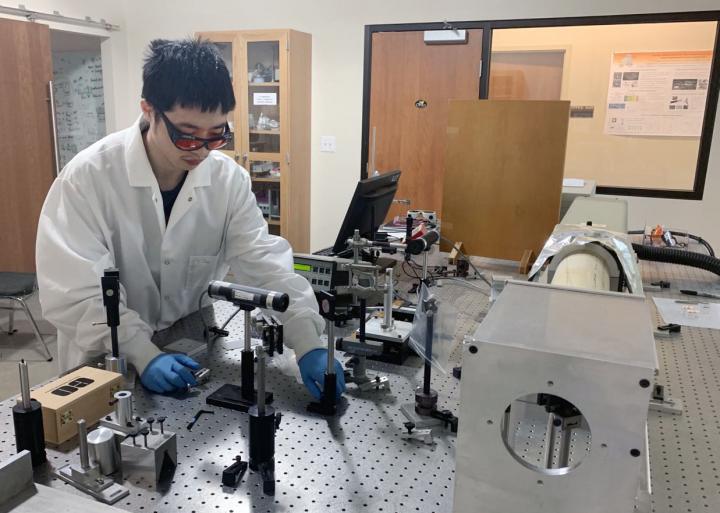 Jun Yi, a student in Clemson University's department of physics and astronomy, worked with professor Apparao Rao, researcher Exian Liu, and professor Jianbo Gao to study the correlation between the phase transition of nanocrystal perovskites and their emission properties. Courtesy of College of Science/Clemson University.
The low-temperature phase transition of CsPbCl3 at about 193 K resulted in a reverse temperature dependence of bandgap that redshifted with increasing temperature until 300 K. The researchers estimated that the pronounced phase transition in CsPbCl3 NCs was due to the condensation of their vibrational modes at low temperature, as well as the presence of the weak quantum confinement effect. The exciton recombination lifetimes showed a similar reverse trend due to the phase transition in CsPbCl3.
The research was published in Nanoscale Advances (www.doi.org/10.1039/D0NA00545B).
