
Aug 31, 2020
(Nanowerk News) The laser printers for the kitchen table are to become cheaper and smaller – and more colorful: "Instead of the CO2 lasers commonly used in the industry, we are relying on much cheaper diode lasers, such as those with lower output found in CD players," explains Dr. Bilal Gökce from Technical Chemistry I at UDE. "However, you have to be a little tricky."
Because the usual polymer powder, the raw material for printing, is white. This means that it reflects all the wavelengths of the visible light – unfortunately including those of diode lasers.
That's when the team had the idea to kill two birds with one stone: The scientists coated the powder grains with nanoparticles made of silver (Advanced Optical Materials, "Plasmonic Seasoning: Giving Color to Desktop Laser 3D Printed Polymers by Highly Dispersed Nanoparticles").
The point is: In the tiny dimensions of a millionth of a millimeter, materials often have surprising properties. For example, silver appears yellow, while nanogold is red to violet.
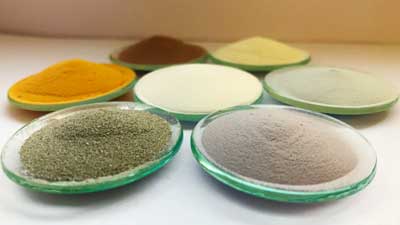 In their publication, the scientists have called it "seasoning" in a winking way and arranged the bowls accordingly: They contain the powder raw material, coated with different nanoparticles for laser-based 3D printing in various colors. (Image: Gökce, CENIDE/UDE)
In their publication, the scientists have called it "seasoning" in a winking way and arranged the bowls accordingly: They contain the powder raw material, coated with different nanoparticles for laser-based 3D printing in various colors. (Image: Gökce, CENIDE/UDE)
