
| Date | 1st, Sep 2020 |
|---|
Home > Press > Machine learning peeks into nano-aquariums
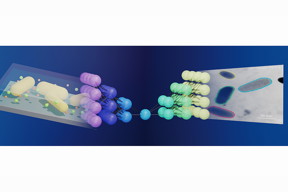 Illinois researchers have linked electron microscope imaging and machine learning, making it much easier to study nanoparticles in action. The schematic shows how a neural network, middle, works as a bridge between liquid-phase electron microscope imaging, left, and streamlined data output, right. For more information visit, pubs.acs.org/doi/10.1021/acscentsci.0c00430.
Graphic courtesy ACS and the Qian Chen group
Illinois researchers have linked electron microscope imaging and machine learning, making it much easier to study nanoparticles in action. The schematic shows how a neural network, middle, works as a bridge between liquid-phase electron microscope imaging, left, and streamlined data output, right. For more information visit, pubs.acs.org/doi/10.1021/acscentsci.0c00430.
Graphic courtesy ACS and the Qian Chen group
Abstract: In the nanoworld, tiny particles such as proteins appear to dance as they transform and assemble to perform various tasks while suspended in a liquid. Recently developed methods have made it possible to watch and record these otherwise-elusive tiny motions, and researchers now take a step forward by developing a machine learning workflow to streamline the process.
Champaign, IL | Posted on August 31st, 2020
The new study, led by Qian Chen, a professor of materials science and engineering at the University of Illinois, Urbana-Champaign, builds upon her past work with liquid-phase electron microscopy and is published in the journal ACS Central Science.
Being able to see � and record � the motions of nanoparticles is essential for understanding a variety of engineering challenges. Liquid-phase electron microscopy, which allows researchers to watch nanoparticles interact inside tiny aquariumlike sample containers, is useful for research in medicine, energy and environmental sustainability and in fabrication of metamaterials, to name a few. However, it is difficult to interpret the dataset, the researchers said. The video files produced are large, filled with temporal and spatial information, and are noisy due to background signals � in other words, they require a lot of tedious image processing and analysis.
�Developing a method even to see these particles was a huge challenge,� Chen said. �Figuring out how to efficiently get the useful data pieces from a sea of outliers and noise has become the new challenge.�
To confront this problem, the team developed a machine learning workflow that is based upon an artificial neural network that mimics, in part, the learning potency of the human brain. The program builds off of an existing neural network, known as U-Net, that does not require handcrafted features or predetermined input and has yielded significant breakthroughs in identifying irregular cellular features using other types of microscopy, the study reports.
�Our new program processed information for three types of nanoscale dynamics including motion, chemical reaction and self-assembly of nanoparticles,� said lead author and graduate student Lehan Yao. �These represent the scenarios and challenges we have encountered in the analysis of liquid-phase electron microscopy videos.�
The researchers collected measurements from approximately 300,000 pairs of interacting nanoparticles, the study reports.
Click here to see liquid-phase electron microscopy with combined machine learning in action.
As found in past studies by Chen�s group, contrast continues to be a problem while imaging certain types of nanoparticles. In their experimental work, the team used particles made out of gold, which is easy to see with an electron microscope. However, particles with lower elemental or molecular weights like proteins, plastic polymers and other organic nanoparticles show very low contrast when viewed under an electron beam, Chen said.
�Biological applications, like the search for vaccines and drugs, underscore the urgency in our push to have our technique available for imaging biomolecules,� she said. �There are critical nanoscale interactions between viruses and our immune systems, between the drugs and the immune system, and between the drug and the virus itself that must be understood. The fact that our new processing method allows us to extract information from samples as demonstrated here gets us ready for the next step of application and model systems.�
The team has made the source code for the machine learning program used in this study publicly available through the supplemental information section of the new paper. �We feel that making the code available to other researchers can benefit the whole nanomaterials research community,�Chen said.
Chen also is affiliated with chemistry, the Beckman Institute for Advanced Science and Technology and the Materials Research Laboratory at the U. of I.
The National Science Foundation and Air Force Office of Scientific Research supported this study.
####
For more information, please click here
Contacts:Qian Chen217-300-1137
Copyright © University of Illinois at Urbana-Champaign
If you have a comment, please Contact us.
Issuers of news releases, not 7th Wave, Inc. or Nanotechnology Now, are solely responsible for the accuracy of the content.
Bookmark:


News and information
 New technology helps reveal inner workings of human genome June 24th, 2022
Boron nitride nanotube fibers get real: Rice lab creates first heat-tolerant, stable fibers from wet-spinning process June 24th, 2022
Nanofabrication
First integrated laser on lithium niobate chip: Research paves the way for high-powered telecommunication systems April 8th, 2022
Atom by atom: building precise smaller nanoparticles with templates March 4th, 2022
Imaging
Snapshot measurement of single nanostructure�s circular dichroism March 25th, 2022
Better understanding superconductors with Higgs spectroscopy Prof. Stefan Kaiser from TU Dresden awarded ERC Consolidator Grant March 18th, 2022
Possible Futures
New technology helps reveal inner workings of human genome June 24th, 2022
Boron nitride nanotube fibers get real: Rice lab creates first heat-tolerant, stable fibers from wet-spinning process June 24th, 2022
Nanomedicine
New technology helps reveal inner workings of human genome June 24th, 2022
New nano-gel to protect children receiving chemotherapy from hearing loss June 17th, 2022
Discoveries
New technology helps reveal inner workings of human genome June 24th, 2022
Boron nitride nanotube fibers get real: Rice lab creates first heat-tolerant, stable fibers from wet-spinning process June 24th, 2022
Materials/Metamaterials
Nanotubes: a promising solution for advanced rubber cables with 60% less conductive filler June 1st, 2022
New route to build materials out of tiny particles May 27th, 2022
A one-stop shop for quantum sensing materials May 27th, 2022
Announcements
New technology helps reveal inner workings of human genome June 24th, 2022
Boron nitride nanotube fibers get real: Rice lab creates first heat-tolerant, stable fibers from wet-spinning process June 24th, 2022
Interviews/Book Reviews/Essays/Reports/Podcasts/Journals/White papers/Posters
Quantum network nodes with warm atoms June 24th, 2022
New technology helps reveal inner workings of human genome June 24th, 2022
Tools
New technology helps reveal inner workings of human genome June 24th, 2022
Snapshot measurement of single nanostructure�s circular dichroism March 25th, 2022
Eyebrow-raising: Researchers reveal why nanowires stick to each other February 11th, 2022
JEOL Introduces New Scanning Electron Microscope with �Simple SEM� Automation and Live Elemental and 3D Analysis January 14th, 2022
