
| Date | 5th, Sep 2020 |
|---|
Home > Press > Painting With Light: Novel Nanopillars Precisely Control the Color and Intensity of Transmitted Light
 Credit: T. Xu/Nanjing University
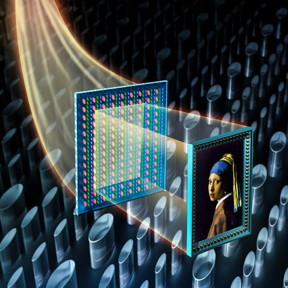
Illustration depicts a faithful reproduction of Johannes Vermeer�s �Girl With a Pearl Earring� using millions of nanopillars that control both the color and intensity of incident light.
Credit: T. Xu/Nanjing University
Illustration depicts a faithful reproduction of Johannes Vermeer�s �Girl With a Pearl Earring� using millions of nanopillars that control both the color and intensity of incident light.
Abstract: By shining white light on a glass slide stippled with millions of tiny titanium dioxide pillars, researchers at the National Institute of Standards and Technology (NIST) and their collaborators have reproduced with astonishing fidelity the luminous hues and subtle shadings of �Girl With a Pearl Earring,� Dutch artist Johannes Vermeer�s masterpiece. The approach has potential applications in improving optical communications and making currency harder to counterfeit.
Gaithersburg, MD | Posted on September 4th, 2020
For example, by adding or dropping a particular color, or wavelength, of light traveling in an optical fiber, scientists can control the amount of information carried by the fiber. By altering the intensity, researchers can maintain t the brightness of the light signal as it travels long distances in the fiber. The approach might also be used to �paint� paper money with small but intricate color details that a counterfeiter would have great difficulty forging.
Other scientists have previously used tiny pillars, or nanopillars, of varying sizes to trap and emit specific colors when illuminated with white light. The width of the nanopillars, which are about 600 nanometers in height, or less than one-hundredth the diameter of a human hair, determines the specific color of light that a pillar traps and emits. For a demanding test of such a technique, researchers examined how well the nanopillars reproduced the colors of a familiar painting, such as the Vermeer.
Although several teams of researchers had successfully arranged millions of nanopillars whose sizes were tailored to transmit red, green or blue light to create a specific palette of output colors, the scientists had no way to control the intensity of those colors. The intensity, or brightness, of colors determines an image�s light and shadow � its chiaroscuro �and enhances the ability to convey impressions of perspective and depth, a signature feature of Vermeer�s work.
Now, by fabricating nanopillars that not only trap and emit specific colors of light but also change its polarization by varying degrees, the NIST researchers and their collaborators from Nanjing University in China have for the first time demonstrated a way to control both color and intensity. The researchers, who include Amit Agrawal and Wenqi Zhu of NIST and the University of Maryland in College Park, and Henri Lezec of NIST, describe their findings in the September 20 issue of the journal Optica, posted online today.
In their new work, the NIST team fabricated on a glass slide nanopillars of titanium dioxide that had an elliptical cross section rather than a circular one. Circular objects have a single uniform diameter, but elliptical objects have a long axis and a short axis.
The researchers designed the nanopillars so that at different locations their long axis was more aligned or less aligned with the polarization of the incoming white light. (Polarized light is light whose electric field vibrates in a particular direction as it journeys across space.) If the nanopillar�s long axis was exactly aligned with the direction of polarization of the incoming light, the polarization of the transmitted light was unaffected. But if the long axis was rotated by some angle � for instance 20 degrees � relative to the direction of polarization of the incoming light, the nanopillar rotated the polarization of the incident light by twice that angle � in this case, 40 degrees.
At each location on the glass slide, the orientation of a nanopillar rotated the polarization of the red, green or blue light it transmitted by a specific amount.
By itself, the rotation imparted by each nanopillar would not in any way alter the intensity of the transmitted light. But in tandem with a special polarizing filter placed on the back of the glass slide, the team achieved that goal.
The filter was oriented so that it prevented any light that had retained its original polarization from passing through. (Sunglasses work in much the same way: The lenses act as vertically polarized filters, reducing the intensity of horizontally polarized glare.) That would be the case for any place on the glass slide where a nanopillar had left unaltered the polarization of the incident light. Such a region would project as a dark spot on a distant screen.
In places where a nanopillar had rotated the polarization of the incident white light, the filter permitted a certain amount of the red, green or blue light to pass. The amount depended on the rotation angle; the greater the angle, the greater the intensity of the transmitted light. In this way, the team, for the first time, controlled both color and brightness.
Once the NIST researchers had demonstrated the basic design, they created a digital copy of a miniature version of the Vermeer painting, about 1 millimeter long. They then used the digital information to guide the fabrication of a matrix of millions of nanopillars. The researchers represented the color and intensity of each picture element, or pixel, of the Vermeer by a group of five nanopillars � one red, two green and two blue � oriented at specific angles to the incoming light. Examining the millimeter-size image that the team had created by shining white light through the nanopillars, the researchers found that they reproduced �Girl With the Pearl Earring� with extreme clarity, even capturing the texture of oil paint on canvas.
�The quality of the reproduction, capturing the subtle color gradations and shadow details, is simply remarkable,� said NIST researcher and study co-author Agrawal. �This work quite elegantly bridges the fields of art and nanotechnology.�
To construct the nanopillars, Agrawal and his colleagues first deposited a layer of an ultrathin polymer on glass, just a few hundred nanometers thick. Using an electron beam like a miniature drill, they then excavated an array of millions of tiny holes of varying dimensions and orientations in the polymer.
Then, using a technique known as atomic layer deposition, they backfilled these holes with titanium dioxide. Finally, the team etched away all of the polymer surrounding the holes, leaving behind millions of tiny pillars of titanium dioxide. The dimension and orientation of each nanopillar represented, respectively, the hue and brightness of the final millimeter-size image.
The nanopillar technique can easily be adapted to transmit specific colors of light, with particular intensities, to communicate information through an optical fiber, or to imprint a valuable item with a miniature, multihued identification mark that would be hard to replicate.
####
For more information, please click here
Contacts:100 Bureau DriveGaithersburg, MD 20899301-975-2000https://www.nist.gov/about-nist/contact-us
Copyright © National Institute of Standards and Technology (NIST)
If you have a comment, please Contact us.
Issuers of news releases, not 7th Wave, Inc. or Nanotechnology Now, are solely responsible for the accuracy of the content.
Bookmark:


Physics
 Flexing the power of a conductive polymer: A new material holds promise for the next generation of organic electronics June 24th, 2022
Observation of fractional exclusion statistics in quantum critical matter May 27th, 2022
News and information
New technology helps reveal inner workings of human genome June 24th, 2022
Boron nitride nanotube fibers get real: Rice lab creates first heat-tolerant, stable fibers from wet-spinning process June 24th, 2022
Laboratories
University of Illinois Chicago joins Brookhaven Lab's Quantum Center June 10th, 2022
A one-stop shop for quantum sensing materials May 27th, 2022
Law enforcement/Anti-Counterfeiting/Security/Loss prevention
How randomly moving electrons can improve cyber security May 27th, 2022
Govt.-Legislation/Regulation/Funding/Policy
Solving the solar energy storage problem with rechargeable batteries that can convert and store energy at once June 24th, 2022
Boron nitride nanotube fibers get real: Rice lab creates first heat-tolerant, stable fibers from wet-spinning process June 24th, 2022
UBCO researchers change the game when it comes to activity tracking: Flexible, highly sensitive motion device created by extrusion printing June 17th, 2022
University of Illinois Chicago joins Brookhaven Lab's Quantum Center June 10th, 2022
Possible Futures
New technology helps reveal inner workings of human genome June 24th, 2022
Boron nitride nanotube fibers get real: Rice lab creates first heat-tolerant, stable fibers from wet-spinning process June 24th, 2022
Optical computing/Photonic computing
Photonic integrated erbium doped amplifiers reach commercial performance: Boosting light power revolutionizes communications and autopilots June 17th, 2022
Electron-phonon coupling assisted universal red luminescence of o-phenylenediamine-based CDs June 10th, 2022
Discoveries
New technology helps reveal inner workings of human genome June 24th, 2022
Boron nitride nanotube fibers get real: Rice lab creates first heat-tolerant, stable fibers from wet-spinning process June 24th, 2022
Materials/Metamaterials
Nanotubes: a promising solution for advanced rubber cables with 60% less conductive filler June 1st, 2022
New route to build materials out of tiny particles May 27th, 2022
A one-stop shop for quantum sensing materials May 27th, 2022
Announcements
New technology helps reveal inner workings of human genome June 24th, 2022
Boron nitride nanotube fibers get real: Rice lab creates first heat-tolerant, stable fibers from wet-spinning process June 24th, 2022
Interviews/Book Reviews/Essays/Reports/Podcasts/Journals/White papers/Posters
Quantum network nodes with warm atoms June 24th, 2022
New technology helps reveal inner workings of human genome June 24th, 2022
