
| Date | 9th, Sep 2020 |
|---|
Home > Press > Boundaries no barrier for thermoelectricity: Rice researchers find potentially useful electrical phenomenon in gold nanowires
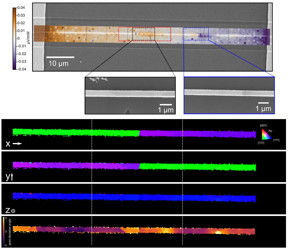 Rice University�s optical detection system reveals small structural defects in a gold nanowire that may appear to be a perfect crystal under a scanning electron microscope. The discovery has implications for making better thin-film electronic devices. (Credit: Charlotte Evans/Rice University)
Abstract: Though the Summer Olympics were postponed, there�s at least one place to see agile hurdlers go for the gold.
Houston, TX | Posted on September 8th, 2020
You just need a way to view these electron games.
Using a novel optical detection system, researchers at Rice University found that electricity generated by temperature differences doesn�t appear to be affected measurably by grain boundaries placed in its way in nanoscale gold wires, while strain and other defects in the material can change this �thermoelectric� response.
The phenomenon could allow for the detection of crystalline defects in conducting materials that are difficult to spot and characterize with even the most advanced microscopic methods.
The result was a surprise to researchers led by Rice physicist Doug Natelson and doctoral alumna Charlotte Evans, now a staff scientist at Sandia National Laboratories, who pursued the explanation after seeing measurements they couldn�t explain a few years ago.
�A lot of times, people think about the thermoelectric effect when they�re building solar panels or generating power from this or that,� Evans said. �We argue instead that the thermoelectric effect is a really interesting diagnostic tool.�
The study appears in the Proceedings of the National Academy of Sciences.
Grain boundaries are the planes in materials where misaligned crystals meet, forcing atoms along the edge to adjust as they bind to their neighbors. Measurements in bi-crystal gold nanowires produced by the group of Stanford University electrical engineer and co-author Jonathan Fan showed no detectable effect on thermoelectric voltages at the grain boundary. The electrons in the metal simply ignored the single grain boundary.
Temperature differences in conductors create thermoelectricity through the Seebeck effect, one type of thermoelectric effect. This effect is commonly used to measure temperature differences and to control thermostats. The Natelson lab triggered the Seebeck effect by heating one portion of Fan�s wires with a tightly controlled laser, driving electrons to move from the hot location toward colder regions, and produced a voltage to be measured. No measurable change in the voltage was seen when the laser was moved across the grain boundary in the bi-crystals.
When the laser was moved across parts of the same wires that were deformed, with distortions in the crystal lattice throughout the wire, changes in the voltage became apparent, Natelson said. Annealing the distorted devices partly healed the defects, resulting in clear changes in the thermoelectric current.
�There's a community of people who play around with improving thermoelectric response,� Natelson said. �They need to be aware that structural issues like very small distortions to the lattice have effects that are not necessarily small. People tend to ignore these tiny structural issues, but anytime you're making thin-film devices, there�s baked-in stress and strain in the material, just because of the way it's made.�
Evans said nanoscale crystals are often characterized via electron backscatter diffraction (EBSD), an expensive and time-consuming process. �The benefit of our process is its simplicity,� she said. �We use a large spot size from a laser, two microns, which is much larger than the size of an e-beam, and we can detect variations using just a lock-in technique, a scanning laser and a voltage amplifier.
�If you look at the plain EBSD data, it looks as though you have a pristine crystal,� she said. �And it's not until you post-process the data and look at how each pixel varies from the next that you would see small distortions along the length of the wire. It�s complicated to detect. That's why it's so remarkable that we could detect these little variations with a laser.�
�So if you want to do something clever and exploit the thermoelectric response, you need to understand the devices you�re making with standard, top-down fabrication methods,� Natelson said. �The stress and strain and what seemed like minor structural imperfections can have an easily detectable influence.�
Stanford alumnus Rui Yang and graduate student Lucia Gan are co-lead authors of the paper. Co-authors are graduate students Mahdiyeh Abbasi and Xifan Wang of Rice and postdoctoral researcher Rachel Traylor of Stanford. Natelson is department chair and a professor of physics and astronomy and a professor of electrical and computer engineering and of materials science and nanoengineering.
The Robert A. Welch Foundation, the National Science Foundation, the Air Force Office of Scientific Research Multidisciplinary University Research Initiative and the Packard Fellowship Foundation supported the research.
####
About Rice UniversityLocated on a 300-acre forested campus in Houston, Rice University is consistently ranked among the nation�s top 20 universities by U.S. News & World Report. Rice has highly respected schools of Architecture, Business, Continuing Studies, Engineering, Humanities, Music, Natural Sciences and Social Sciences and is home to the Baker Institute for Public Policy. With 3,962 undergraduates and 3,027 graduate students, Rice�s undergraduate student-to-faculty ratio is just under 6-to-1. Its residential college system builds close-knit communities and lifelong friendships, just one reason why Rice is ranked No. 1 for lots of race/class interaction and No. 1 for quality of life by the Princeton Review. Rice is also rated as a best value among private universities by Kiplinger�s Personal Finance.
Follow Rice News and Media Relations via Twitter @RiceUNews.
For more information, please click here
Contacts:Jeff Falk713-348-6775
Mike Williams713-348-6728
Copyright © Rice University
If you have a comment, please Contact us.
Issuers of news releases, not 7th Wave, Inc. or Nanotechnology Now, are solely responsible for the accuracy of the content.
Bookmark:


 Rice Department of Physics and Astronomy:
Wiess School of Natural Sciences:
News and information
New technology helps reveal inner workings of human genome June 24th, 2022
Boron nitride nanotube fibers get real: Rice lab creates first heat-tolerant, stable fibers from wet-spinning process June 24th, 2022
Laboratories
University of Illinois Chicago joins Brookhaven Lab's Quantum Center June 10th, 2022
A one-stop shop for quantum sensing materials May 27th, 2022
Imaging
Snapshot measurement of single nanostructure�s circular dichroism March 25th, 2022
Better understanding superconductors with Higgs spectroscopy Prof. Stefan Kaiser from TU Dresden awarded ERC Consolidator Grant March 18th, 2022
Visualizing the invisible: New fluorescent DNA label reveals nanoscopic cancer features March 4th, 2022
Govt.-Legislation/Regulation/Funding/Policy
Solving the solar energy storage problem with rechargeable batteries that can convert and store energy at once June 24th, 2022
Boron nitride nanotube fibers get real: Rice lab creates first heat-tolerant, stable fibers from wet-spinning process June 24th, 2022
UBCO researchers change the game when it comes to activity tracking: Flexible, highly sensitive motion device created by extrusion printing June 17th, 2022
University of Illinois Chicago joins Brookhaven Lab's Quantum Center June 10th, 2022
Possible Futures
New technology helps reveal inner workings of human genome June 24th, 2022
Boron nitride nanotube fibers get real: Rice lab creates first heat-tolerant, stable fibers from wet-spinning process June 24th, 2022
Discoveries
New technology helps reveal inner workings of human genome June 24th, 2022
Boron nitride nanotube fibers get real: Rice lab creates first heat-tolerant, stable fibers from wet-spinning process June 24th, 2022
Materials/Metamaterials
Nanotubes: a promising solution for advanced rubber cables with 60% less conductive filler June 1st, 2022
New route to build materials out of tiny particles May 27th, 2022
A one-stop shop for quantum sensing materials May 27th, 2022
Announcements
New technology helps reveal inner workings of human genome June 24th, 2022
Boron nitride nanotube fibers get real: Rice lab creates first heat-tolerant, stable fibers from wet-spinning process June 24th, 2022
Military
Boron nitride nanotube fibers get real: Rice lab creates first heat-tolerant, stable fibers from wet-spinning process June 24th, 2022
Bumps could smooth quantum investigations: Rice University models show unique properties of 2D materials stressed by contoured substrates June 10th, 2022
Nanostructured fibers can impersonate human muscles June 3rd, 2022
Lightening up the nanoscale long-wavelength optoelectronics May 13th, 2022
Battery Technology/Capacitors/Generators/Piezoelectrics/Thermoelectrics/Energy storage
Solving the solar energy storage problem with rechargeable batteries that can convert and store energy at once June 24th, 2022
OCSiAl expands its graphene nanotube production capacities to Europe June 17th, 2022
Engineering piezoelectricity and strain sensitivity in CdS to promote piezocatalytic hydrogen evolution May 13th, 2022
Grants/Sponsored Research/Awards/Scholarships/Gifts/Contests/Honors/Records
Solving the solar energy storage problem with rechargeable batteries that can convert and store energy at once June 24th, 2022
Boron nitride nanotube fibers get real: Rice lab creates first heat-tolerant, stable fibers from wet-spinning process June 24th, 2022
Research partnerships
New technology helps reveal inner workings of human genome June 24th, 2022
Boron nitride nanotube fibers get real: Rice lab creates first heat-tolerant, stable fibers from wet-spinning process June 24th, 2022
