
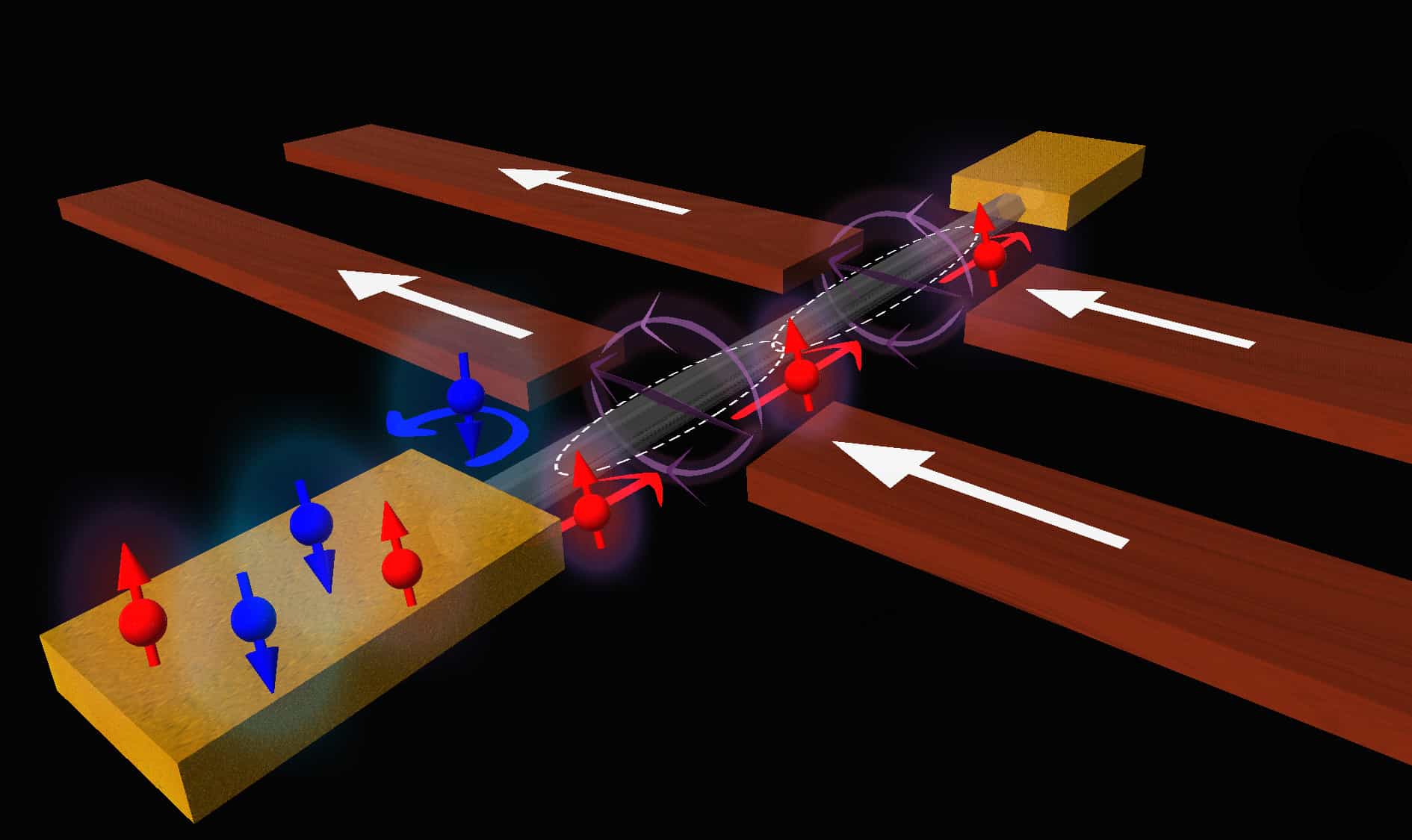
 Spin device: in this diagram of the spin valve the nanowire runs between a source and drain (both shown in gold) and the locations of the two quantum dots on the nanowire are denoted by the dashed ellipses. The brown bars are nanomagnets and the white arrows show their magnetizations. In this example, spin-up electrons can travel across the nanowire whilst spin-down electrons cannot. (Courtesy: University of Basel Department of Physics)
Researchers in Switzerland and Italy have developed a method for generating currents of electrons with a known quantum spin without the need for large external magnetic fields. This could enable the development of devices that are compatible with superconducting electronic elements, paving the way for the next generation of highly efficient electronics.
Following the discovery of giant magnetoresistance as well as the observation of spin injection and detection in metals in the late 1980s, a field of research known as “spintronics” emerged dedicated to creating practical devices that exploit electron spin. Semiconductor-based spintronics systems have garnered particular research interest because semiconductors can be integrated within modern-day electronics, thus improving the efficiency and storage capacity of devices. But in order to make useful spintronics devices, researchers need to be able to control and detect the spin state of electrons with a high level of accuracy.
Controlling electron spin
One method for controlling the electron spin current is a device known as the “spin valve”, which usually consists of a non-magnetic material sandwiched between ferromagnetic materials. This material configuration allows electrons with one spin to propagate through the device, while the opposite spin is reflected or scattered away. This occurs because spin propagation depends on the alignment of the magnetic moments in the ferromagnet. Thus, a “spin polarized current” is produced. This is a flow of electrons that, in theory, all are in a set spin state (all spin-up or all spin-down).
