
Sep 16, 2020
(Nanowerk News) The eyes of many insects, including the fruit fly, are covered by a thin and transparent coating made up of tiny protuberances with anti-reflective, anti-adhesive properties. An article published in the journal Nature ("Reverse and forward engineering of Drosophila corneal nanocoatings") reveals the secrets of how this nano-coating is made.
The authors, from the University of Geneva (UNIGE) and University of Lausanne (UNIL) – together with ETH Zurich (ETHZ) – show that the coating only consists of two ingredients: a protein called retinin and corneal wax. These two components automatically generate the regular network of protuberances by playing the roles of activator and inhibitor, respectively, in a morphogenesis process modelled in the 1950s by Alan Turing.
The multi-disciplinary team even succeeded in artificially reproducing the phenomenon by mixing retinin and wax on different kinds of surface. This process, which is very inexpensive and is based on biodegradable materials, was used to obtain nano-coatings with a morphology similar to that of insects, with anti-adhesive and anti-reflective functionalities that could have numerous applications in areas as diverse as contact lenses, medical implants and textiles.
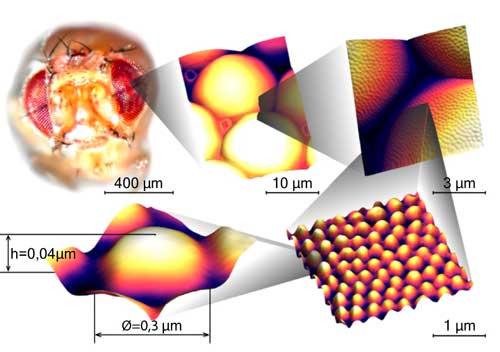 Successive enlargements of a fly’s eye. The eye is made up of many facets, which are themselves covered by a thin layer of protuberances a few tens of nanometres high. 1 micrometer (um) = 1000 nanometers (nm). (Image: Vladimir Katanaev) (click on image to enlarge)
“The nano-coating that covers the surface of the eyes of some insects was discovered in the late 1960s in moths,” begins Vladimir Katanaev, a professor in the Department of Cell Physiology and Metabolism in UNIGE’s Faculty of Medicine and the study’s lead investigator. “It’s made up of a dense network of small protrusions about 200 nanometres in diameter and several dozens of nanometres in height. It has the effect of reducing light reflection.”
The cornea of an insect without a coating typically reflects about 4% of the incident light, whereas the proportion drops to zero in insects that do have the covering. Although an improvement of 4% may seem small, it is enough of an advantage – especially in dark conditions – to have been selected during evolution. Thanks to its anti-adhesive properties, the coating also provides physical protection against the tiniest dust particles in the air.
Professor Katanaev moved into this research field ten years ago. In 2011, he and his team were the first to discover the nano-coating on the eyes of fruit flies (Drosophila melanogaster). This insect is much more suited to scientific research than moths, in particular because its genome has been completely sequenced.
Successive enlargements of a fly’s eye. The eye is made up of many facets, which are themselves covered by a thin layer of protuberances a few tens of nanometres high. 1 micrometer (um) = 1000 nanometers (nm). (Image: Vladimir Katanaev) (click on image to enlarge)
“The nano-coating that covers the surface of the eyes of some insects was discovered in the late 1960s in moths,” begins Vladimir Katanaev, a professor in the Department of Cell Physiology and Metabolism in UNIGE’s Faculty of Medicine and the study’s lead investigator. “It’s made up of a dense network of small protrusions about 200 nanometres in diameter and several dozens of nanometres in height. It has the effect of reducing light reflection.”
The cornea of an insect without a coating typically reflects about 4% of the incident light, whereas the proportion drops to zero in insects that do have the covering. Although an improvement of 4% may seem small, it is enough of an advantage – especially in dark conditions – to have been selected during evolution. Thanks to its anti-adhesive properties, the coating also provides physical protection against the tiniest dust particles in the air.
Professor Katanaev moved into this research field ten years ago. In 2011, he and his team were the first to discover the nano-coating on the eyes of fruit flies (Drosophila melanogaster). This insect is much more suited to scientific research than moths, in particular because its genome has been completely sequenced.
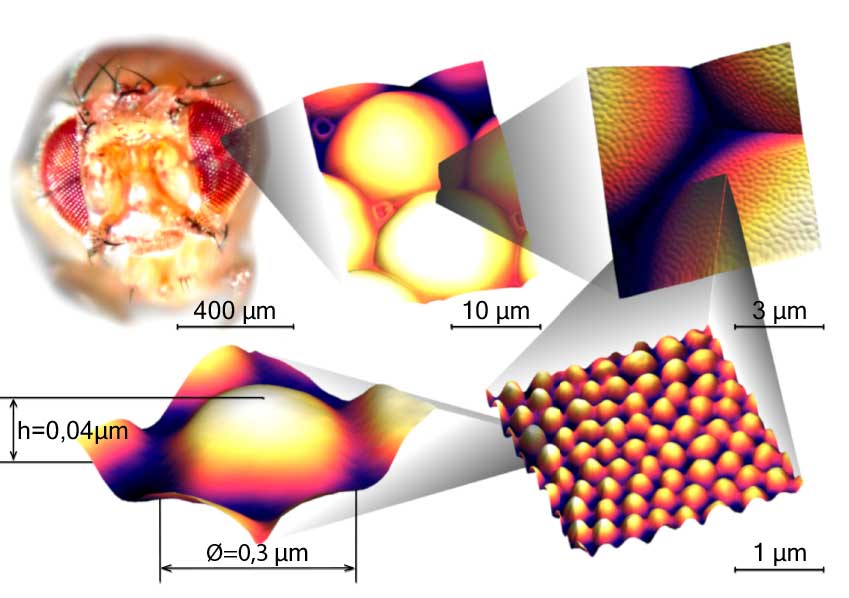 Successive enlargements of a fly’s eye. The eye is made up of many facets, which are themselves covered by a thin layer of protuberances a few tens of nanometres high. 1 micrometer (um) = 1000 nanometers (nm). (Image: Vladimir Katanaev) (click on image to enlarge)
“The nano-coating that covers the surface of the eyes of some insects was discovered in the late 1960s in moths,” begins Vladimir Katanaev, a professor in the Department of Cell Physiology and Metabolism in UNIGE’s Faculty of Medicine and the study’s lead investigator. “It’s made up of a dense network of small protrusions about 200 nanometres in diameter and several dozens of nanometres in height. It has the effect of reducing light reflection.”
The cornea of an insect without a coating typically reflects about 4% of the incident light, whereas the proportion drops to zero in insects that do have the covering. Although an improvement of 4% may seem small, it is enough of an advantage – especially in dark conditions – to have been selected during evolution. Thanks to its anti-adhesive properties, the coating also provides physical protection against the tiniest dust particles in the air.
Professor Katanaev moved into this research field ten years ago. In 2011, he and his team were the first to discover the nano-coating on the eyes of fruit flies (Drosophila melanogaster). This insect is much more suited to scientific research than moths, in particular because its genome has been completely sequenced.
Successive enlargements of a fly’s eye. The eye is made up of many facets, which are themselves covered by a thin layer of protuberances a few tens of nanometres high. 1 micrometer (um) = 1000 nanometers (nm). (Image: Vladimir Katanaev) (click on image to enlarge)
“The nano-coating that covers the surface of the eyes of some insects was discovered in the late 1960s in moths,” begins Vladimir Katanaev, a professor in the Department of Cell Physiology and Metabolism in UNIGE’s Faculty of Medicine and the study’s lead investigator. “It’s made up of a dense network of small protrusions about 200 nanometres in diameter and several dozens of nanometres in height. It has the effect of reducing light reflection.”
The cornea of an insect without a coating typically reflects about 4% of the incident light, whereas the proportion drops to zero in insects that do have the covering. Although an improvement of 4% may seem small, it is enough of an advantage – especially in dark conditions – to have been selected during evolution. Thanks to its anti-adhesive properties, the coating also provides physical protection against the tiniest dust particles in the air.
Professor Katanaev moved into this research field ten years ago. In 2011, he and his team were the first to discover the nano-coating on the eyes of fruit flies (Drosophila melanogaster). This insect is much more suited to scientific research than moths, in particular because its genome has been completely sequenced.
