
| Date | 19th, Sep 2020 |
|---|
Home > Press > Shape matters for light-activated nanocatalysts - Study: Pointed tips on aluminum 'octopods' increase catalytic reactivity
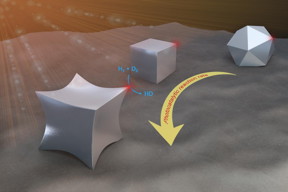 A study of aluminum nanocatalysts by Rice University's Laboratory for Nanophotonics found that octopods (left), six-sided particles with sharply pointed corners, had a reaction rate five times higher than nanocubes (center) and 10 times higher than 14-sided nanocrystals.
CREDIT
Image courtesy of Lin Yuan/Rice University
A study of aluminum nanocatalysts by Rice University's Laboratory for Nanophotonics found that octopods (left), six-sided particles with sharply pointed corners, had a reaction rate five times higher than nanocubes (center) and 10 times higher than 14-sided nanocrystals.
CREDIT
Image courtesy of Lin Yuan/Rice University
Abstract: Points matter when designing nanoparticles that drive important chemical reactions using the power of light.
Houston, TX | Posted on September 18th, 2020
Researchers at Rice University's Laboratory for Nanophotonics (LANP) have long known that a nanoparticle's shape affects how it interacts with light, and their latest study shows how shape affects a particle's ability to use light to catalyze important chemical reactions.
In a comparative study, LANP graduate students Lin Yuan and Minhan Lou and their colleagues studied aluminum nanoparticles with identical optical properties but different shapes. The most rounded had 14 sides and 24 blunt points. Another was cube-shaped, with six sides and eight 90-degree corners. The third, which the team dubbed "octopod," also had six sides, but each of its eight corners ended in a pointed tip.
All three varieties have the ability to capture energy from light and release it periodically in the form of super-energetic hot electrons that can speed up catalytic reactions. Yuan, a chemist in the research group of LANP director Naomi Halas, conducted experiments to see how well each of the particles performed as photocatalysts for hydrogen dissociation reaction. The tests showed octopods had a 10 times higher reaction rate than the 14-sided nanocrystals and five times higher than the nanocubes. Octopods also had a lower apparent activation energy, about 45% lower than nanocubes and 49% lower than nanocrystals.
"The experiments demonstrated that sharper corners increased efficiencies," said Yuan, co-lead author of the study, which is published in the American Chemical Society journal ACS Nano. "For the octopods, the angle of the corners is about 60 degrees, compared to 90 degrees for the cubes and more rounded points on the nanocrystals. So the smaller the angle, the greater the increase in reaction efficiencies. But how small the angle can be is limited by chemical synthesis. These are single crystals that prefer certain structures. You cannot make infinitely more sharpness."
Lou, a physicist and study co-lead author in the research group of LANP's Peter Nordlander, verified the results of the catalytic experiments by developing a theoretical model of the hot electron energy transfer process between the light-activated aluminum nanoparticles and hydrogen molecules.
"We input the wavelength of light and particle shape," Lou said. "Using these two aspects, we can accurately predict which shape will produce the best catalyst."
The work is part of an ongoing green chemistry effort by LANP to develop commercially viable light-activated nanocatalysts that can insert energy into chemical reactions with surgical precision. LANP has previously demonstrated catalysts for ethylene and syngas production, the splitting of ammonia to produce hydrogen fuel and for breaking apart "forever chemicals."
"This study shows that photocatalyst shape is another design element engineers can use to create photocatalysts with the higher reaction rates and lower activation barriers," said Halas, Rice's Stanley C. Moore Professor of Electrical and Computer Engineering, director of Rice's Smalley-Curl Institute and a professor of chemistry, bioengineering, physics and astronomy, and materials science and nanoengineering.
###
Nordlander is the Wiess Chair and Professor of Physics and Astronomy, and professor of electrical and computer engineering, and materials science and nanoengineering.
Additional study co-authors include Benjamin Clark, Minghe Lou, Linan Zhou, Shu Tian and Christian Jacobson, all of Rice. The research was supported by the Welch Foundation (C-1220, C-1222), the Air Force Office of Scientific Research (FA9550-15-1-0022), the Defense Threat Reduction Agency (HDTRA 1-16-1-0042) and the Department of Defense National Defense Science & Engineering Graduate Fellowship Program.
####
About Rice UniversityLocated on a 300-acre forested campus in Houston, Rice University is consistently ranked among the nation's top 20 universities by U.S. News & World Report. Rice has highly respected schools of Architecture, Business, Continuing Studies, Engineering, Humanities, Music, Natural Sciences and Social Sciences and is home to the Baker Institute for Public Policy. With 3,978 undergraduates and 3,192 graduate students, Rice's undergraduate student-to-faculty ratio is just under 6-to-1. Its residential college system builds close-knit communities and lifelong friendships, just one reason why Rice is ranked No. 1 for lots of race/class interaction and No. 1 for quality of life by the Princeton Review. Rice is also rated as a best value among private universities by Kiplinger's Personal Finance.
Follow Rice News and Media Relations via Twitter @RiceUNews.
Contacts:Jade Boyd
713-348-6778
@RiceUNews
Copyright © Rice University
If you have a comment, please Contact us.
Issuers of news releases, not 7th Wave, Inc. or Nanotechnology Now, are solely responsible for the accuracy of the content.
Bookmark:


 The DOI of the ACS Nano paper is: 10.1021/acsnano.0c05383
News and information
New technology helps reveal inner workings of human genome June 24th, 2022
Boron nitride nanotube fibers get real: Rice lab creates first heat-tolerant, stable fibers from wet-spinning process June 24th, 2022
Chemistry
Nanoscale chemically ordered-disordered domains in Fe3Pt alloys and their three-dimensional interface and lattice strain May 27th, 2022
Flexible quantum sieve made at TU Dresden filters the fuel of Starship Enterprise April 15th, 2022
Govt.-Legislation/Regulation/Funding/Policy
Solving the solar energy storage problem with rechargeable batteries that can convert and store energy at once June 24th, 2022
Boron nitride nanotube fibers get real: Rice lab creates first heat-tolerant, stable fibers from wet-spinning process June 24th, 2022
UBCO researchers change the game when it comes to activity tracking: Flexible, highly sensitive motion device created by extrusion printing June 17th, 2022
University of Illinois Chicago joins Brookhaven Lab's Quantum Center June 10th, 2022
Possible Futures
New technology helps reveal inner workings of human genome June 24th, 2022
Boron nitride nanotube fibers get real: Rice lab creates first heat-tolerant, stable fibers from wet-spinning process June 24th, 2022
Discoveries
New technology helps reveal inner workings of human genome June 24th, 2022
Boron nitride nanotube fibers get real: Rice lab creates first heat-tolerant, stable fibers from wet-spinning process June 24th, 2022
Announcements
New technology helps reveal inner workings of human genome June 24th, 2022
Boron nitride nanotube fibers get real: Rice lab creates first heat-tolerant, stable fibers from wet-spinning process June 24th, 2022
Interviews/Book Reviews/Essays/Reports/Podcasts/Journals/White papers/Posters
Quantum network nodes with warm atoms June 24th, 2022
New technology helps reveal inner workings of human genome June 24th, 2022
Military
Boron nitride nanotube fibers get real: Rice lab creates first heat-tolerant, stable fibers from wet-spinning process June 24th, 2022
Bumps could smooth quantum investigations: Rice University models show unique properties of 2D materials stressed by contoured substrates June 10th, 2022
Nanostructured fibers can impersonate human muscles June 3rd, 2022
Lightening up the nanoscale long-wavelength optoelectronics May 13th, 2022
Grants/Sponsored Research/Awards/Scholarships/Gifts/Contests/Honors/Records
Solving the solar energy storage problem with rechargeable batteries that can convert and store energy at once June 24th, 2022
Boron nitride nanotube fibers get real: Rice lab creates first heat-tolerant, stable fibers from wet-spinning process June 24th, 2022
