
| Date | 26th, Sep 2020 |
|---|
Home > Press > Secure nano-carrier delivers medications directly to cells:Nanoparticles with synthetic DNA can control release of active agents
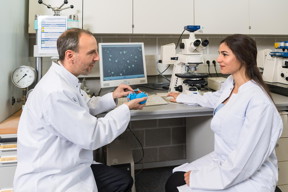 Prof. Oliver Lieleg and Ceren Kimna are conducting research on nanoparticles that release drugs precisely into the affected cells.
CREDIT
Uli Benz / TUM
Prof. Oliver Lieleg and Ceren Kimna are conducting research on nanoparticles that release drugs precisely into the affected cells.
CREDIT
Uli Benz / TUM
Munich, Germany | Posted on September 25th, 2020
The human body is made up of billions of cells. In the case of cancer, the genome of several of these cells is changed pathologically so that the cells divide in an uncontrolled manner. The cause of virus infections is also found within the affected cells. During chemotherapy for example, drugs are used to try to destroy these cells. However, the therapy impacts the entire body, damaging healthy cells as well and resulting in side effects which are sometimes quite serious.
A team of researchers led by Prof. Oliver Lieleg, Professor of Biomechanics and a member of the TUM Munich School of BioEngineering, and Prof. Thomas Crouzier of the KTH has developed a transport system which releases the active agents of medications in affected cells only. "The drug carriers are accepted by all the cells," Lieleg explains. "But only the diseased cells should be able to trigger the release of the active agent."
Synthetic DNA keeps the drug carriers closed
The scientists have now shown that the mechanism functions in tumor model systems based on cell cultures. First they packaged the active ingredients. For this purpose, they used so-called mucins, the main ingredient of the mucus found for example on the mucus membranes of the mouth, stomach and intestines. Mucins consist of a protein background to which sugar molecules are docked. "Since mucins occur naturally in the body, opened mucin particles can later be broken down by the cells," Lieleg says.
Another important part of the package also occurs naturally in the body: deoxyribonucleic acid (DNA), the carrier of our genetic information. The researchers synthetically created DNA structures with the properties they desired and chemically bonded these structures to the mucins. If glycerol is now added to the solution containing the mucin DNA molecules and the active ingredient, the solubility of the mucins decreases, they fold up and enclose the active agent. The DNA strands bond to one another and thus stabilize the structure so that the mucins can no longer unfold themselves.
The lock to the key
The DNA-stabilized particles can only be opened by the right "key" in order to once again release the encapsulated active agent molecules. Here the researchers use what are called microRNA molecules. RNA or ribonucleic acid has a structure very similar to that of DNA and plays a major role in the body's synthesis of proteins; it can also regulate other cell processes.
"Cancer cells contain microRNA strands whose structure we know precisely," explains Ceren Kimna, lead author of the study. "In order to use them as keys, we modified the lock accordingly by meticulously designing the synthetic DNA strands which stabilize our medication carrier particles." The DNA strands are structured in such a way that the microRNA can bind to them and as a result break down the existing bonds which are stabilizing the structure. The synthetic DNA strands in the particles can also be adapted to microRNA structures which occur with other diseases such as diabetes or hepatitis.
The clinical application of the new mechanism has not yet been tested; additional laboratory investigations with more complex tumor model systems are necessary first. The researchers also plan to investigate further modifying this mechanism to release active agents in order to improve existing cancer therapies.
####
For more information, please click here
Contacts:Stefanie Reiffert
49-089-289-10519
@TU_Muenchen
Prof. Dr. Oliver LielegTechnical University of MunichProfessorship of Biomechanics089/289-10952
Copyright © Technical University of Munich (TUM)
If you have a comment, please Contact us.
Issuers of news releases, not 7th Wave, Inc. or Nanotechnology Now, are solely responsible for the accuracy of the content.
Bookmark:


Cancer
 New technology helps reveal inner workings of human genome June 24th, 2022
News and information
New technology helps reveal inner workings of human genome June 24th, 2022
Boron nitride nanotube fibers get real: Rice lab creates first heat-tolerant, stable fibers from wet-spinning process June 24th, 2022
Possible Futures
New technology helps reveal inner workings of human genome June 24th, 2022
Boron nitride nanotube fibers get real: Rice lab creates first heat-tolerant, stable fibers from wet-spinning process June 24th, 2022
Nanomedicine
New technology helps reveal inner workings of human genome June 24th, 2022
New nano-gel to protect children receiving chemotherapy from hearing loss June 17th, 2022
Discoveries
New technology helps reveal inner workings of human genome June 24th, 2022
Boron nitride nanotube fibers get real: Rice lab creates first heat-tolerant, stable fibers from wet-spinning process June 24th, 2022
Announcements
New technology helps reveal inner workings of human genome June 24th, 2022
Boron nitride nanotube fibers get real: Rice lab creates first heat-tolerant, stable fibers from wet-spinning process June 24th, 2022
Interviews/Book Reviews/Essays/Reports/Podcasts/Journals/White papers/Posters
Quantum network nodes with warm atoms June 24th, 2022
New technology helps reveal inner workings of human genome June 24th, 2022
Nanobiotechnology
New technology helps reveal inner workings of human genome June 24th, 2022
New nano-gel to protect children receiving chemotherapy from hearing loss June 17th, 2022
