
| Date | 26th, Sep 2020 |
|---|
Home > Press > Spin clean-up method brings practical quantum computers closer to reality: Osaka City University develops a quantum algorithm that removes pesky spin contaminants from chemical calculations on quantum computers
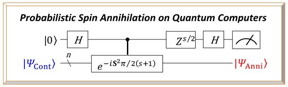 If the measurement outcome in the quantum circuit is the |0? state, the spin contaminated wave function |?Cont? is projected out onto the spin annihilated one |?Anni?. The rightmost part of the top line denotes the measurement.
CREDIT
Kenji Sugisaki, Kazunobu Sato and Takeji Takui, Osaka City University
If the measurement outcome in the quantum circuit is the |0? state, the spin contaminated wave function |?Cont? is projected out onto the spin annihilated one |?Anni?. The rightmost part of the top line denotes the measurement.
CREDIT
Kenji Sugisaki, Kazunobu Sato and Takeji Takui, Osaka City University
Abstract: Quantum computers are the new frontier in advanced research technology, with potential applications such as performing critical calculations, protecting financial assets, or predicting molecular behavior in pharmaceuticals. Researchers from Osaka City University have now solved a major problem hindering large-scale quantum computers from practical use: precise and accurate predictions of atomic and molecular behavior.
Osaka, Japan | Posted on September 25th, 2020
They published their method to remove extraneous information from quantum chemical calculations on Sept. 17 as an advanced online article in Physical Chemistry Chemical Physics, a journal of the Royal Society of Chemistry.
"One of the most anticipated applications of quantum computers is electronic structure simulations of atoms and molecules," said paper authors Kenji Sugisaki, Lecturer and Takeji Takui, Professor Emeritus in the Department of Chemistry and Molecular Materials Science in Osaka City University's Graduate School of Science.
Quantum chemical calculations are ubiquitous across scientific disciplines, including pharmaceutical therapy development and materials research. All of the calculations are based on solving physicist Erwin Schr�dinger's equation, which uses electronic and molecular interactions that result in a particular property to describe the state of a quantum-mechanical system.
"Schr�dinger equations govern any behavior of electrons in molecules, including all chemical properties of molecules and materials, including chemical reactions," Sugisaki and Takui said.
On classical computers, such precise equations would take exponential time. On quantum computers, this precision is possible in realistic time, but it requires "cleaning" during the calculations to obtain the true nature of the system, according to them.
A quantum system at a specific moment in time, known as a wave function, has a property described as spin, which is the total of the spin of each electron in the system. Due to hardware faults or mathematical errors, there may be incorrect spins informing the system's spin calculation. To remove these 'spin contaminants,' the researchers implemented an algorithm that allows them to select the desired spin quantum number. This purifies the spin, removing contaminants during each calculation--a first on quantum computers, according to them.
"Quantum chemical calculations based on exactly solving Schr�dinger equations for any behavior of atoms and molecules can afford predictions of their physical-chemical properties and complete interpretations on chemical reactions and processes," they said, noting that this is not possible with currently available classical computers and algorithms. "The present paper has given a solution by implementing a quantum algorithm on quantum computers."
The researchers next plan to develop and implement algorithms designed to determine the state of electrons in molecules with the same accuracy for both excited- or ground-state electrons.
###
Other contributors include Kazuo Toyota, Kazunobu Sato and Daisuke Shiomi, all of whom are affiliated with the Department of Chemistry and Molecular Materials Science in Osaka City University's Graduate School of Science. Sugisaki is also affiliated with the Japan Science and Technology Agency's PRESTO Project, "Quantum Software." Takui is also a University Research Administrator in the Research Support Department/University Research Administrator Center of Osaka City University.
####
About Osaka City UniversityWe are Osaka City University - the oldest research university in Osaka. With 9 undergraduate faculties and 11 graduate schools all dedicated to making urban life better, energy cleaner, and people healthier and happier, we have won numerous awards and have produced 2 Nobel laureates. For more information, please visit our website at https://www.osaka-cu.ac.jp/en
For more information, please click here
Contacts:James Gracey
81-666-053-454
@OCU_PR
Copyright © Osaka City University
If you have a comment, please Contact us.
Issuers of news releases, not 7th Wave, Inc. or Nanotechnology Now, are solely responsible for the accuracy of the content.
Bookmark:


Quantum Physics
 Quantum network nodes with warm atoms June 24th, 2022
News and information
New technology helps reveal inner workings of human genome June 24th, 2022
Boron nitride nanotube fibers get real: Rice lab creates first heat-tolerant, stable fibers from wet-spinning process June 24th, 2022
Possible Futures
New technology helps reveal inner workings of human genome June 24th, 2022
Boron nitride nanotube fibers get real: Rice lab creates first heat-tolerant, stable fibers from wet-spinning process June 24th, 2022
Quantum Computing
University of Illinois Chicago joins Brookhaven Lab's Quantum Center June 10th, 2022
Bumps could smooth quantum investigations: Rice University models show unique properties of 2D materials stressed by contoured substrates June 10th, 2022
Discoveries
New technology helps reveal inner workings of human genome June 24th, 2022
Boron nitride nanotube fibers get real: Rice lab creates first heat-tolerant, stable fibers from wet-spinning process June 24th, 2022
Announcements
New technology helps reveal inner workings of human genome June 24th, 2022
Boron nitride nanotube fibers get real: Rice lab creates first heat-tolerant, stable fibers from wet-spinning process June 24th, 2022
Interviews/Book Reviews/Essays/Reports/Podcasts/Journals/White papers/Posters
Quantum network nodes with warm atoms June 24th, 2022
New technology helps reveal inner workings of human genome June 24th, 2022
Quantum nanoscience
Bumps could smooth quantum investigations: Rice University models show unique properties of 2D materials stressed by contoured substrates June 10th, 2022
UCI scientists turn a hydrogen molecule into a quantum sensor: New technique enables precise measurement of electrostatic properties of materials April 22nd, 2022
