
“A concept for creating controllable ultrastrong coupling at room temperature in relatively simple systems can offer a testbed for fundamental physics,” said Timur Shegai, associate professor at Chalmers and an author of the paper introducing the work. “The fact that this ultrastrong coupling ‘costs’ energy could lead to observable effects; for example, it could modify the reactivity of chemicals or tailor van der Waals interactions. Ultrastrong coupling enables a variety of intriguing physical phenomena.
“We are still not entirely sure what is the limit of coupling in our system, but it is clearly much higher than we see now. Importantly, the platform that allows studying ultrastrong coupling is now accessible at room temperature.”
On a surface 100× times smaller than the end of a human hair, the researchers showed that it is possible to create controllable ultrastrong interaction between light and matter at ambient conditions — more specifically, room temperature and ambient atmospheric pressure.
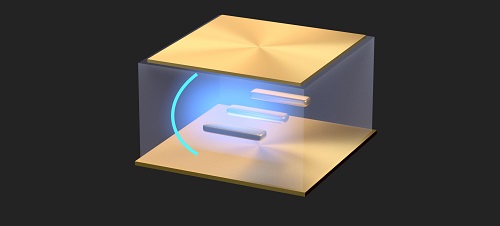
The system the researchers developed is somewhat analogous to a resonator, in this case represented by two gold mirrors separated by a few hundred nanometers, as a single tone in music. The nanorods fabricated between the mirrors affect how light moves between the mirrors and change their resonance frequency. Instead of sounding like a single tone, in the couple system, the tone splits into two: a lower pitch and a higher pitch.
The energy separation between the two new pitches represents the strength of interaction. Specifically in the ultrastrong coupling case, the strength of the interaction is great enough that it becomes comparable to the frequency of the original resonator. The interaction causes light and matter to intertwine into a single object, forming quasiparticles known as polaritons, which possess unique optical and electronic properties.
The number of gold nanorods sandwiched between the mirrors determines how strong the interaction is, but at the same time it controls the so-called zero-point energy of the system. In increasing or decreasing the number of rods, it is possible to supply or remove energy from the ground state of the system and thereby increase or decrease the energy stored in the resonator box.
By looking at the light transmission spectra through the mirrors and performing simple mathematics, the researchers indirectly measured how the number of nanorods changed the vacuum energy. The resulting values turned out to be comparable to the thermal energy, which may lead to observable phenomena in the future.
The research was published in Nature Communications (www.doi.org/10.1038/s41467-020-16524-x).
