
| Date | 1st, Oct 2020 |
|---|
Home > Press > The most sensitive and fastest graphene microwave bolometer
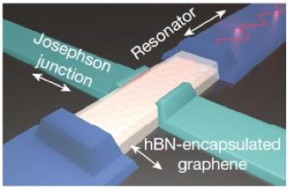 Schematics of the device, which consists of a graphene Josephson junction, which is integrated into a microwave circuit.
CREDIT
harvard-icfo-mit-bbntechnologies-nims
Schematics of the device, which consists of a graphene Josephson junction, which is integrated into a microwave circuit.
CREDIT
harvard-icfo-mit-bbntechnologies-nims
Abstract: Bolometers are devices that measure the power of incident electromagnetic radiation thru the heating of materials, which exhibit a temperature-electric resistance dependence. These instruments are among the most sensitive detectors so far used for infrared radiation detection and are key tools for applications that range from advanced thermal imaging, night vision, infrared spectroscopy to observational astronomy, to name a few.
Barcelona, Spain | Posted on September 30th, 2020
Even though they have proven to be excellent sensors for this specific range of radiation, the challenge lies in attaining high sensitivity, fast response time and strong light absorption, which not always are accomplished all together. Many studies have been conducted to obtain these higher-sensitivity bolometers by searching to reduce the size of the detector and thus increase the thermal response, and in doing so, they have found that graphene seems to be an excellent candidate for this.
If we focus on the infrared range, several experiments have demonstrated that if you take a sheet of graphene and place it in between two layers of superconducting material to create a Josephson junction, you can obtain a single photon detector device. At low temperatures, and in the absence of photons, a superconducting current flows through the device. When a single infrared photon passes through the detector, the heat it generates is enough to warm up the graphene, which alters the Josephson junction such that no superconducting current can flow. So you can actually detect the photons that are passing through the device by measuring the current. This can be done basically because graphene has an almost negligible electronic heat capacity. This means that, contrary to materials that retain heat like water, in the case of graphene a single low-energy photon can heat the detector enough to block the superconducting current, and then dissipate quickly, allowing the detector to rapidly reset, and thus achieving very fast time responses and high sensitivities.
Trying to take a step further and move to higher wavelengths, in a recent study published in Nature, a team of scientists which includes ICFO researcher Dmitri Efetov, together with colleagues from Harvard University, Raytheon BBN Technologies, MIT, and the National Institute for Material Sciences, has been able to develop a graphene-based bolometer that can detect microwave photons at extremely high sensitivities and with fast time responses.
Just like with the infrared range, the team took a sheet of graphene and placed it in between two layers of superconducting material to create a Josephson junction. This time, they went an entirely new route and attached a microwave resonator to generate the microwave photons and by passing these photons through the device, were able to reach an unprecedented detection levels. In particular, they were able to detect single photons with a much lower energy resolution, equivalent to that of a single 32 Ghz photon, and achieve detection readouts 100.000 times faster than the fastest nanowire bolometers constructed so far.
The results achieved in this study mean a major breakthrough in the field of bolometers. Not only has graphene proven to be an ideal material for infrared sensing and imaging, but it has also proven to span to higher wavelengths, reaching the microwave, where it has also shown to attain extremely high sensitivities and ultra-fast read out times.
As Prof. at ICFO Dmitri Efetov comments "such achievements were thought impossible with traditional materials, and graphene did the trick again. This open entirely new avenues for quantum sensors for quantum computation and quantum communication".
####
About ICFO-The Institute of Photonic SciencesICFO was founded by the Government of Catalonia and the Universitat Polit�cnica de Catalunya (UPC), both of which are members of its board of trustees along with the Cellex and Mir-Puig Foundations, philanthropic entities that have played a critical role in the advancement of the institute. Located in the Mediterranean Technology Park in the metropolitan area of Barcelona, the institute currently hosts 400 people, organized in 25 research groups in 60 state-of-the-art research laboratories. Research lines encompass diverse areas in which photonics plays a decisive role, with an emphasis on basic and applied themes relevant to medicine and biology, advanced imaging techniques, information technologies, a range of environmental sensors, tunable and ultra-fast lasers, quantum science, photovoltaics and the properties and applications of nano-materials such as graphene, among others. In addition to three state awarded Severo Ochoa accreditations of excellence, ICFOnians have secured 15 ICREA Professorships and 37 European Research Council grants. ICFO is proactive in fostering entrepreneurial activities, spin-off creation, and creating collaborations and links between industry and ICFO researchers. To date, ICFO has helped create 8 start-up companies.
For more information, please click here
Contacts:Alina Hirschmann
0034-935-542-246
Copyright © ICFO-The Institute of Photonic Sciences
If you have a comment, please Contact us.
Issuers of news releases, not 7th Wave, Inc. or Nanotechnology Now, are solely responsible for the accuracy of the content.
Bookmark:


Quantum communication
 Quantum network nodes with warm atoms June 24th, 2022
Quantum Physics
Quantum network nodes with warm atoms June 24th, 2022
University of Illinois Chicago joins Brookhaven Lab's Quantum Center June 10th, 2022
Bumps could smooth quantum investigations: Rice University models show unique properties of 2D materials stressed by contoured substrates June 10th, 2022
News and information
New technology helps reveal inner workings of human genome June 24th, 2022
Boron nitride nanotube fibers get real: Rice lab creates first heat-tolerant, stable fibers from wet-spinning process June 24th, 2022
Graphene/ Graphite
OCSiAl expands its graphene nanotube production capacities to Europe June 17th, 2022
Bumps could smooth quantum investigations: Rice University models show unique properties of 2D materials stressed by contoured substrates June 10th, 2022
Possible Futures
New technology helps reveal inner workings of human genome June 24th, 2022
Boron nitride nanotube fibers get real: Rice lab creates first heat-tolerant, stable fibers from wet-spinning process June 24th, 2022
Quantum Computing
University of Illinois Chicago joins Brookhaven Lab's Quantum Center June 10th, 2022
Bumps could smooth quantum investigations: Rice University models show unique properties of 2D materials stressed by contoured substrates June 10th, 2022
Sensors
Photonic integrated erbium doped amplifiers reach commercial performance: Boosting light power revolutionizes communications and autopilots June 17th, 2022
A one-stop shop for quantum sensing materials May 27th, 2022
New nanomechanical oscillators with record-low loss May 13th, 2022
Discoveries
New technology helps reveal inner workings of human genome June 24th, 2022
Boron nitride nanotube fibers get real: Rice lab creates first heat-tolerant, stable fibers from wet-spinning process June 24th, 2022
Materials/Metamaterials
Nanotubes: a promising solution for advanced rubber cables with 60% less conductive filler June 1st, 2022
New route to build materials out of tiny particles May 27th, 2022
A one-stop shop for quantum sensing materials May 27th, 2022
Announcements
New technology helps reveal inner workings of human genome June 24th, 2022
Boron nitride nanotube fibers get real: Rice lab creates first heat-tolerant, stable fibers from wet-spinning process June 24th, 2022
Interviews/Book Reviews/Essays/Reports/Podcasts/Journals/White papers/Posters
Quantum network nodes with warm atoms June 24th, 2022
New technology helps reveal inner workings of human genome June 24th, 2022
Quantum nanoscience
Bumps could smooth quantum investigations: Rice University models show unique properties of 2D materials stressed by contoured substrates June 10th, 2022
UCI scientists turn a hydrogen molecule into a quantum sensor: New technique enables precise measurement of electrostatic properties of materials April 22nd, 2022
