
| Date | 13th, Oct 2020 |
|---|
Home > Press > Surface waves can help nanostructured devices keep their cool
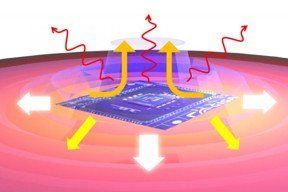 A research team led by the Institute of Industrial Science, the University of Tokyo finds that hybrid surface waves called surface phonon-polaritons can conduct heat away from nanoscale material structures
CREDIT
Institute of Industrial Science, the University of Tokyo
A research team led by the Institute of Industrial Science, the University of Tokyo finds that hybrid surface waves called surface phonon-polaritons can conduct heat away from nanoscale material structures
CREDIT
Institute of Industrial Science, the University of Tokyo
Abstract: The continuing progress in miniaturization of silicon microelectronic and photonic devices is causing cooling of the device structures to become increasingly challenging. Conventional heat transport in bulk materials is dominated by acoustic phonons, which are quasiparticles that represent the material's lattice vibrations, similar to the way that photons represent light waves. Unfortunately, this type of cooling is reaching its limits in these tiny structures.
Tokyo, Japan | Posted on October 12th, 2020
However, surface effects become dominant as the materials in nanostructured devices become thinner, which means that surface waves may provide the thermal transport solution required. Surface phonon-polaritons (SPhPs) - hybrid waves composed of surface electromagnetic waves and optical phonons that propagate along the surfaces of dielectric membranes - have shown particular promise, and a team led by researchers from the Institute of Industrial Science, the University of Tokyo has now demonstrated and verified the thermal conductivity enhancements provided by these waves.
"We generated SPhPs on silicon nitride membranes with various thicknesses and measured the thermal conductivities of these membranes over wide temperature ranges," says lead author of the study Yunhui Wu. "This allowed us to establish the specific contributions of the SPhPs to the improved thermal conductivity observed in the thinner membranes."
The team observed that the thermal conductivity of membranes with thicknesses of 50 nm or less actually doubled when the temperature increased from 300 K to 800 K (approximately 27�C to 527�C). In contrast, the conductivity of a 200-nm-thick membrane decreased over the same temperature range because the acoustic phonons still dominated at that thickness.
"Measurements showed that the dielectric function of silicon nitride did not change greatly over the experimental temperature range, which meant that the observed thermal enhancements could be attributed to the action of the SPhPs," explains the Institute of Industrial Science's Masahiro Nomura, senior author of the study. "The SPhP propagation length along the membrane interface increases when the membrane thickness decreases, which allows SPhPs to conduct much more thermal energy than acoustic phonons when using these very thin membranes."
The new cooling channel provided by the SPhPs can thus compensate for the reduced phonon thermal conductivity that occurs in nanostructured materials. SPhPs are thus expected to find applications in thermal management of silicon-based microelectronic and photonic devices.
####
For more information, please click here
Contacts:Masahiro Nomura
81-354-526-303
Copyright © Institute of Industrial Science, the University of Tokyo
If you have a comment, please Contact us.
Issuers of news releases, not 7th Wave, Inc. or Nanotechnology Now, are solely responsible for the accuracy of the content.
Bookmark:


Physics
 Flexing the power of a conductive polymer: A new material holds promise for the next generation of organic electronics June 24th, 2022
News and information
New technology helps reveal inner workings of human genome June 24th, 2022
Boron nitride nanotube fibers get real: Rice lab creates first heat-tolerant, stable fibers from wet-spinning process June 24th, 2022
Chip Technology
Boron nitride nanotube fibers get real: Rice lab creates first heat-tolerant, stable fibers from wet-spinning process June 24th, 2022
Controlled synthesis of crystal flakes paves path for advanced future electronics June 17th, 2022
Optical computing/Photonic computing
Photonic integrated erbium doped amplifiers reach commercial performance: Boosting light power revolutionizes communications and autopilots June 17th, 2022
Electron-phonon coupling assisted universal red luminescence of o-phenylenediamine-based CDs June 10th, 2022
Discoveries
New technology helps reveal inner workings of human genome June 24th, 2022
Boron nitride nanotube fibers get real: Rice lab creates first heat-tolerant, stable fibers from wet-spinning process June 24th, 2022
Announcements
New technology helps reveal inner workings of human genome June 24th, 2022
Boron nitride nanotube fibers get real: Rice lab creates first heat-tolerant, stable fibers from wet-spinning process June 24th, 2022
Interviews/Book Reviews/Essays/Reports/Podcasts/Journals/White papers/Posters
Quantum network nodes with warm atoms June 24th, 2022
New technology helps reveal inner workings of human genome June 24th, 2022
Photonics/Optics/Lasers
Photonic integrated erbium doped amplifiers reach commercial performance: Boosting light power revolutionizes communications and autopilots June 17th, 2022
Marching to the Cadence of Electronics: Innovation A new paper in Nature validates technology developed by John Bowers and collaborators June 10th, 2022
