
The photon emitter is based on a common 2D semiconductor material (tungsten disulfide, WS2), which the researchers grew on a graphene sheet. To facilitate photon emission, the material has a sulfur atom removed from its crystal structure. That imperfection serves as a point where the application of an electric current can generate the photon.
Through simulations and experimentation, the team determined exactly where to introduce an imperfection to the structure. Then, using the gold-coated tip of a scanning tunneling microscope, an electron is injected into the defect. When the electron travels from the probe tip, a well-defined portion of its energy transforms into a single photon. Finally, the probe tip acts as an antenna that helps guide the emitted photon to an optical detector that records its wavelength and position.
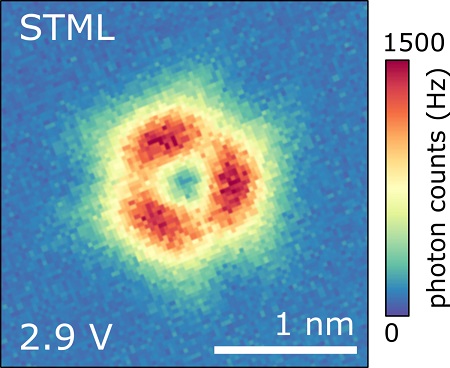
“In terms of technique, this work has been a great breakthrough because we can map light emission from a single defect with subnanometer resolution. We visualize light emission with atomic resolution,” said Katherine Cochrane, a postdoctoral researcher at the Molecular Foundry in the Lawrence Berkeley National Laboratory and lead author on the research paper.
Historically, the challenge in developing single-photon-emitting technology hasn’t been how to generate a single photon, but how to make them identical and to produce them on demand. Photon-emitting devices such as the quantum dots used in QLED TVs are fabricated through lithography and thus subject to inherent variability.
The research provides strategy for making groups of perfectly identical photons, and the researchers intend to work on employing new materials to uses as photon sources in quantum networks and simulations.
“The demonstration of electrically driven single-photon emission at a precise point constitutes a big step in the quest for integrable quantum technologies,” said Alex Weber-Bargioni, a staff scientist at Berkeley Lab’s Molecular Foundry who led the project.
The research was published in Science Advances (http://dx.doi.org/10.1126/sciadv.abb5988).
