
| Date | 14th, Oct 2020 |
|---|
Home > Press > Controlling the speed of enzyme motors brings biomedical applications of nanorobots closer: Recent advances in this field have made micro- and nanomotors promising devices for solving many biomedical problems
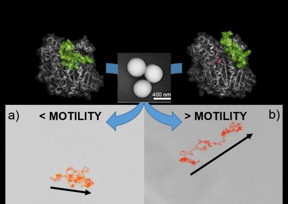 a) Trajectory of an enzyme-powered nanomotor prepared with lipase in a closed conformation and without controlled orientation during immobilization on the silicon nanoparticle surface. b) Trajectory of an enzyme-powered nanomotor prepared with lipase in an open conformation and with controlled orientation during immobilization on the silicon nanoparticle Surface. The central panel shows a scanning electron microscopy image of nanomotors like those used in the experiment.
CREDIT
CNIC/ IBEC
a) Trajectory of an enzyme-powered nanomotor prepared with lipase in a closed conformation and without controlled orientation during immobilization on the silicon nanoparticle surface. b) Trajectory of an enzyme-powered nanomotor prepared with lipase in an open conformation and with controlled orientation during immobilization on the silicon nanoparticle Surface. The central panel shows a scanning electron microscopy image of nanomotors like those used in the experiment.
CREDIT
CNIC/ IBEC
Abstract: A study by scientists at the Centro Nacional de Investigaciones Cardiovasculares (CNIC), the Universidad Complutense (UCM), Universidad de Girona (UdG), and the Institute for Bioengineering of Catalonia (IBEC), working together with other international centers, has overcome one of the key hurdles to the use of nanorobots powered by lipases, enzymes that play essential roles in digestion by breaking down fats in foods so that they can be absorbed.
Madrid, Spain | Posted on October 13th, 2020
The study was coordinated by Marco Filice of the CNIC Microscopy and Dynamic Imaging Unit--part of the ReDIB Infraestructura Cient�fico T�cnica Singular (ICTS)--, professor at Pharmacy Faculty (UCM) and ICREA Research Professor Samuel S�nchez of the IBEC. The article, published in the journal Angewandte Chemie International Edition, describes a tool for modulating motors powered by enzymes, broadening their potential biomedical and environmental applications.
Microorganisms are able to swim through complex environments, respond to their surroundings, and organize themselves autonomously. Inspired by these abilities, over the past 20 years scientists have managed to artificially replicate these tiny swimmers, first at the macro-micro scale and then at the nano scale, finding applications in environmental remediation and biomedicine.
"The speed, load-bearing capacity, and ease of surface functionalization of micro and nanomotors has seen recent research advances convert these devices into promising instruments for solving many biomedical problems. However, a key challenge to the wider use of these nanorobots is choosing an appropriate motor to propel them," explained S�nchez.
Over the past 5 years, the IBEC group has pioneered the use of enzymes to generate the propulsive force for nanomotors. "Bio-catalytic nanomotors use biological enzymes to convert chemical energy into mechanical force, and this approach has sparked great interest in the field, with urease, catalase, and glucose oxidase among the most frequent choices to power these tiny engines," said S�nchez.
The CNIC group is a leader in the structural manipulation and immobilization of lipase enzymes on the surface of different nanomaterials. Lipases make excellent nanomotor components because their catalytic mechanism involves major conformational changes between an open, active form and a closed,
"In this project, we investigated the effect of modulating the catalytic activity of lipase enzymes to propel silicon-based nanoparticles," explained Filice.
In addition to the 3-dimensional conformation of the enzyme, the team also investigated how controlling the orientation of the enzyme during its immobilization on the nanomotor surface affects its catalytic activity and therefore the propulsion of the nanorobots.
The researchers chemically modified the surface of silicon nanoparticles to generate three specific combinations of lipase conformations and orientations during immobilization: 1) open conformation plus controlled orientation; 2) closed conformation plus uncontrolled orientation; 3) a situation intermediate between 1 and 2.
The team analyzed the three types of nanorobot with spectroscopic techniques, assays to assess catalytic parameters related to enzyme activity, Dynamic Molecular simulations (performed by Professor Silvia Osuna's team at UdG), and direct tracking of individual nanomotor trajectories by microscopy techniques. "The results demonstrate that combining an open enzyme conformation with a specific orientation on the nanomotor is critical to achieving controlled propulsion."
####
For more information, please click here
Contacts:F�tima Lois
34-639-282-477
@CNIC_CARDIO
Copyright © Centro Nacional de Investigaciones Cardiovasculares
If you have a comment, please Contact us.
Issuers of news releases, not 7th Wave, Inc. or Nanotechnology Now, are solely responsible for the accuracy of the content.
Bookmark:


News and information
 New technology helps reveal inner workings of human genome June 24th, 2022
Boron nitride nanotube fibers get real: Rice lab creates first heat-tolerant, stable fibers from wet-spinning process June 24th, 2022
Robotics
Nanostructured fibers can impersonate human muscles June 3rd, 2022
Imaging
Snapshot measurement of single nanostructure�s circular dichroism March 25th, 2022
Better understanding superconductors with Higgs spectroscopy Prof. Stefan Kaiser from TU Dresden awarded ERC Consolidator Grant March 18th, 2022
Visualizing the invisible: New fluorescent DNA label reveals nanoscopic cancer features March 4th, 2022
Possible Futures
New technology helps reveal inner workings of human genome June 24th, 2022
Boron nitride nanotube fibers get real: Rice lab creates first heat-tolerant, stable fibers from wet-spinning process June 24th, 2022
Molecular Machines
Nanotech scientists create world's smallest origami bird March 17th, 2021
Giant nanomachine aids the immune system: Theoretical chemistry August 28th, 2020
Kavli Lectures: The art of building small and innovating for industrial impact August 7th, 2020
Molecular Nanotechnology
Nanotech scientists create world's smallest origami bird March 17th, 2021
Light-controlled nanomachine controls catalysis: A molecular motor enables the speed of chemical processes to be controlled using light impulses November 23rd, 2020
DNA origami to scale-up molecular motors June 13th, 2019
Big energy savings for tiny machines May 24th, 2019
Nanomedicine
New technology helps reveal inner workings of human genome June 24th, 2022
New nano-gel to protect children receiving chemotherapy from hearing loss June 17th, 2022
Discoveries
New technology helps reveal inner workings of human genome June 24th, 2022
Boron nitride nanotube fibers get real: Rice lab creates first heat-tolerant, stable fibers from wet-spinning process June 24th, 2022
Announcements
New technology helps reveal inner workings of human genome June 24th, 2022
Boron nitride nanotube fibers get real: Rice lab creates first heat-tolerant, stable fibers from wet-spinning process June 24th, 2022
Interviews/Book Reviews/Essays/Reports/Podcasts/Journals/White papers/Posters
Quantum network nodes with warm atoms June 24th, 2022
New technology helps reveal inner workings of human genome June 24th, 2022
Tools
New technology helps reveal inner workings of human genome June 24th, 2022
Snapshot measurement of single nanostructure�s circular dichroism March 25th, 2022
Eyebrow-raising: Researchers reveal why nanowires stick to each other February 11th, 2022
JEOL Introduces New Scanning Electron Microscope with �Simple SEM� Automation and Live Elemental and 3D Analysis January 14th, 2022
Nanobiotechnology
New technology helps reveal inner workings of human genome June 24th, 2022
New nano-gel to protect children receiving chemotherapy from hearing loss June 17th, 2022
