
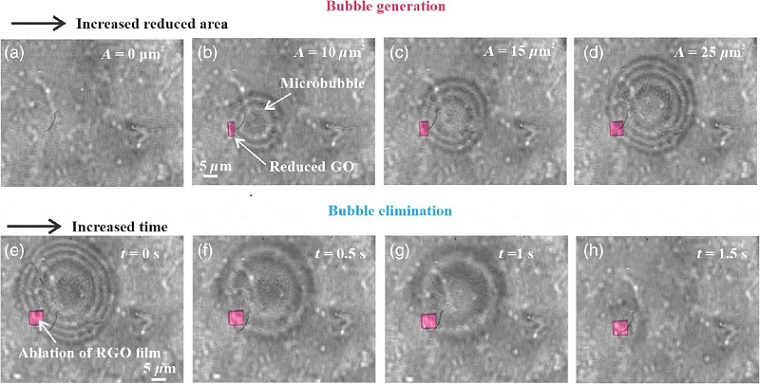
The researchers used a graphene film enriched with oxygen functional groups and, because gases are unable to penetrate through graphene oxide materials, laser light to locally irradiate the film to generate gases. The gases encapsulate inside the film to form microbubbles, resembling miniature balloons. The laser effectively controlled the positions of the microbubbles and aided in the researchers’ ability to systematically create and eliminate specific numbers of the structures at will. By irradiating the area and power in the system, the researchers were also able to control the amount of gases present — necessary to achieving high precision.
Accordingly, the manufactured bubbles themselves were of a high physical quality, supporting their amenability to highly precise applications with advanced optoelectronic and micromechanical devices. Microbubbles are 1 to 50 µm in diameter and have previously been applied as actuators in lab-on-a-chip microfluidic mixing devices and in optical resonators, DNA trapping, and photonics lithography.
Microbubbles with controllable volume and curvature are essential in photonics especially, in applications such as imaging and trapping, said Baohua Jia, professor and founding director of the Centre for Translational Atomaterials at Swinburne University of Technology.
Jia was joined by researchers from National University of Singapore, University of Melbourne, Rutgers University, and Monash University.
The lens additionally focused light at different wavelengths at the same focal point without chromatic aberration. The researchers showed this feature via a demonstration of a focused ultrabroadband white light, spanning the visible to near-infrared range and maintaining the same performance. In addition to microscopy, particularly compact microscopy, the demonstration showed potential for use in high-resolution spectroscopy.
Related to the role and functionality of the materials involved in the development, Jia said the work establishes a pathway for the integration of graphene microbubbles as nanophotonic components, in miniaturized lab-on-a-chip devices, and in applications in medical imaging.
The research was published in Advanced Photonics (www.doi.org/10.1117/1.AP.2.5.055001).
