
According to an article published in the Geochemical Perspectives Letters journal, low pressure and temperature geological processes that occur on Earth can promote the formation of natural diamonds.
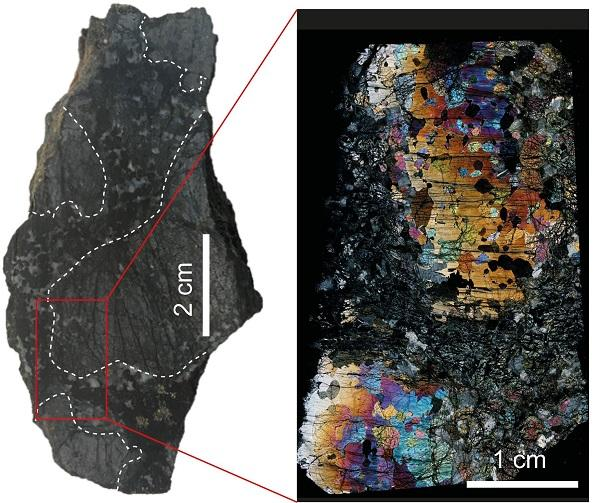 The fluid inclusions inside the olivine contain nanodiamonds, apart from serpentine, magnetite, metallic silicon, and pure methane. Image Credit: University of Barcelona.
The study confirms the newly discovered mechanism, which is far from the traditional one with respect to the formation of diamonds under extremely high pressures. The study involved specialists from the Mineral Resources Research Group of the Faculty of Earth Sciences from the University of Barcelona (UB).
Others who participated in the research work are specialists from the UB’s Institute of Nanoscience and Nanotechnology (IN2UB), the University of Granada (UGR), the Andalusian Institute of Earth Sciences (IACT), the Institute of Ceramics and Glass (CSIC), and the National Autonomous University of Mexico (UNAM).
The study was performed as part of the doctoral thesis carried out by Núria Pujol-Solà (UB), a researcher and the study’s first author, under the guidance of scientists Joaquín A. Proenza from UB and Antonio García-Casco from UGR.
Diamond: The Toughest of All Minerals
Diamond (taken from the Greek word Adamas, which means “invincible”) is a symbol of richness and luxury. It is the most priceless gem and the strongest mineral (with a value of 10 on the Mohs scale).
Diamond constitutes of chemically pure carbon, and as per the classic hypothesis, this mineral crystallizes the cubic system under very high-pressure conditions at significant depths in the mantle of the Earth.
For the first time, the study has confirmed that natural diamonds form under low pressures in the oceanic rocks present in the Moa-Baracoa Ophiolitic Massif in Cuba. This significant geological structure is located in the north-eastern part of the island and is formed by the representative rocks of the Oceanic lithosphere—that is, ophiolites.
Such oceanic rocks appeared on the continental edge of North America at the time of the collision of the Caribbean oceanic island arch that occurred between 40 and 70 million years ago.
“During its formation in the abysmal marine seafloors, in the cretaceous period -about 120 million years ago-, these oceanic rocks underwent mineral alterations due to marine water infiltrations, a process that led to small fluid inclusions inside the olivine, the most common mineral in this kind of rock,” stated Proenza, a member of the Department of Mineralogy, Petrology and Applied Geology at the UB, and García-Casco from the Department of Mineralogy and Petrology at the UGR.
Proenza is also the principal researcher of the project in which the latest article featured.
These fluid inclusions contain nanodiamonds -of about 200 and 300 nanometres-, apart from serpentine, magnetite, metallic silicon and pure methane. All these materials have formed under low pressure (
