
Oct 22, 2020
(Nanowerk News) Effects at the interface between magnetic and non-magnetic layers have been exploited for data storage for three decades. This has led to a steady increase in hard drive storage capacity and is one reason why researchers see potential for ushering data processing into a new era. One way these interfaces can be produced is using ion beams.
Scientists led by Dr. Alina Maria Deac from the Helmholtz-Zentrum Dresden-Rossendorf (HZDR) have now shown the exact processes taking place. Their results, published in the journal Applied Materials and Interfaces ("Ion-Irradiation-Induced Cobalt/Cobalt Oxide Heterostructures: Printing 3D Interfaces"), could advance the development of powerful neuromorphic computers.
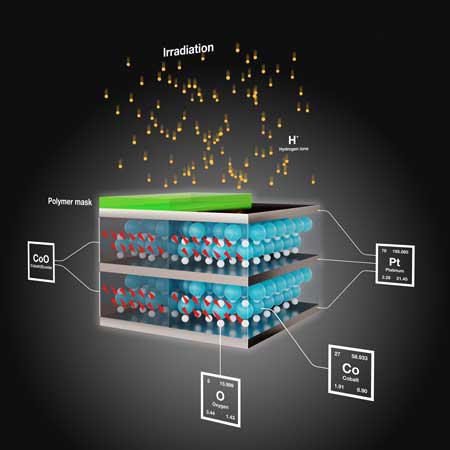 Generation of three-dimensional nanostructures with ion beams. (Image: HZDR/Juniks) (click on image to enlarge)
Spintronics is considered a promising field of research for smaller, more powerful and economical hardware. While the electric charge is the main focus in conventional semiconductor electronics, the magnetic moment of the electrons is of decisive importance in spintronics. It has been known for several years that such nanostructures, which consist of magnetic and non-magnetic layers, can be produced using ion beams.
Non-magnetic cobalt oxide, for example, when bombarded with ions, converts to ferromagnetic cobalt. Thus, by introducing multilayers of non-magnetic cobalt oxide and platinum, ion irradiation yields structures where magnetic and non-magnetic layers alternate. Various effects occur at the interfaces between these layers, which are only a few nanometers thick. These effects are essential for magnetic data storage and transmission and could considerably improve these aspects.
Generation of three-dimensional nanostructures with ion beams. (Image: HZDR/Juniks) (click on image to enlarge)
Spintronics is considered a promising field of research for smaller, more powerful and economical hardware. While the electric charge is the main focus in conventional semiconductor electronics, the magnetic moment of the electrons is of decisive importance in spintronics. It has been known for several years that such nanostructures, which consist of magnetic and non-magnetic layers, can be produced using ion beams.
Non-magnetic cobalt oxide, for example, when bombarded with ions, converts to ferromagnetic cobalt. Thus, by introducing multilayers of non-magnetic cobalt oxide and platinum, ion irradiation yields structures where magnetic and non-magnetic layers alternate. Various effects occur at the interfaces between these layers, which are only a few nanometers thick. These effects are essential for magnetic data storage and transmission and could considerably improve these aspects.
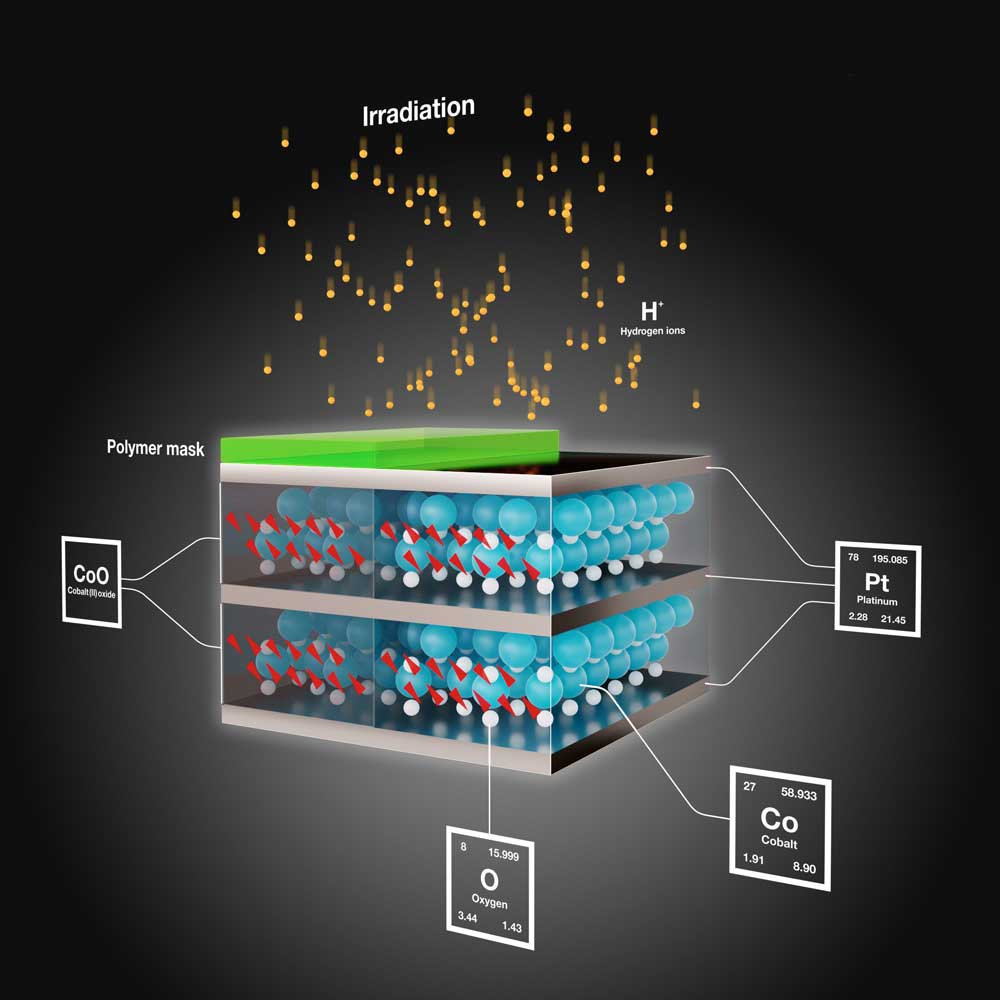 Generation of three-dimensional nanostructures with ion beams. (Image: HZDR/Juniks) (click on image to enlarge)
Spintronics is considered a promising field of research for smaller, more powerful and economical hardware. While the electric charge is the main focus in conventional semiconductor electronics, the magnetic moment of the electrons is of decisive importance in spintronics. It has been known for several years that such nanostructures, which consist of magnetic and non-magnetic layers, can be produced using ion beams.
Non-magnetic cobalt oxide, for example, when bombarded with ions, converts to ferromagnetic cobalt. Thus, by introducing multilayers of non-magnetic cobalt oxide and platinum, ion irradiation yields structures where magnetic and non-magnetic layers alternate. Various effects occur at the interfaces between these layers, which are only a few nanometers thick. These effects are essential for magnetic data storage and transmission and could considerably improve these aspects.
Generation of three-dimensional nanostructures with ion beams. (Image: HZDR/Juniks) (click on image to enlarge)
Spintronics is considered a promising field of research for smaller, more powerful and economical hardware. While the electric charge is the main focus in conventional semiconductor electronics, the magnetic moment of the electrons is of decisive importance in spintronics. It has been known for several years that such nanostructures, which consist of magnetic and non-magnetic layers, can be produced using ion beams.
Non-magnetic cobalt oxide, for example, when bombarded with ions, converts to ferromagnetic cobalt. Thus, by introducing multilayers of non-magnetic cobalt oxide and platinum, ion irradiation yields structures where magnetic and non-magnetic layers alternate. Various effects occur at the interfaces between these layers, which are only a few nanometers thick. These effects are essential for magnetic data storage and transmission and could considerably improve these aspects.
