
| Date | 24th, Oct 2020 |
|---|
Home > Press > Cicada-inspired waterproof surfaces closer to reality, researchers report
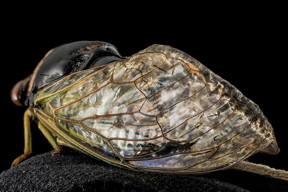 Researchers have demonstrated a new fabrication technique that allows them replicate the nanostructures found on cicada wings that make them water- and microbe-repellent.
Photo by Wayne Boo, U.S. Geological Survey
Researchers have demonstrated a new fabrication technique that allows them replicate the nanostructures found on cicada wings that make them water- and microbe-repellent.
Photo by Wayne Boo, U.S. Geological Survey
Abstract: A multidisciplinary group that studies the physical and chemical properties of insect wings has demonstrated the ability to reproduce the nanostructures that help cicada wings repel water and prevent bacteria from establishing on the surface. The new technique � which uses commercial nail polish � is economical and straightforward, and the researchers said it will help fabricate future high-tech waterproof materials.
Champaign, IL | Posted on October 23rd, 2020
The team used a simplified version of a fabrication process � called nanoimprinting lithography � to make a template of the complex pillar-shaped nanostructures on the wings of Neotibicen pruinosus, an annual cicada found in the central region of the United States. The templates are fully dissolvable and produce replicas that average 94.4% of the pillar height and 106% of the original wing, or master structure�s pillar diameter, the researchers said.
The results of the study are published in the journal Nano Letters.
�We chose to work with wings of this species of cicada because our past work demonstrates how the complex nanostructures on their wings provide an outstanding ability to repel water. That is a highly desirable property that will be useful in many materials engineering applications, from aircraft wings to medical equipment,� said Marianne Alleyne, an entomology professor at the University of Illinois at Urbana-Champaign, who co-led the study with Donald Cropek, of the U.S. Army Corps of Engineers� Construction Engineering Research Laboratory, and Nenad Miljkovic, a professor of mechanical science and engineering at Illinois.
Nanoimprinting lithography is not new but can be labor-intensive and expensive, the researchers said. Some approaches use toxic materials that can damage the original copied object, like a delicate cicada wing. Others require high temperatures that are not compatible with biological samples such as plants or insects.
�Our process allows us to do this in an open lab at room temperature and atmospheric pressure,� Cropek said. �We use nail polish and rubbing alcohol, which does not inflict any damage to the delicate wing nanostructures.�
In the lab, the team applies a quick-drying nail polish directly to a cicada wing, which is then left to cure at room temperature.
�It was not easy to find the right formula of nail polish because we want to avoid one that will warp or stretch the template during removal,� Alleyne said. Once completed, the template can be coated with a polymer or metal then dissolved away, leaving only the replica metal or polymer.
To show the versatility of the new method, the team experimented with two very different replica materials: copper metal and a flexible silicon-based organic polymer called PDMS.
�We showed that the technique is compatible with physical vapor deposition and electrochemical deposition of metals, oxides or ceramics, as well as chemical vapor deposition and spin coating of softer materials like polymers,� Miljkovic said.
�Copper is particularly interesting to us because of its inherent antimicrobial properties, and our past work indicates that some cicada species display antimicrobial properties on their wings,� Alleyne said. �We don�t know if it is the chemicals on the wing�s surface or the physical nanostructures, or a combination of both chemistry and topography, that produce the bactericidal activity, but being able to produce materials with different chemistries and structures will help us answer that fundamental question. This new, relatively simple fabrication method will ultimately help us design multifunctional engineered materials.�
Alleyne is also an affiliate of mechanical science and engineering and the Beckman Institute for Advanced Science and Technology at Illinois. Miljkovic is also an affiliate of electrical and computer engineering and the Materials Research Lab at Illinois.
The U.S. Army Corps of Engineers� Construction Engineering Research Laboratory, National Science Foundation and the Japanese Ministry of Education, Culture, Sports, Science, and Technology supported this research.
####
For more information, please click here
Contacts:LOIS YOKSOULIANPHYSICAL SCIENCES EDITOR217-244-2788
Marianne Alleyne, call 217-333-8652; email
To reach Donald Cropek, call 217-373-6737;
To reach Nenad Miljkovic, call 617-981-9247; email
Copyright © University of Illinois at Urbana-Champaign
If you have a comment, please Contact us.
Issuers of news releases, not 7th Wave, Inc. or Nanotechnology Now, are solely responsible for the accuracy of the content.
Bookmark:


News and information
 New technology helps reveal inner workings of human genome June 24th, 2022
Boron nitride nanotube fibers get real: Rice lab creates first heat-tolerant, stable fibers from wet-spinning process June 24th, 2022
Govt.-Legislation/Regulation/Funding/Policy
Solving the solar energy storage problem with rechargeable batteries that can convert and store energy at once June 24th, 2022
Boron nitride nanotube fibers get real: Rice lab creates first heat-tolerant, stable fibers from wet-spinning process June 24th, 2022
UBCO researchers change the game when it comes to activity tracking: Flexible, highly sensitive motion device created by extrusion printing June 17th, 2022
University of Illinois Chicago joins Brookhaven Lab's Quantum Center June 10th, 2022
Possible Futures
New technology helps reveal inner workings of human genome June 24th, 2022
Boron nitride nanotube fibers get real: Rice lab creates first heat-tolerant, stable fibers from wet-spinning process June 24th, 2022
Discoveries
New technology helps reveal inner workings of human genome June 24th, 2022
Boron nitride nanotube fibers get real: Rice lab creates first heat-tolerant, stable fibers from wet-spinning process June 24th, 2022
Materials/Metamaterials
Nanotubes: a promising solution for advanced rubber cables with 60% less conductive filler June 1st, 2022
New route to build materials out of tiny particles May 27th, 2022
A one-stop shop for quantum sensing materials May 27th, 2022
Announcements
New technology helps reveal inner workings of human genome June 24th, 2022
Boron nitride nanotube fibers get real: Rice lab creates first heat-tolerant, stable fibers from wet-spinning process June 24th, 2022
Interviews/Book Reviews/Essays/Reports/Podcasts/Journals/White papers/Posters
Quantum network nodes with warm atoms June 24th, 2022
New technology helps reveal inner workings of human genome June 24th, 2022
Military
Boron nitride nanotube fibers get real: Rice lab creates first heat-tolerant, stable fibers from wet-spinning process June 24th, 2022
Bumps could smooth quantum investigations: Rice University models show unique properties of 2D materials stressed by contoured substrates June 10th, 2022
Nanostructured fibers can impersonate human muscles June 3rd, 2022
Lightening up the nanoscale long-wavelength optoelectronics May 13th, 2022
Water
Scientists offer solutions for risky tap water June 17th, 2022
UBCO researchers change the game when it comes to activity tracking: Flexible, highly sensitive motion device created by extrusion printing June 17th, 2022
Organic water splitters get a boost June 10th, 2022
Research partnerships
New technology helps reveal inner workings of human genome June 24th, 2022
Boron nitride nanotube fibers get real: Rice lab creates first heat-tolerant, stable fibers from wet-spinning process June 24th, 2022
