
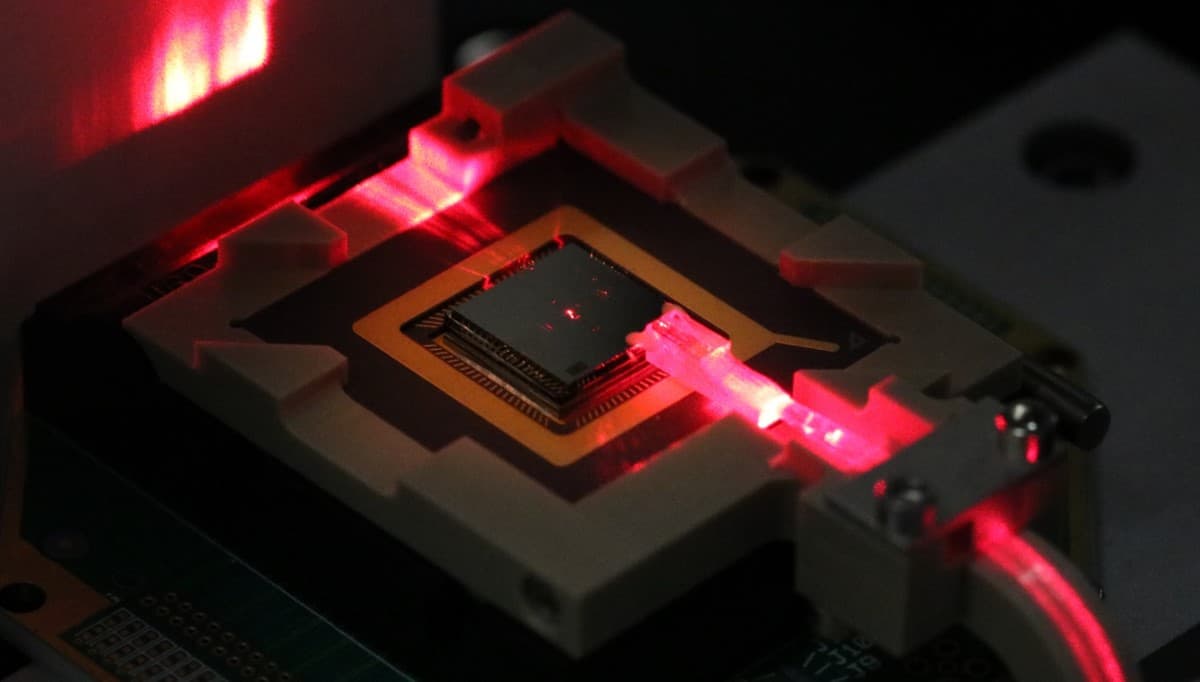
 Direct coupling: fibre optics send light directly into the MIT ion-trap chip. When in use, the chip is cryogenically cooled in a vacuum chamber, and waveguides on the chip deliver the light to an ion trapped above the chip's surface. (Courtesy: MIT)
An important step towards creating a scalable quantum computer based on trapped ions has been made by two independent research groups in the US and Switzerland. The teams have developed the optics needed to manipulate multiple trapped ions that are integrated onto single chips.
The first practical implementation of quantum gates – the fundamental components of a quantum computer — was made in 1995 by Chris Monroe and David Wineland at the US National Institute for Standards and Technology in Colorado. The researchers trapped beryllium ions in a vacuum chamber and controlled their electronic energy levels using lasers. The energy level of the ions was coupled to their motional state, which – owing to the electromagnetic interaction between ions – made the state of one ion conditional on the state of another.
Since then quantum gates have been created using various other systems as quantum bits (qubits). These include Rydberg atoms, impurities in diamond and superconducting circuits – the latter being used in state-of-the-art quantum computers built by Google and Intel. Commenting on superconductor-based systems, Monroe (now at the University of Maryland, College Park) says, “They use similar tools [to today’s computers], all of the chips are on a two-dimensional surface and you have to wire them together. People are familiar with those basic fabrication tools.” In contrast, he says, trapped-ion qubit technology requires more unfamiliar technology: “It has lasers, it has optics, it has individual atoms in a vacuum chamber.”
Prone to imperfections
Despite their current popularity, progress has recently slowed in the development of superconducting quantum computers, and some researchers are skeptical they will ever scale to thousands of qubits or beyond. This is because, whereas isolated atoms in free space are guaranteed to be identical by the laws of quantum mechanics and can therefore maintain coherent entangled states reliably, manufactured circuit elements are inherently prone to imperfections and almost impossible to isolate from noise.
Several research groups and commercial companies are therefore focusing on developing the technology needed to scale up trapped-ion systems. Around 15 years ago, says John Chiaverini of Massachusetts Institute of Technology, researchers began fabricating ion traps on chips. Mastering this basic technology of holding different atoms in different places allows researchers to “utilize some of the other stuff that the [semiconductor] industry has built up over 50 or 60 years and put other things in those ion trap chips, like integrated electronics and integrated photonics,” he says. “That work has really only started in earnest in the last five or six years.”
Now, two papers published side by side in Nature – one from the MIT researchers led by Chiaverini and colleague Jeremy Sage, the other from scientists at ETH Zurich – present complementary advances in manipulation of trapped ions using integrated photonics. Both teams fabricated waveguides on chips to deliver the light necessary to excite specific transitions in their chosen ions — the ETH Zurich group used calcium and the MIT researchers chose strontium.
