
| Date | 31st, Oct 2020 |
|---|
Home > Press > Breakthrough quantum-dot transistors create a flexible alternative to conventional electronics: Quantum dot logic circuits provide the long-sought building blocks for innovative devices, including printable electronics, flexible displays, and medical diagnostics
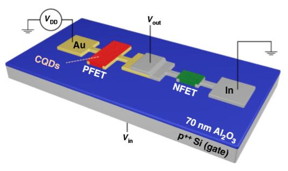 By depositing gold (Au) and Indium (In) contacts, researchers create two crucial types of quantum dot transistors on the same substrate, opening the door to a host of innovative electronics.
CREDIT
Los Alamos National Laboratory/University of California, Irvine
By depositing gold (Au) and Indium (In) contacts, researchers create two crucial types of quantum dot transistors on the same substrate, opening the door to a host of innovative electronics.
CREDIT
Los Alamos National Laboratory/University of California, Irvine
Abstract: Researchers at Los Alamos National Laboratory and their collaborators from the University of California, Irvine have created fundamental electronic building blocks out of tiny structures known as quantum dots and used them to assemble functional logic circuits. The innovation promises a cheaper and manufacturing-friendly approach to complex electronic devices that can be fabricated in a chemistry laboratory via simple, solution-based techniques, and offer long-sought components for a host of innovative devices.
Los Alamos, NM | Posted on October 30th, 2020
"Potential applications of the new approach to electronic devices based on non-toxic quantum dots include printable circuits, flexible displays, lab-on-a-chip diagnostics, wearable devices, medical testing, smart implants, and biometrics," said Victor Klimov, a physicist specializing in semiconductor nanocrystals at Los Alamos and lead author on a paper announcing the new results in the October 19 issue of Nature Communications.
For decades, microelectronics has relied on extra-high purity silicon processed in a specially created clean-room environment. Recently, silicon-based microelectronics has been challenged by several alternative technologies that allow for fabricating complex electronic circuits outside a clean room, via inexpensive, readily accessible chemical techniques. Colloidal semiconductor nanoparticles made with chemistry methods in much less stringent environments are one such emerging technology. Due to their small size and unique properties directly controlled by quantum mechanics, these particles are dubbed quantum dots.
A colloidal quantum dot consists of a semiconductor core covered with organic molecules. As a result of this hybrid nature, they combine the advantages of well-understood traditional semiconductors with the chemical versatility of molecular systems. These properties are attractive for realizing new types of flexible electronic circuits that could be printed onto virtually any surface including plastic, paper, and even human skin. This capability could benefit numerous areas including consumer electronics, security, digital signage and medical diagnostics.
A key element of electronic circuitry is a transistor that acts as a switch of electrical current activated by applied voltage. Usually transistors come in pairs of n- and p-type devices that control flows of negative and positive electrical charges, respectively. Such pairs of complementary transistors are the cornerstone of the modern CMOS (complementary metal oxide semiconductor) technology, which enables microprocessors, memory chips, image sensors and other electronic devices.
The first quantum dot transistors were demonstrated almost two decades ago. However, integrating complementary n- and p-type devices within the same quantum dot layer remained a long-standing challenge. In addition, most of the efforts in this area have focused on nanocrystals based on lead and cadmium. These elements are highly toxic heavy metals, which greatly limits practical utility of the demonstrated devices.
The team of Los Alamos researchers and their collaborators from the University of California, Irvine have demonstrated that by using copper indium selenide (CuInSe2) quantum dots devoid of heavy metals they were able to address both the problem of toxicity and simultaneously achieve straightforward integration of n- and p-transistors in the same quantum dot layer. As a proof of practical utility of the developed approach, they created functional circuits that performed logical operations.
The innovation that Klimov and colleagues are presenting in their new paper allows them to define p- and n-type transistors by applying two different types of metal contacts (gold and indium, respectively). They completed the devices by depositing a common quantum dot layer on top of the pre-patterned contacts. "This approach permits straightforward integration of an arbitrary number of complementary p- and n-type transistors into the same quantum dot layer prepared as a continuous, un-patterned film via standard spin-coating," said Klimov.
###
Publication: J. Yun, J. Lim, J. Roh, D. C. J. Neo, M. Law, and V. I. Klimov, Solution-processable integrated CMOS circuits based on colloidal CuInSe2 quantum dots, Nature Communications, DOI: 10.1038/s41467-020-18932-5.
Funding: This work was supported by the Laboratory Directed Research and Development (LDRD) program at Los Alamos National Laboratory under project 20200213DR and the University of California (UC) Office of the President under the UC Laboratory Fees Research Program Collaborative Research and Training Award LFR-17-477148.
####
About Los Alamos National LaboratoryLos Alamos National Laboratory, a multidisciplinary research institution engaged in strategic science on behalf of national security, is operated by Triad, a public service oriented, national security science organization equally owned by its three founding members: Battelle Memorial Institute (Battelle), the Texas A&M University System (TAMUS), and the Regents of the University of California (UC) for the Department of Energy's National Nuclear Security Administration.
Los Alamos enhances national security by ensuring the safety and reliability of the U.S. nuclear stockpile, developing technologies to reduce threats from weapons of mass destruction, and solving problems related to energy, environment, infrastructure, health, and global security concerns.
LA-UR-20-28576
For more information, please click here
Contacts:James Riordon
505-551-4004
@LosAlamosNatLab
Copyright © Los Alamos National Laboratory
If you have a comment, please Contact us.
Issuers of news releases, not 7th Wave, Inc. or Nanotechnology Now, are solely responsible for the accuracy of the content.
Bookmark:


News and information
 New technology helps reveal inner workings of human genome June 24th, 2022
Boron nitride nanotube fibers get real: Rice lab creates first heat-tolerant, stable fibers from wet-spinning process June 24th, 2022
Laboratories
University of Illinois Chicago joins Brookhaven Lab's Quantum Center June 10th, 2022
A one-stop shop for quantum sensing materials May 27th, 2022
Display technology/LEDs/SS Lighting/OLEDs
A solution to perovskite solar cell scalability problems April 22nd, 2022
Wearable electronics
�Fruitcake� structure observed in organic polymers June 3rd, 2022
Internet-of-Things
Lightening up the nanoscale long-wavelength optoelectronics May 13th, 2022
Govt.-Legislation/Regulation/Funding/Policy
Solving the solar energy storage problem with rechargeable batteries that can convert and store energy at once June 24th, 2022
Boron nitride nanotube fibers get real: Rice lab creates first heat-tolerant, stable fibers from wet-spinning process June 24th, 2022
UBCO researchers change the game when it comes to activity tracking: Flexible, highly sensitive motion device created by extrusion printing June 17th, 2022
University of Illinois Chicago joins Brookhaven Lab's Quantum Center June 10th, 2022
Possible Futures
New technology helps reveal inner workings of human genome June 24th, 2022
Boron nitride nanotube fibers get real: Rice lab creates first heat-tolerant, stable fibers from wet-spinning process June 24th, 2022
Chip Technology
Boron nitride nanotube fibers get real: Rice lab creates first heat-tolerant, stable fibers from wet-spinning process June 24th, 2022
Controlled synthesis of crystal flakes paves path for advanced future electronics June 17th, 2022
Discoveries
New technology helps reveal inner workings of human genome June 24th, 2022
Boron nitride nanotube fibers get real: Rice lab creates first heat-tolerant, stable fibers from wet-spinning process June 24th, 2022
Announcements
New technology helps reveal inner workings of human genome June 24th, 2022
Boron nitride nanotube fibers get real: Rice lab creates first heat-tolerant, stable fibers from wet-spinning process June 24th, 2022
Interviews/Book Reviews/Essays/Reports/Podcasts/Journals/White papers/Posters
Quantum network nodes with warm atoms June 24th, 2022
New technology helps reveal inner workings of human genome June 24th, 2022
Quantum Dots/Rods
New substance classes for nanomaterials: Nano spheres and diamond slivers made of silicon and germanium: Potential applications as nano semiconductor materials September 10th, 2021
�Missing jigsaw piece�: engineers make critical advance in quantum computer design August 20th, 2021
