
| Date | 21st, Nov 2020 |
|---|
Home > Press > Staying ahead of the curve with 3D curved graphene
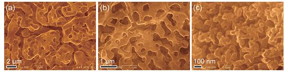 An Electrical transport of 3D graphene with various curvature radii
CREDIT
Tohoku University
An Electrical transport of 3D graphene with various curvature radii
CREDIT
Tohoku University
Abstract: A team of researchers has amplified 3D graphene's electrical properties by controlling its curvature.
Sendai City, Japan | Posted on November 20th, 2020
"Our research showed the conservation and the degradation of the ultra-low dissipative transport of Dirac electrons on the 3D curved surface for the first time," said Yoichi Tanabe, leading author of the study.
Graphene is a 2D atomic-layer material, shaped like honeycombs, which possesses excellent electrical, chemical, thermal, and mechanical properties for a wide range of applications such as semiconductors, electrical batteries, and composites.
Graphene sheets stacked together form graphite which makes up the lead in our pencils. However, packing together graphene tightly means it loses its 2D electronic properties.
One way to overcome this is to separate the graphene sheets with air-filled pores--like a sponge--at the nanometer scale and make it into a three-dimensional structure. This amplifies graphene's properties for practical purposes.
But doing so is not without its challenges; converting 2D graphene into 3D graphene introduces crystal defects and a host of other problems that cause it to lose its desirable characteristics. Little is known about how the curved surface degrades the graphene's electric transport properties and whether this is the reason for graphene losing its Dirac fermions.
The research team sought to investigate this by taking a single, 2D graphene sheet and folding it into a 3D structure with a bicontinuous and open porous structure.
The structure, with a curvature radius down to 25-50 nanometers, retained the basic electronic properties of 2D graphene well. Meanwhile, the motion of electrons on the 3D curvature enhanced electron scattering that had originated from the intrinsic curvature effects. In fact, nanoscale curvature provides a new degree of freedom to manipulate graphene's electronic behaviors for the emergent and unique electrical properties of 3D graphene.
####
For more information, please click here
Contacts:Mingwei Chen
81-222-175-992
@TohokuUniPR
Copyright © Tohoku University
If you have a comment, please Contact us.
Issuers of news releases, not 7th Wave, Inc. or Nanotechnology Now, are solely responsible for the accuracy of the content.
Bookmark:


News and information
 New technology helps reveal inner workings of human genome June 24th, 2022
Boron nitride nanotube fibers get real: Rice lab creates first heat-tolerant, stable fibers from wet-spinning process June 24th, 2022
2 Dimensional Materials
Controlled synthesis of crystal flakes paves path for advanced future electronics June 17th, 2022
Solving the puzzle of 2D disorder: An interdisciplinary team developed a new method to characterize disorder in 2D materials June 17th, 2022
UBCO researchers change the game when it comes to activity tracking: Flexible, highly sensitive motion device created by extrusion printing June 17th, 2022
Bumps could smooth quantum investigations: Rice University models show unique properties of 2D materials stressed by contoured substrates June 10th, 2022
Graphene/ Graphite
OCSiAl expands its graphene nanotube production capacities to Europe June 17th, 2022
Bumps could smooth quantum investigations: Rice University models show unique properties of 2D materials stressed by contoured substrates June 10th, 2022
Nanotubes: a promising solution for advanced rubber cables with 60% less conductive filler June 1st, 2022
Possible Futures
New technology helps reveal inner workings of human genome June 24th, 2022
Boron nitride nanotube fibers get real: Rice lab creates first heat-tolerant, stable fibers from wet-spinning process June 24th, 2022
Chip Technology
Boron nitride nanotube fibers get real: Rice lab creates first heat-tolerant, stable fibers from wet-spinning process June 24th, 2022
Controlled synthesis of crystal flakes paves path for advanced future electronics June 17th, 2022
Discoveries
New technology helps reveal inner workings of human genome June 24th, 2022
Boron nitride nanotube fibers get real: Rice lab creates first heat-tolerant, stable fibers from wet-spinning process June 24th, 2022
Materials/Metamaterials
Nanotubes: a promising solution for advanced rubber cables with 60% less conductive filler June 1st, 2022
New route to build materials out of tiny particles May 27th, 2022
A one-stop shop for quantum sensing materials May 27th, 2022
Announcements
New technology helps reveal inner workings of human genome June 24th, 2022
Boron nitride nanotube fibers get real: Rice lab creates first heat-tolerant, stable fibers from wet-spinning process June 24th, 2022
Interviews/Book Reviews/Essays/Reports/Podcasts/Journals/White papers/Posters
Quantum network nodes with warm atoms June 24th, 2022
New technology helps reveal inner workings of human genome June 24th, 2022
Battery Technology/Capacitors/Generators/Piezoelectrics/Thermoelectrics/Energy storage
Solving the solar energy storage problem with rechargeable batteries that can convert and store energy at once June 24th, 2022
OCSiAl expands its graphene nanotube production capacities to Europe June 17th, 2022
Engineering piezoelectricity and strain sensitivity in CdS to promote piezocatalytic hydrogen evolution May 13th, 2022
