
| Date | 21st, Nov 2020 |
|---|
Home > Press > Improving quantum dot interactions, one layer at a time: Scientists have found a way to control an interaction between quantum dots that could lead to more efficient solar cells
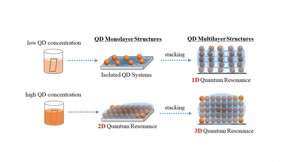 Low quantum dot concentrations during superlattice fabrication suppresses quantum resonance between dots in the same layer, while high concentrations activates it
CREDIT
DaeGwi Kim, Osaka City University
Low quantum dot concentrations during superlattice fabrication suppresses quantum resonance between dots in the same layer, while high concentrations activates it
CREDIT
DaeGwi Kim, Osaka City University
Abstract: Osaka City University scientists and colleagues in Japan have found a way to control an interaction between quantum dots that could greatly improve charge transport, leading to more efficient solar cells. Their findings were published in the journal Nature Communications.
Osaka, Japan | Posted on November 20th, 2020
Nanomaterials engineer DaeGwi Kim led a team of scientists at Osaka City University, RIKEN Center for Emergent Matter Science and Kyoto University to investigate ways to control a property called quantum resonance in layered structures of quantum dots called superlattices.
"Our simple method for fine-tuning quantum resonance is an important contribution to both optical materials and nanoscale material processing," says Kim.
Quantum dots are nanometer-sized semiconductor particles with interesting optical and electronic properties. When light is shone on them, for example, they emit strong light at room temperature, a property called photoluminescence. When quantum dots are close enough to each other, their electronic states are coupled, a phenomenon called quantum resonance. This greatly improves their ability to transport electrons between them. Scientists have been wanting to manufacture devices using this interaction, including solar cells, display technologies, and thermoelectric devices.
However, they have so far found it difficult to control the distances between quantum dots in 1D, 2D and 3D structures. Current fabrication processes use long ligands to hold quantum dots together, which hinders their interactions.
Kim and his colleagues found they could detect and control quantum resonance by using cadmium telluride quantum dots connected with short N-acetyl-L-cysteine ligands. They controlled the distance between quantum dot layers by placing a spacer layer between them made of oppositely charged polyelectrolytes. Quantum resonance is detected between stacked dots when the spacer layer is thinner than two nanometers. The scientists also controlled the distance between quantum dots in a single layer, and thus quantum resonance, by changing the concentration of quantum dots used in the layering process.
The team next plans to study the optical properties, especially photoluminescence, of quantum dot superlattices made using their layer-by-layer approach. "This is extremely important for realizing new optical electronic devices made with quantum dot superlattices," says Kim.
Kim adds that their fabrication method can be used with other types of water-soluble quantum dots and nanoparticles. "Combining different types of semiconductor quantum dots, or combining semiconductor quantum dots with other nanoparticles, will expand the possibilities of new material design," says Kim.
####
About Osaka City UniversityWe are Osaka City University - the oldest research university in Osaka. With 9 undergraduate faculties and 11 graduate schools all dedicated to making urban life better, energy cleaner, and people healthier and happier, we have won numerous awards and have produced 2 Nobel laureates. For more information, please visit our website at https://www.osaka-cu.ac.jp/en
For more information, please click here
Contacts:James Gracey
81-666-053-592
@OCU_PR
Copyright © Osaka City University
If you have a comment, please Contact us.
Issuers of news releases, not 7th Wave, Inc. or Nanotechnology Now, are solely responsible for the accuracy of the content.
Bookmark:


News and information
 New technology helps reveal inner workings of human genome June 24th, 2022
Boron nitride nanotube fibers get real: Rice lab creates first heat-tolerant, stable fibers from wet-spinning process June 24th, 2022
Display technology/LEDs/SS Lighting/OLEDs
A solution to perovskite solar cell scalability problems April 22nd, 2022
Graphene crystals grow better under copper cover April 1st, 2022
Possible Futures
New technology helps reveal inner workings of human genome June 24th, 2022
Boron nitride nanotube fibers get real: Rice lab creates first heat-tolerant, stable fibers from wet-spinning process June 24th, 2022
Discoveries
New technology helps reveal inner workings of human genome June 24th, 2022
Boron nitride nanotube fibers get real: Rice lab creates first heat-tolerant, stable fibers from wet-spinning process June 24th, 2022
Announcements
New technology helps reveal inner workings of human genome June 24th, 2022
Boron nitride nanotube fibers get real: Rice lab creates first heat-tolerant, stable fibers from wet-spinning process June 24th, 2022
Interviews/Book Reviews/Essays/Reports/Podcasts/Journals/White papers/Posters
Quantum network nodes with warm atoms June 24th, 2022
New technology helps reveal inner workings of human genome June 24th, 2022
Energy
Solving the solar energy storage problem with rechargeable batteries that can convert and store energy at once June 24th, 2022
Organic water splitters get a boost June 10th, 2022
Engineering piezoelectricity and strain sensitivity in CdS to promote piezocatalytic hydrogen evolution May 13th, 2022
Battery Technology/Capacitors/Generators/Piezoelectrics/Thermoelectrics/Energy storage
Solving the solar energy storage problem with rechargeable batteries that can convert and store energy at once June 24th, 2022
OCSiAl expands its graphene nanotube production capacities to Europe June 17th, 2022
Engineering piezoelectricity and strain sensitivity in CdS to promote piezocatalytic hydrogen evolution May 13th, 2022
Quantum Dots/Rods
New substance classes for nanomaterials: Nano spheres and diamond slivers made of silicon and germanium: Potential applications as nano semiconductor materials September 10th, 2021
�Missing jigsaw piece�: engineers make critical advance in quantum computer design August 20th, 2021
Solar/Photovoltaic
Solving the solar energy storage problem with rechargeable batteries that can convert and store energy at once June 24th, 2022
USTC found a pathway to high-quality ZnSe quantum wires April 8th, 2022
Graphene crystals grow better under copper cover April 1st, 2022
Peering into precise ultrafast dynamics in matter March 25th, 2022
Quantum nanoscience
Bumps could smooth quantum investigations: Rice University models show unique properties of 2D materials stressed by contoured substrates June 10th, 2022
UCI scientists turn a hydrogen molecule into a quantum sensor: New technique enables precise measurement of electrostatic properties of materials April 22nd, 2022
