
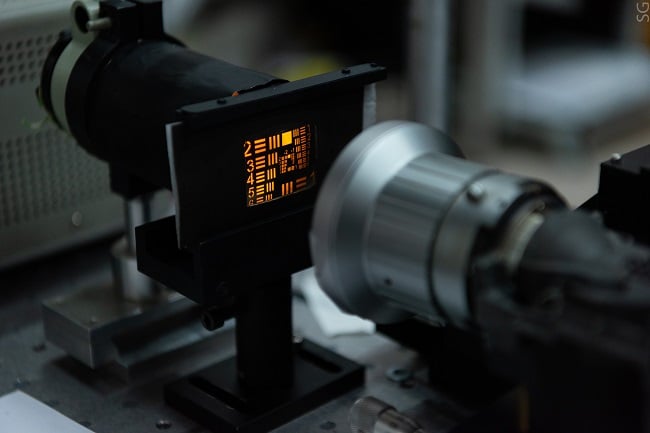
 Image of a photon being scaled through special patterns. Courtesy of Sergey Gnuskov/NUST MISIS.
The researchers are specifically eyeing the creation of a 1000-pixel single-photon video detector capable of detecting particles and that can obtain an image in near-complete darkness. With 8 pixels currently in place, the researchers said they are able to achieve understanding of and control the principles of the matrix.
Image of a photon being scaled through special patterns. Courtesy of Sergey Gnuskov/NUST MISIS.
The researchers are specifically eyeing the creation of a 1000-pixel single-photon video detector capable of detecting particles and that can obtain an image in near-complete darkness. With 8 pixels currently in place, the researchers said they are able to achieve understanding of and control the principles of the matrix. “The detector itself is located inside the cryostat at a temperature of only 2 K, which is close to absolute zero. When a photon is detected, it sends a signal to the processing circuit, and an image appears on the display,” said Grigory Goltsman, chief researcher at NUST MISI NTI Center “Quantum Communications” and founder of the Skontel company.
The goal is to obtain 1 million pixels from a matrix of 1000 pixels, and to be able to “open” one pixel at a time such as in older TVs. This will be a slow process, the researchers said. The team will apply distinct patterns to further scale the resulting image. Scaling is among the next steps the researchers will begin.
“There is a way to speed up the process: Open pixels in groups. For this purpose, special stencils are used. You open one pattern, measure how much light hits the detector, then you open the second pattern, and so on,” said Alexander Korneev, senior researcher at NUST MISIS NTI Center “Quantum Communications.”
The device, once completed, will have additional applications in medical diagnostic devices.
