
| Date | 28th, Nov 2020 |
|---|
Home > Press > Russian scientists improve 3D printing technology for aerospace composites using oil waste
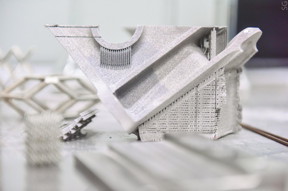 Aviation parts printed on a 3D printer from new metal powders
CREDIT
Sergey Gnuskov/NUST MISIS
Aviation parts printed on a 3D printer from new metal powders
CREDIT
Sergey Gnuskov/NUST MISIS
Abstract: Scientists from NUST MISIS have improved the technology of 3D printing from aluminum, having achieved an increase in the hardness of products by 1,5 times. The nanocarbon additive to aluminum powder, which they have developed, obtained from the products of processing associated petroleum gas, will improve the quality of 3D printed aerospace composites. The research results are published in the international scientific journal Composites Communications
Moscow, Russia | Posted on November 27th, 2020
Today, the main field of application for aluminum 3D printing is the creation of high-tech parts for the aviation and space industries. The presence of even the slightest defects in printed structures is critical to the safety of the technology being created. According to NUST MISIS scientists, the main risk of such defects is the high porosity of the material, caused, among other reasons, by the qualities of the original aluminum powder. To ensure a uniform and dense microstructure of printed products, scientists from the MISIS Catalis Lab proposed adding carbon nanofibers to the aluminum powder. The use of this modifying additive makes it possible to ensure a low porosity of the material and an increase in its hardness by 1.5 times.
"Changing the chemical and phase composition of the powder for printing by introducing additional components into the main matrix allows improving its properties. In particular, carbon nanofibers have high thermal conductivity, which helps to minimize temperature gradients between printed layers during product synthesis, at the stage of selective laser melting. Thanks to this, the microstructure of the material can be almost completely eliminated from inhomogeneities," said the head of the laboratory, professor at NUST MISIS, Ph.D. Alexander Gromov.
The technology for the synthesis of nanocarbon additives developed by the research team includes methods of chemical deposition, ultrasonic treatment, and IR heat treatment. The used carbon nanofibers must be a by-product of associated petroleum gas processing. During its catalytic decomposition, carbon accumulates in the form of nanofibers on dispersed metal particles of the catalyst. Usually, at present, associated gases are simply burned in the fields, which harms the environment. Therefore, the application of the new method also has a serious environmental significance, -- said Professor Gromov. The study has been carried out jointly with specialists from the Boreskov Institute of Catalysis SB RAS. In the future, the research team plans to determine the optimal conditions for selective laser melting of new composite powders, as well as to develop a technology for post-processing and industrial use of synthesized products.
####
For more information, please click here
Contacts:Lyudmila Dozhdikova
892-504-31990
Copyright © National University of Science and Technology MISIS
If you have a comment, please Contact us.
Issuers of news releases, not 7th Wave, Inc. or Nanotechnology Now, are solely responsible for the accuracy of the content.
Bookmark:


3D & 4D printing/Additive-manufacturing
News and information
 New technology helps reveal inner workings of human genome June 24th, 2022
Boron nitride nanotube fibers get real: Rice lab creates first heat-tolerant, stable fibers from wet-spinning process June 24th, 2022
Possible Futures
New technology helps reveal inner workings of human genome June 24th, 2022
Boron nitride nanotube fibers get real: Rice lab creates first heat-tolerant, stable fibers from wet-spinning process June 24th, 2022
Discoveries
New technology helps reveal inner workings of human genome June 24th, 2022
Boron nitride nanotube fibers get real: Rice lab creates first heat-tolerant, stable fibers from wet-spinning process June 24th, 2022
Announcements
New technology helps reveal inner workings of human genome June 24th, 2022
Boron nitride nanotube fibers get real: Rice lab creates first heat-tolerant, stable fibers from wet-spinning process June 24th, 2022
Interviews/Book Reviews/Essays/Reports/Podcasts/Journals/White papers/Posters
Quantum network nodes with warm atoms June 24th, 2022
New technology helps reveal inner workings of human genome June 24th, 2022
Aerospace/Space
Boron nitride nanotube fibers get real: Rice lab creates first heat-tolerant, stable fibers from wet-spinning process June 24th, 2022
University of Strathclyde and National University of Singapore to co-ordinate satellite quantum communications May 13th, 2022
Lightening up the nanoscale long-wavelength optoelectronics May 13th, 2022
