
| Date | 4th, Dec 2020 |
|---|
Home > Press > Chemists get peek at novel fluorescence: Rice University scientists discover delayed phenomenon in carbon nanotubes
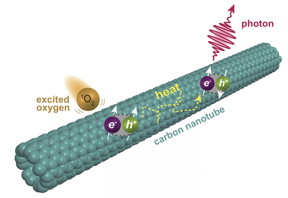 Chemists at Rice University have discovered a second level of fluorescence in single-walled carbon nanotubes. The fluorescence is triggered when oxygen molecules excited into a singlet state interact with nanotubes, prompting excitons to form triplet states that upconvert into fluorescing singlets. (Credit: Illustration by Ching-Wei Lin/Rice University)
Abstract: That carbon nanotubes fluoresce is no longer a surprise. Finding a second level of fluorescence is surprising and potentially useful.
Houston, TX | Posted on December 3rd, 2020
How does it work? Wait for it.
The Rice University lab of Bruce Weisman, a professor of chemistry who led the pioneering discovery of nanotube fluorescence in 2002, found that single-walled nanotubes emit a delayed secondary fluorescence when triggered by a multistep process in a solution with dye molecules and dissolved oxygen.
The delay is only microseconds, but it�s enough to be detected with some effort.
The complex process is detailed by Weisman, lead author and Rice alumnus Ching-Wei Lin and research scientist Sergei Bachilo in the Journal of the American Chemical Society.
The reaction begins when light excites a solution containing a dye called rose bengal. Oxygen molecules dissolved in the solution capture energy from the dye, forming energized O2. These then transfer their energy to nanotubes, where excitons -- quasiparticles made of electrons and electron holes -- are generated in their triplet state. With a bit of added thermal energy, those excitons get promoted to a higher energy singlet state that emits the observed fluorescence.
�For a number of years, we have been looking at interesting effects involving nanotubes and oxygen,� Weisman said. �We�ve found quite a range of things that can happen, from physical effects like this energy transfer or the reversible quenching of fluorescence, to the triggering of chemical reactions between nanotubes and DNA. So this study was part of a larger program of exploration.�
Their ability to excite dissolved oxygen molecules prompted the researchers to see how that would affect adjacent nanotubes, Weisman said.
�We make singlet oxygen by exciting a dye molecule with visible light, and then the oxygen deactivates the dye and gets excited itself,� he said. �That idea goes back decades in photophysics and is very conventional. What�s unusual here is that the singlet oxygen interacts with the nanotube to directly make triplet-state excitations in the tube. Those triplet states have been pretty elusive.
�Triplet states of organic molecules are the longest-lived excited states,� Weisman said. �Their lifetimes are orders of magnitude greater than the singlet excited states, so they can hang around long enough to bump into something else and undergo chemical reactions.
�But because nanotube triplet states don�t emit light or directly absorb light very well, they are tricky to study and not too much is known about them,� he said. �What we�ve been doing is trying to understand them a little better.�
Triggering fluorescence still required an extra step. �Just by random thermal agitation in their surroundings, these guys can sometimes get kicked up to the bright singlet state, and then they can tell you they�re there by spitting out a photon,� Weisman said.
Because the triplet state can last 10 microseconds or so, that upconverted emission is called delayed fluorescence.
The researchers had to find a way to detect the relatively weak effect amid the nanotubes� bright primary fluorescence. �It was like trying to see a dim object right after being blinded by a bright camera flash,� Weisman said. �We had to devise some special instrumentation.�
One device �is basically a fast mechanical shutter� that covers the short-wave infrared (SWIR) spectrometer during the bright flash and then quickly opens up, a kind of reverse camera that goes from covered to open in seven microseconds. The other device, he said, is a sensitive detector that�s triggered with an electronic signal and measures how the weak emission fades away over time. �These systems were both built by Ching-Wei, who�s a terrific experimentalist,� he said.
Weisman and colleagues have employed nanotube fluorescence in medical imaging technologies and in nanotube-based smart skin to measure strain in surfaces, among other applications. He said the new discovery could eventually find its way into optoelectronics and solar energy.
�There�s not a direct step where somebody�s going to read this and make a new, more efficient device,� Weisman said. �But this fundamental knowledge of processes and properties is the foundation on which new technologies are built.�
The National Science Foundation and the Welch Foundation supported the research.
####
About Rice UniversityLocated on a 300-acre forested campus in Houston, Rice University is consistently ranked among the nation�s top 20 universities by U.S. News & World Report. Rice has highly respected schools of Architecture, Business, Continuing Studies, Engineering, Humanities, Music, Natural Sciences and Social Sciences and is home to the Baker Institute for Public Policy. With 3,978 undergraduates and 3,192 graduate students, Rice�s undergraduate student-to-faculty ratio is just under 6-to-1. Its residential college system builds close-knit communities and lifelong friendships, just one reason why Rice is ranked No. 1 for lots of race/class interaction and No. 1 for quality of life by the Princeton Review. Rice is also rated as a best value among private universities by Kiplinger�s Personal Finance.
Follow Rice News and Media Relations via Twitter @RiceUNews.
For more information, please click here
Contacts:Jeff Falk713-348-6775
Mike Williams713-348-6728
Copyright © Rice University
If you have a comment, please Contact us.
Issuers of news releases, not 7th Wave, Inc. or Nanotechnology Now, are solely responsible for the accuracy of the content.
Bookmark:


 Nanotubes are beacons in cancer-imaging technique:
Researchers advance techniques to detect ovarian cancer:
�Smart skin� simplifies spotting strain in structures:
Wiess School of Natural Sciences:
News and information
New technology helps reveal inner workings of human genome June 24th, 2022
Boron nitride nanotube fibers get real: Rice lab creates first heat-tolerant, stable fibers from wet-spinning process June 24th, 2022
Imaging
Snapshot measurement of single nanostructure�s circular dichroism March 25th, 2022
Better understanding superconductors with Higgs spectroscopy Prof. Stefan Kaiser from TU Dresden awarded ERC Consolidator Grant March 18th, 2022
Visualizing the invisible: New fluorescent DNA label reveals nanoscopic cancer features March 4th, 2022
Govt.-Legislation/Regulation/Funding/Policy
Solving the solar energy storage problem with rechargeable batteries that can convert and store energy at once June 24th, 2022
Boron nitride nanotube fibers get real: Rice lab creates first heat-tolerant, stable fibers from wet-spinning process June 24th, 2022
UBCO researchers change the game when it comes to activity tracking: Flexible, highly sensitive motion device created by extrusion printing June 17th, 2022
University of Illinois Chicago joins Brookhaven Lab's Quantum Center June 10th, 2022
Possible Futures
New technology helps reveal inner workings of human genome June 24th, 2022
Boron nitride nanotube fibers get real: Rice lab creates first heat-tolerant, stable fibers from wet-spinning process June 24th, 2022
Chip Technology
Boron nitride nanotube fibers get real: Rice lab creates first heat-tolerant, stable fibers from wet-spinning process June 24th, 2022
Controlled synthesis of crystal flakes paves path for advanced future electronics June 17th, 2022
Nanotubes/Buckyballs/Fullerenes/Nanorods
Boron nitride nanotube fibers get real: Rice lab creates first heat-tolerant, stable fibers from wet-spinning process June 24th, 2022
Nanotubes: a promising solution for advanced rubber cables with 60% less conductive filler June 1st, 2022
Protective equipment with graphene nanotubes meets the strictest ESD safety standards March 25th, 2022
CEA and Startup C12 Join Forces to Develop Next-Generation Quantum Computers with Multi-Qubit Chips at Wafer Scale March 25th, 2022
Nanomedicine
New technology helps reveal inner workings of human genome June 24th, 2022
New nano-gel to protect children receiving chemotherapy from hearing loss June 17th, 2022
Optical computing/Photonic computing
Photonic integrated erbium doped amplifiers reach commercial performance: Boosting light power revolutionizes communications and autopilots June 17th, 2022
Electron-phonon coupling assisted universal red luminescence of o-phenylenediamine-based CDs June 10th, 2022
Discoveries
New technology helps reveal inner workings of human genome June 24th, 2022
Boron nitride nanotube fibers get real: Rice lab creates first heat-tolerant, stable fibers from wet-spinning process June 24th, 2022
Announcements
New technology helps reveal inner workings of human genome June 24th, 2022
Boron nitride nanotube fibers get real: Rice lab creates first heat-tolerant, stable fibers from wet-spinning process June 24th, 2022
Interviews/Book Reviews/Essays/Reports/Podcasts/Journals/White papers/Posters
Quantum network nodes with warm atoms June 24th, 2022
New technology helps reveal inner workings of human genome June 24th, 2022
Energy
Solving the solar energy storage problem with rechargeable batteries that can convert and store energy at once June 24th, 2022
Organic water splitters get a boost June 10th, 2022
Engineering piezoelectricity and strain sensitivity in CdS to promote piezocatalytic hydrogen evolution May 13th, 2022
Grants/Sponsored Research/Awards/Scholarships/Gifts/Contests/Honors/Records
Solving the solar energy storage problem with rechargeable batteries that can convert and store energy at once June 24th, 2022
Boron nitride nanotube fibers get real: Rice lab creates first heat-tolerant, stable fibers from wet-spinning process June 24th, 2022
Photonics/Optics/Lasers
Photonic integrated erbium doped amplifiers reach commercial performance: Boosting light power revolutionizes communications and autopilots June 17th, 2022
Marching to the Cadence of Electronics: Innovation A new paper in Nature validates technology developed by John Bowers and collaborators June 10th, 2022
Solar/Photovoltaic
Solving the solar energy storage problem with rechargeable batteries that can convert and store energy at once June 24th, 2022
USTC found a pathway to high-quality ZnSe quantum wires April 8th, 2022
Graphene crystals grow better under copper cover April 1st, 2022
Peering into precise ultrafast dynamics in matter March 25th, 2022
