
| Date | 11th, Dec 2020 |
|---|
December 11, 2020 feature
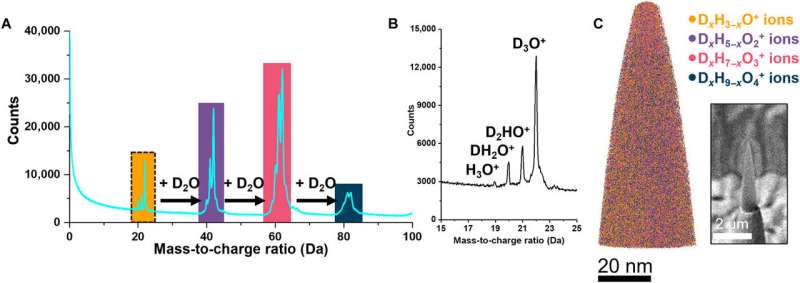 Summary of the atom probe data from a thick layer of ice. (A) Mass spectrum of acquired APT dataset of D2O ice at 100 pJ, 200 kHz, and a detection rate of 0.5%. (B) Sectioned mass spectrum from (A) to illustrate DxH3−xO complex peaks. (C) 3D reconstruction map of D2O. Inset capture shows SEM image of the specimen. Credit: Science Advances, doi: 10.1126/sciadv.abd6324
Advances in transmission electron microscopy (TEM) can allow cryo-imaging of biological and biochemical systems in liquid form, however, such approaches do not possess advanced analytical capabilities. In a new report now published on Science Advances, A. A. El-Zoka and an international team of researchers in Germany, Canada, France, and the U.K., used atom probe tomography to analyze frozen liquids in three-dimensions (3-D) with sub-nanometer scale resolution. In this work, the team first introduced a specimen preparation strategy using nano-porous gold and used ice formed from high-purity deuterated water (hard water) alongside a solution of sodium chloride (50 mM) dissolved in high-purity deuterated water. They then analyzed the gold-ice interface to reveal increased solute concentrations across the interface. The scientists explored a range of experimental conditions to understand atom probe analyses of bulk aqueous specimens. Then they discussed the physical processes associated with the observed phenomena. The study showed the practicality of using frozen water as a carrier for near-atomic-scale analyses of objects in solution via atom probe tomography.
Transmission electron microscopy and atom probe tomography
Transmission electron microscopy (TEM) has undergone significant progress in recent decades, partly leading to the 2017 Nobel prize in Chemistry, due to the innovation of cryo-electron microscopy (cryo-EM) to determine the high-resolution structure of biomolecules in solution. The cryo-EM technique notably offers the ability to freeze specimens rapidly so that water molecules present in the specimens turn into transparent ice crystals. Tremendous parallel efforts have similarly established atomically resolved electron tomography methods to accomplish groundbreaking discoveries in materials science. Despite the powerful analytical capabilities, the approaches cannot readily measure the atomic-scale composition of a specimen. Here, El-Zoka et al. described the analysis of micron-thick layers of frozen water formed on nanoporous gold (NPG), with typical applications in catalysis, electrochemical sensing and actuation due to a high surface-area-to-volume ratio and gold-rich surface. The team therefore used NPG as a hydrophilic (water-loving) substrate on which to analyze ice using atom probe tomography.
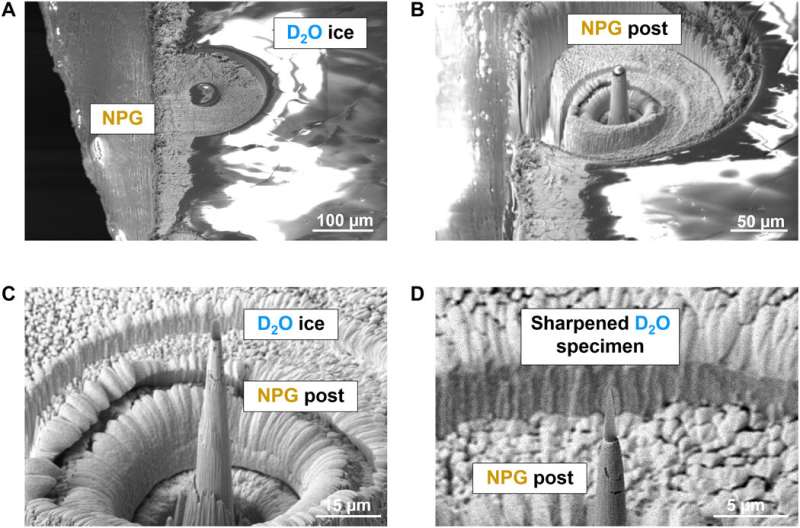 SEM images of in situ APT specimen preparation of an ice sample on NPG (nanoporous gold). (A) The 200- and 75-μm ion beam annular patterns for outer and inner diameters, respectively, were made on the ice/NPG sample. (B) The ice/NPG pillar was milled until the height of the Au post reached